
News
Vivo may release a phone with OPPO Find X-like sliding mechanism
It resembles the OPPO Find X too


Radical front-facing cameras aren’t as pronounced in 2020, but Vivo may soon change that with a sliding mechanism.
Remember the OPPO Find X? This flagship smartphone from OPPO had a radical design that gave way to a fully immersive screen. Find X’s pop-up mechanism housed its selfie cameras, which only comes up when in use. The unique design spurred other manufacturers like Xiaomi to come up with their own take on a phone with a sliding mechanism. As such, the world got a Xiaomi Mi Mix 3, which is as unique as the Find X.
Now, Vivo may also join OPPO and Xiaomi with a device that has a sliding mechanism. As spotted by Gizmochina, Vivo recently patented a smartphone with an unusual pop-out.
Vivo’s newest patent shows a smartphone with a design that somewhat resembles the OPPO Find X. Upfront, the display takes up the whole space, making up for a truly immersive viewing experience. Vivo’s patent points toward a phone with super-thin bezels all around.
On the back, there are four cameras with the primary one separated from the rest. Looking into the back, one can notice a triangular protrusion. This is actually the pop-up mechanism of the phone. The pop-up reveals another circular cut-out in the back. It could be the LED flash for the rear cameras, but it could also be another camera.
Going back to the front, Vivo’s new patent shows no cut-out for the pop-up. As Gizmochina pointed out, the front pop-up could be a second screen, with the selfie camera hidden underneath. Whatever it turns out to be, Vivo is cooking up a pretty interesting device.
It is unclear though if the patent will translate to an actual device. Companies file a lot of patents in a year, and most of them never see the light of the day. However, it’s worth speculating what Vivo could be planning this year.

Laptops
Apple unveils MacBook Pro with PROLED XDR display and Touch
Apple brings Touch to MacBook Pro


Apple has unveiled its new MacBook Pro with PROLED XDR Display, introducing tandem OLED technology and touchscreen capabilities to the Mac for the first time.
Available in 14-inch and 16-inch models, the new MacBook Pro combines a redesigned display with Apple’s M5 Pro and M5 Max chips. It also introduces the Dynamic Island to Mac, alongside improvements to graphics performance, on-device AI, and battery life.
Apple says the new MacBook Pro delivers up to 2,000 nits of peak HDR and SDR brightness, a 10,000,000:1 contrast ratio, and a 120Hz variable refresh rate. The laptop also offers up to 24 hours of battery life in a thinner and lighter design.
The new models are designed for professionals working in video production, photography, graphic design, software development, 3D rendering, and other demanding workflows.
PROLED XDR brings tandem OLED to MacBook Pro

The new MacBook Pro introduces Apple’s PROLED XDR display, which uses tandem OLED technology to improve brightness, contrast, and color accuracy.
Unlike conventional OLED designs, the display uses two self-illuminating pixel layers. Apple says this approach helps maintain brightness and grayscale uniformity while minimizing internal reflections.
The display delivers up to 2,000 nits of peak HDR and SDR brightness and a 10,000,000:1 contrast ratio. It also supports ProMotion, with adaptive refresh rates ranging from 10Hz to 120Hz.
These features should benefit professionals who need precise control over colors, shadows, and highlights when editing photos, grading HDR video, or designing print materials.
The display supports both the P3 and Adobe RGB color spaces, with more than 80 percent coverage of the Rec. 2020 color space for HDR video editing and color grading.
Apple also offers an optional nano-texture finish, which is etched directly into the cover glass to reduce glare and reflections. This should make the laptop easier to use in bright environments.
For professionals who need consistent color reproduction, Apple includes display calibration and reference modes for cinematic production, photography, print, and design. New DICOM medical imaging reference modes also support medical image review for research and educational purposes, but not diagnostic use.
Touch arrives on MacBook Pro
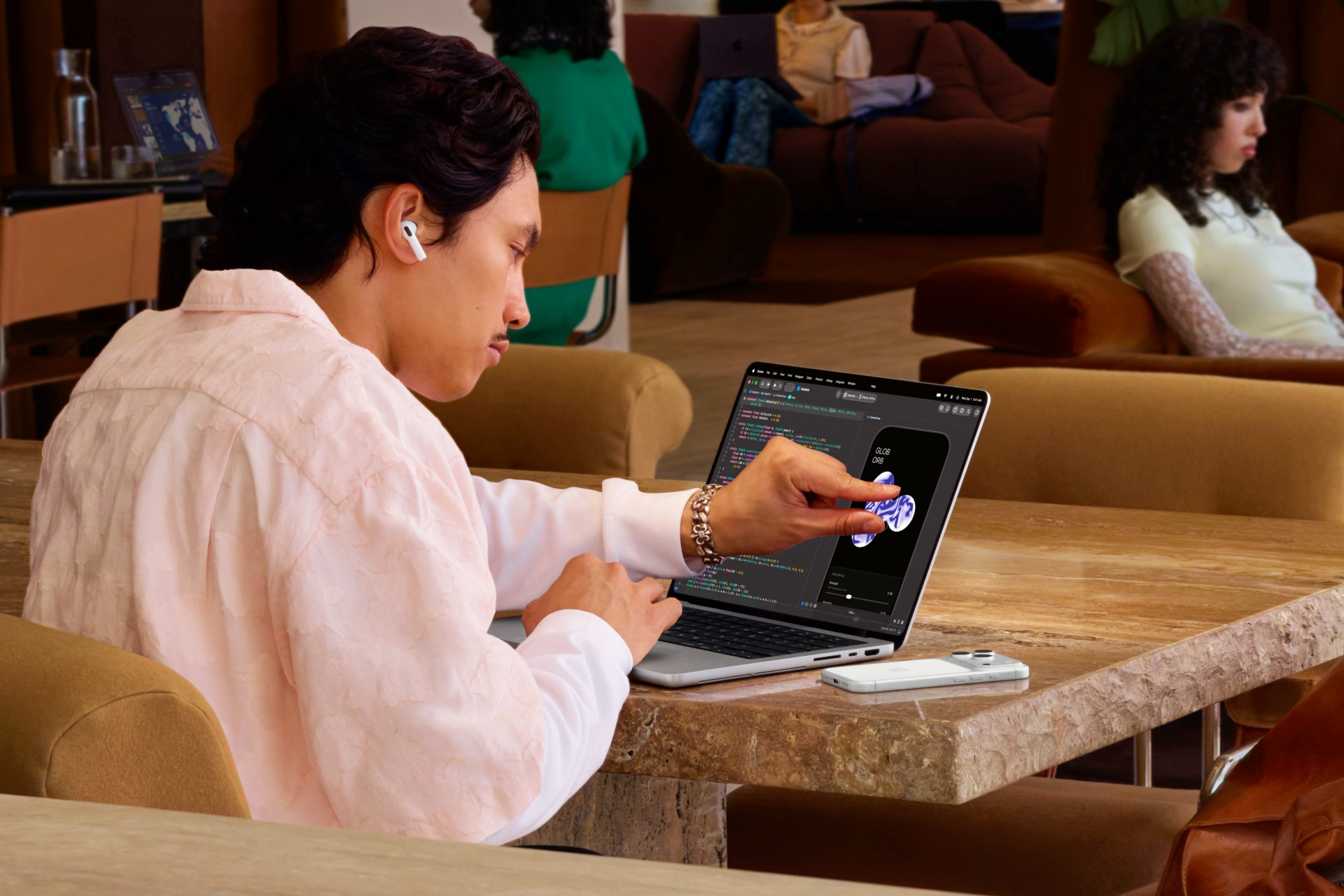
For the first time, MacBook Pro users can interact directly with the display using Touch.
The touchscreen supports familiar gestures, including swiping through webpages, pinching to zoom in on photos, and dragging and dropping content between windows. Users can also double-tap windows to expand them or flick them into a tiled layout.
Apple has integrated the touch sensor directly into the display panel rather than layering it on top. This design aims to reduce latency and make interactions feel more immediate.
Touch also introduces new possibilities for creative work. Graphic designers can manipulate their designs directly on the screen, while musicians can play software instruments using a Multi-Touch keyboard and onscreen chord and drum pads.
Apple’s own applications are optimized for Touch, while macOS automatically translates touch input into clicks for many existing applications.
Third-party applications will also benefit from the feature. Apple lists productivity and collaboration tools such as Notion, Canva, Zoom, Microsoft Word, Excel, PowerPoint, and Outlook, alongside creative applications such as Adobe Lightroom, DaVinci Resolve, Blender, Cinema 4D, ZBrush, Shapr3D, and Algoriddim djay Pro.
Touch works alongside the keyboard and trackpad rather than replacing them. Apple has also redesigned the hinge to provide greater stability when users interact with the display.
Dynamic Island comes to Mac
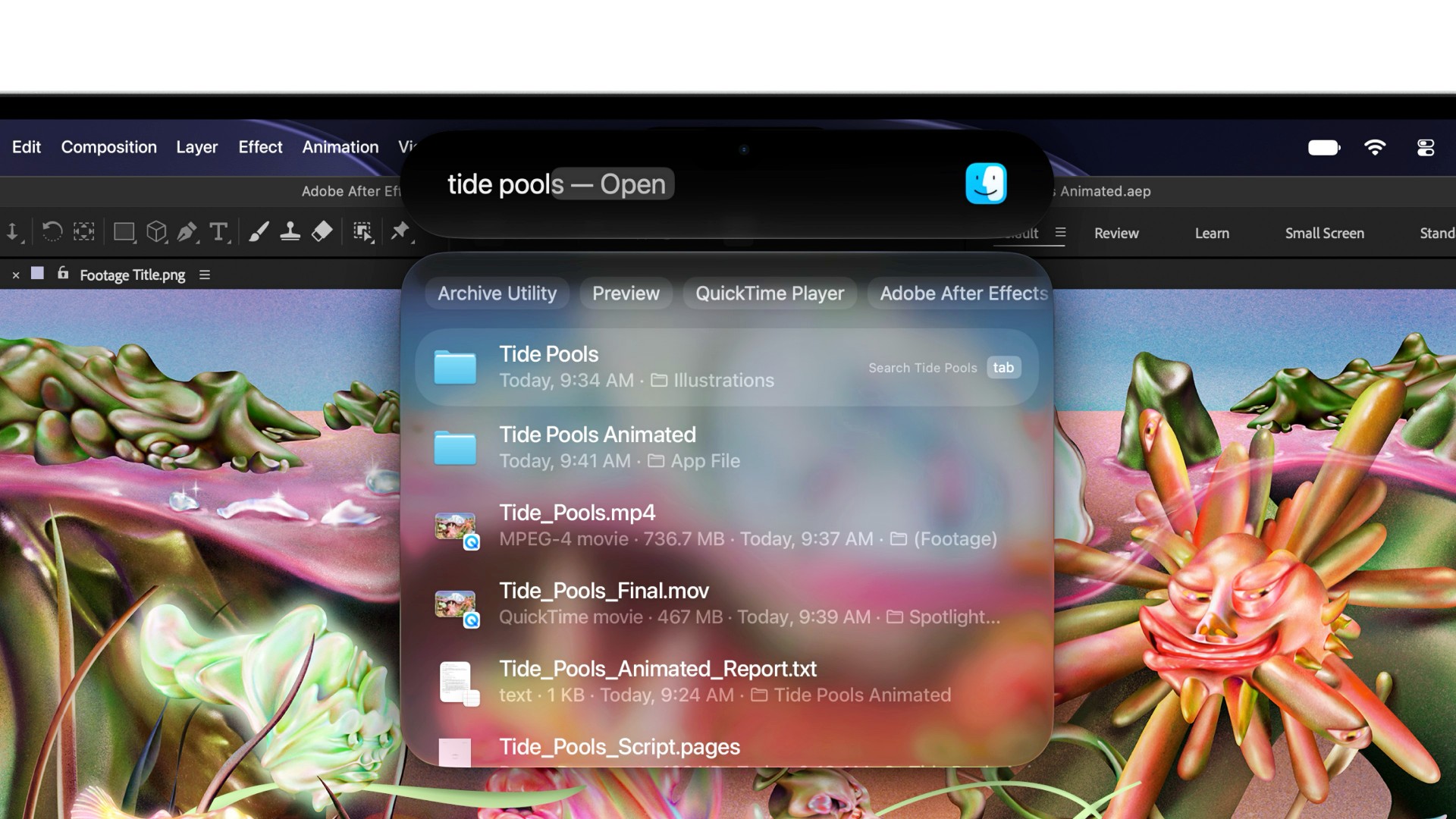
The Dynamic Island makes its Mac debut on the new MacBook Pro.
It serves as a central location for Spotlight, Live Activities, and Siri AI, allowing users to search their computers, access real-time updates, and interact with the assistant.
Users can also perform quick actions directly through the Dynamic Island, such as accepting an AirDrop request, controlling music playback, or responding to a phone call.
The feature brings an interface familiar to iPhone users to the Mac, making selected notifications and interactions more accessible without requiring users to navigate away from their current tasks.
The new MacBook Pro runs macOS 27, which integrates Apple’s latest software features and AI capabilities.
M5 Pro and M5 Max power demanding workflows
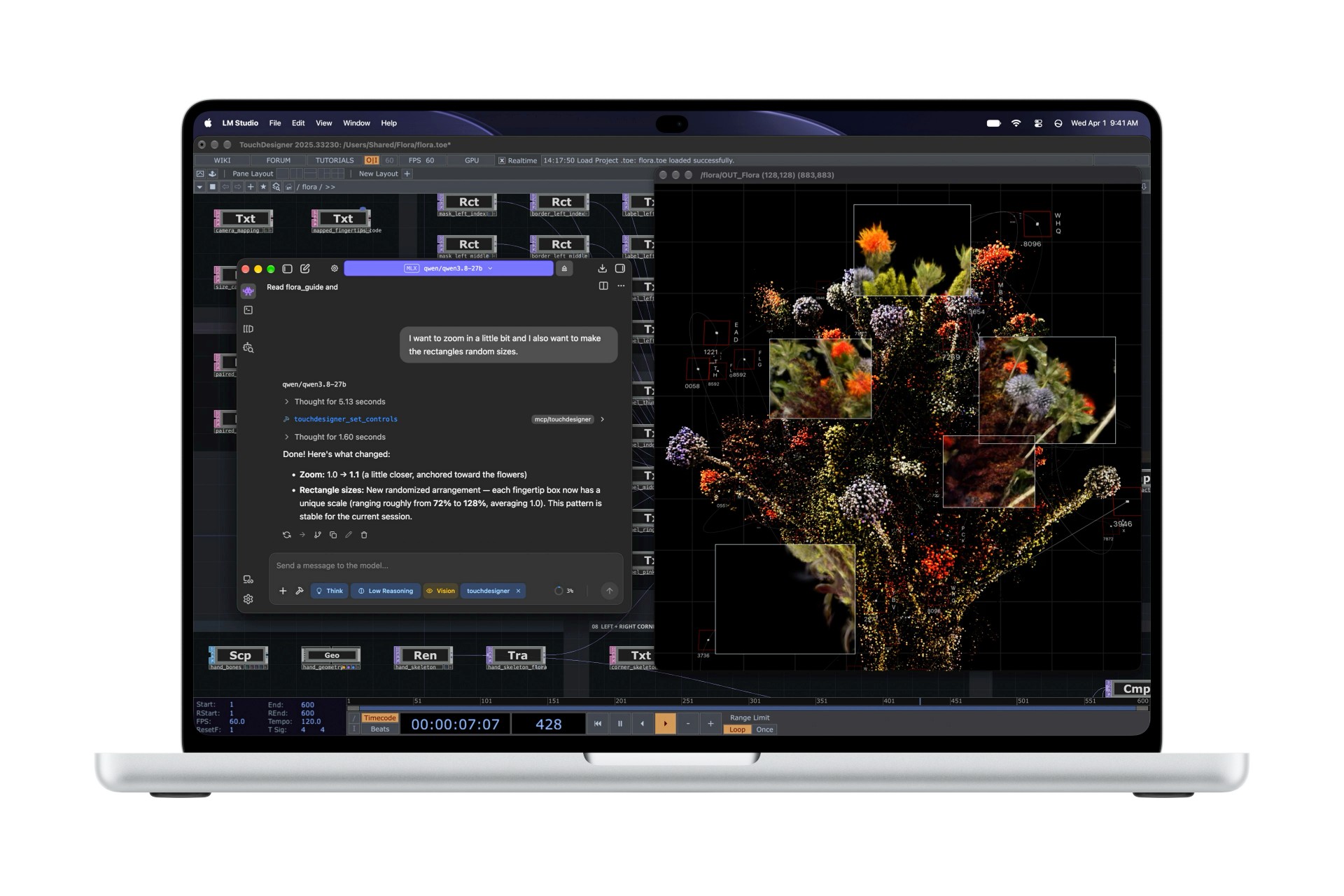
The new MacBook Pro comes with Apple’s M5 Pro or M5 Max chip, depending on the configuration.
Apple positions M5 Pro for professionals who need high performance for software development, scientific computing, and creative production. M5 Max targets users with more demanding requirements, including 3D artists, AI developers, and film composers.
Both chips feature enhanced CPU performance, faster unified memory, and GPUs with Neural Accelerators in every core. They also include enhanced shader cores and a third-generation ray-tracing engine.
These improvements accelerate graphics-intensive tasks such as 3D rendering, animation, and gaming. They also help with AI workloads, including running large language models locally.
Apple says the M5 Max can run large language models with hundreds of billions of parameters entirely on the device, depending on the model and configuration. This enables demanding AI workflows without relying entirely on cloud processing.
The new MacBook Pro supports up to 128GB of unified memory and up to 16TB of storage, giving professionals more room for large projects, high-resolution media, and complex datasets.
Thinner, lighter design with up to 24 hours of battery life

Despite its upgraded display and performance, the new MacBook Pro is thinner and lighter than its predecessor.
The 14-inch model weighs 3 pounds, or approximately 1.36kg, while the 16-inch model weighs 4 pounds, or approximately 1.81kg.
The 14-inch model is half a pound lighter, while the 16-inch model is 0.7 pounds lighter than the previous generation.
Apple has also redesigned the thermal architecture to maintain sustained performance while directing warm air away from the display.
Battery life reaches up to 24 hours, giving professionals more flexibility when working away from a power outlet.
The new MacBook Pro also features an enhanced six-speaker sound system. Its redesigned woofers deliver 50 percent deeper bass, while updated tweeters improve clarity. The system supports Spatial Audio and Dolby Atmos.
For calls and recordings, the laptop includes studio-quality microphones and a 12-megapixel Center Stage camera.
Connectivity includes Thunderbolt 5 and a range of ports for external displays, storage, and other peripherals. The laptop also supports Apple’s broader ecosystem of accessories and services.
MacBook Pro with PROLED XDR pricing and availability

In the United States, the 14-inch MacBook Pro with PROLED XDR Display starts at US$2,899 with M5 Pro, while the 16-inch model starts at US$3,399. Education pricing starts at US$2,749 and US$3,199, respectively.
For customers who need more computing power, the 14-inch model with M5 Max starts at US$4,499, while the 16-inch model starts at US$4,799. Education pricing starts at US$4,199 for the 14-inch model and US$4,499 for the 16-inch model.
In the Philippines, the 14-inch MacBook Pro with M5 Pro starts at PHP 214,990, with education pricing at PHP 203,990. The 16-inch model starts at PHP 249,990, with education pricing at PHP 234,990.
The M5 Max configurations start at PHP 329,990 for the 14-inch model and PHP 344,990 for the 16-inch model. Education pricing is PHP 307,990 and PHP 322,990, respectively.
In Singapore, the 14-inch MacBook Pro with M5 Pro starts at SGD 3,999, with education pricing at SGD 3,789. The 16-inch model starts at SGD 4,499, with education pricing at SGD 4,229.
For M5 Max configurations, the 14-inch model starts at SGD 6,299, with education pricing at SGD 5,869. The 16-inch model starts at SGD 6,499, with education pricing at SGD 6,089.
Pre-orders in the United States began on October 28, 2026, while pre-orders in Singapore began on October 29. The new MacBook Pro will begin arriving at customers’ doors and Apple Store locations on November 6.
In the Philippines, the new MacBook Pro with PROLED XDR Display will be available soon through the Apple Store online and Apple Authorized Resellers.
News
Amazon updates its Echo lineup for 2026
Say hi to the new Echo Dot, Echo Studio with Home Camera, Echo Show 16, and Echo Time.


Amazon is refreshing its Echo catalog once again. This time, besides updating the Echo Dot and the Echo Show, the lineup now includes the new Echo Studio with Home Camera and the Echo Time.
Amazon Photo Frame
Featuring a 10-inch anti-glare touchscreen display, the Amazon Photo Frame is the smartest way to display your photos.

The frame integrates with Amazon Photos, with its unlimited photo storage, so you can display all your photos in one hub. Plus, Alexa+ automatically selects the best shots, preventing bloopers and duplicates from showing up.
Echo Dot
Still one of the most iconic speakers in the entire lineup, the Echo Dot gets a modest upgrade with the new AZ3 chipset. On-device processing and more natural conversations are now possible on the Echo Dot.

Plus, with a fourth microphone, the new Dot can now hear better and can even detect who’s speaking. Once it detects who’s speaking, the device can tailor its functions depending on the speaker. For example, if the Dot detects that you’re speaking, it can play your playlists, rather than your partner’s.
It also has Omnisense which can detect your immediate surroundings. For example, it can detect if the temperature is changing so it can adjust the thermostat. It can also detect if someone enters the room so it can open the lights.
Echo Studio with Home Camera
Technically not a new device, the Echo Studio with Home Camera upgrades the old speaker with new tricks and a home camera.

The Echo Studio is the lineup’s most powerful speaker, built with a high-excursion woofer, three full-range drivers, and Dolby Atmos. The new version upgrades this system with an improved Advanced Room Adaptation and Adaptive Volume. The speaker can automatically tune its sound according to the room’s acoustics. It can also change its volume depending on where you are, so the volume stays the same for you.
Finally, the home camera adds a layer of intelligence to the speaker. You can check up on the room while you’re out. Plus, the camera, armed with Alexa, can answer queries for you.
Echo Show 16
As the name hints, the Echo Show 16 features a 16-inch screen that’s set in a 40 percent thinner frame. The new model reengineers the audio system with eight custom micro woofers and two tweeters. It also has the Advanced Room Adaptation of the Studio and the Omnisense of the Dot.
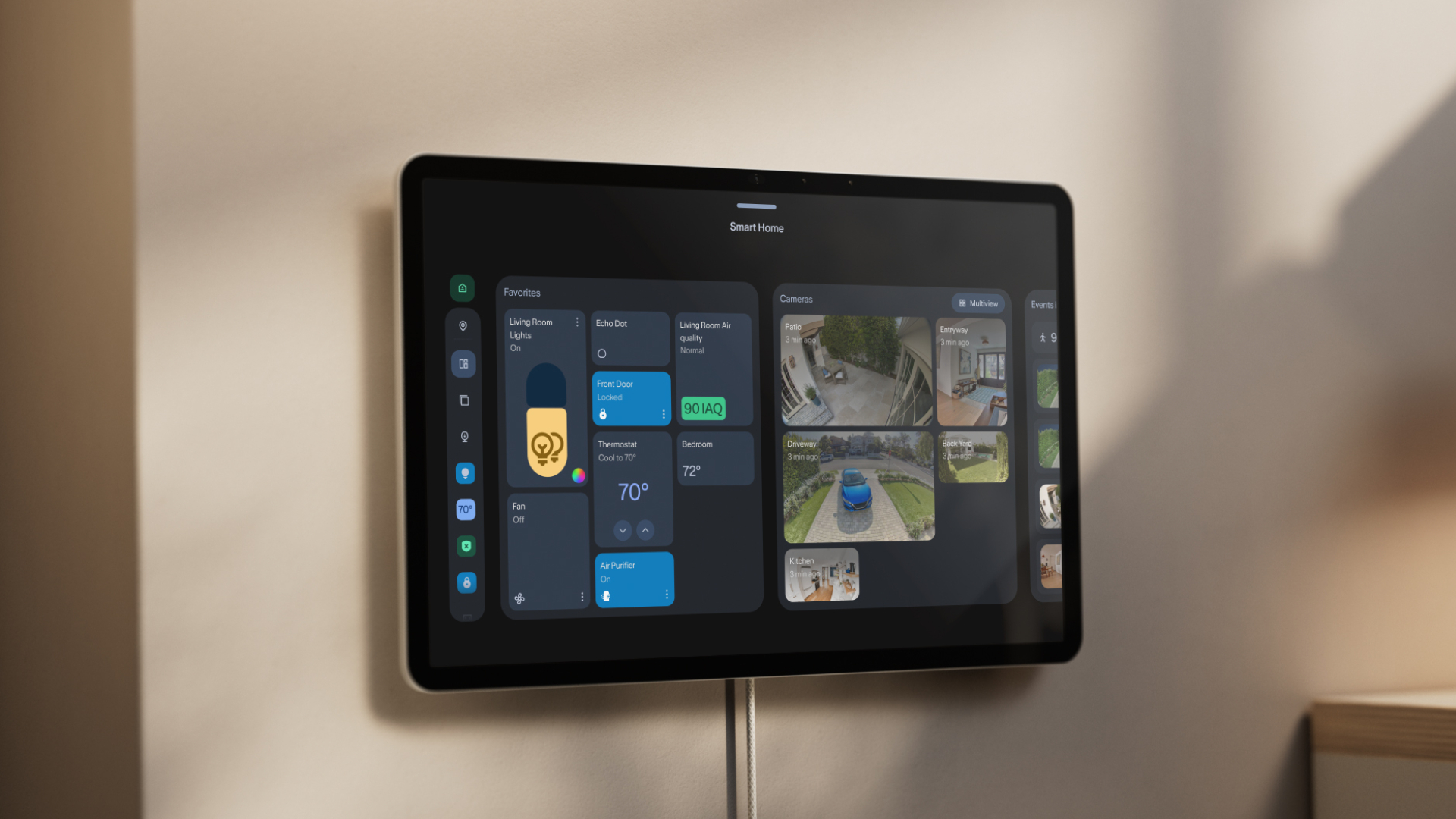
The new version has a 13-megapixel camera for better video quality when dropping in on someone else in the house. With this camera, Visual ID is better and can detect users from 17 feet away.
Finally, the 16-inch frame comes with Fire TV built-in, so you can enjoy your favorite content right on the screen. It also has a Nanomatte display option that reduces glare for uninterrupted viewing.
Echo Time
Rounding out this latest lineup, the Echo Time packs in the power of Echo inside an alarm clock.
The alarm clock as the lineup’s iconic circular form factor with a 3.2-inch touchscreen. Users can customize this further with a variety of faces from your favorite franchises like Batman or The Powerpuff Girls.

Touting the National Sleep Foundation’s SleepMark, the Echo Time uses smart alarms that can wake you up at the perfect time within 10 to 60 minutes of your set alarm. If it detects that you’re in a lighter sleep phase, the clock can start waking you up, so you don’t feel groggy in the morning.
Around the time you wake up, the display will also begin mimicking the lights of a sunrise. Then, before you sleep, it changes to a gentler light to help you sleep.
With Alexa+, users can better tell the clock what they want in the morning. For example, telling the clock to remind you to pick up your lunch before heading out sets a reminder for the morning.
Price, availability
The Alexa Photo Frame is available in Black for US$ 199.99. Meanwhile, a real Birch and Walnut framed version costs US$ 229.00.
The Echo Dot is available now in Graphite, Glacier White, Agave Green, and Coral Pink for US$ 99.99.
The Echo Studio with Home Camera is available in Graphite for US$ 249.99.
Shipping later this year, the Echo Show 16 sells for US$ 499.99
Finally, the Echo Time is available now in Graphite, Glacier White, and Coral Pink. It sells for US$ 199.99.


Apple has unveiled its new iMac powered by the M6 chip, bringing faster performance, enhanced on-device AI capabilities, and improved connectivity to its all-in-one desktop computer.
Announced on October 27, the new iMac retains its slim design and 24-inch display while introducing hardware upgrades for everyday productivity, creative workflows, and AI-powered applications.
Apple claims the M6-powered iMac delivers up to 18 times faster performance than the most popular Intel-based iMac. It also offers up to five times faster on-device AI performance than the previous-generation M4 model.
The new iMac comes in seven colors: blue, green, pink, yellow, purple, orange, and silver.
M6 brings faster performance and AI capabilities
The new iMac features Apple’s M6 chip, with configurations offering either a 10-core CPU and 10-core GPU or a 12-core CPU and 12-core GPU.
The 12-core CPU delivers improved performance for everyday applications, multitasking, and demanding workloads. Meanwhile, the GPU now features Neural Accelerators in every core to accelerate AI processing and graphics-intensive tasks.
Apple claims the new iMac delivers up to twice the graphics performance of the M4 model. Users can expect improvements in photo editing, video production, and gaming, including titles that use ray tracing.
The M6 also features a Dual 16-core Neural Engine, which delivers up to twice the AI computing performance of the previous generation. Combined with memory bandwidth of up to 170GB/s, the chip can handle demanding on-device AI workloads, including running large language models.
Apple highlights several performance improvements over previous generations:
- Up to 2.5 times faster performance in Microsoft Excel compared to the M1 iMac.
- Up to 3.3 times faster graphics performance in applications such as Affinity compared to the M1 iMac.
- Up to 12 times faster on-device AI prompt processing in LM Studio compared to the M1 iMac.
- Up to twice the gaming performance with ray tracing compared to the M4 iMac.
These improvements make the iMac a more capable desktop for professionals, students, and creators who need additional computing power without moving to a separate desktop tower.
A desktop built for AI
Apple is positioning the new iMac as a platform for its expanding AI ecosystem.
Running macOS 27, the desktop supports Apple Intelligence features and Siri AI, Apple’s next-generation assistant. Users can ask questions, search for information across their messages and emails, and perform actions across supported applications.
Siri AI is also integrated into Spotlight, allowing users to search for information and ask follow-up questions. Visual Intelligence lets users interact with content on their screen, whether it’s a chart in a spreadsheet or an image in a browser.
Other AI-powered features extend to everyday applications. Safari can automatically organize tabs into topics and notify users about website changes, including product restocks and price drops. Users can also create Shortcuts automations by describing what they want to accomplish.
For creative professionals, Apple Intelligence adds tools for photo editing and other productivity tasks. The iMac also supports third-party AI applications optimized for Apple silicon, including LM Studio and Topaz Studio.
Apple says these capabilities allow users to run supported AI workloads locally, helping preserve privacy by processing certain tasks directly on the device.
Siri AI is available in beta in macOS 27.2, with language and regional availability restrictions applying to some Apple Intelligence features.
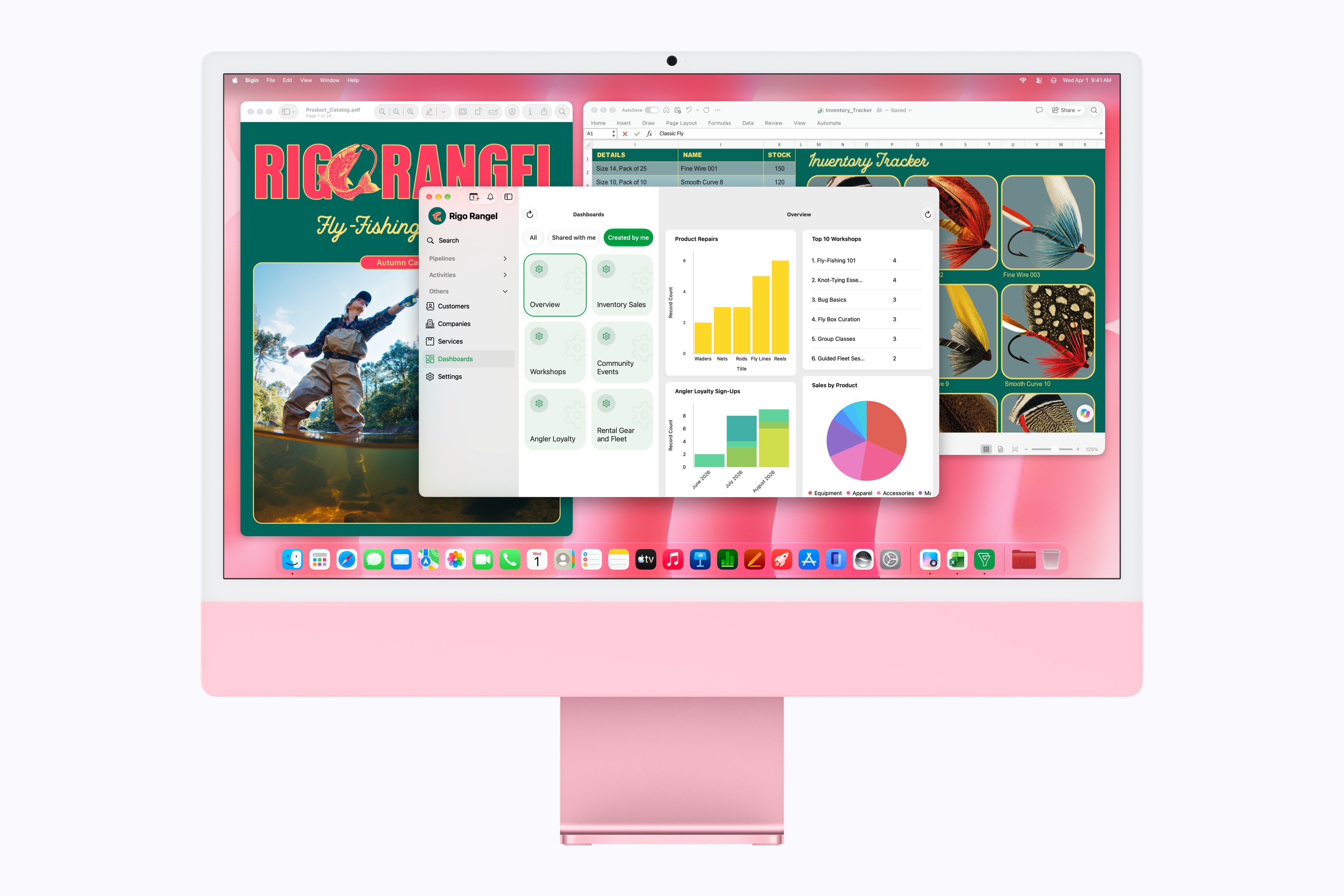
24-inch 4.5K Retina display
The new iMac retains its 24-inch 4.5K Retina display, which offers a resolution of 4,480 x 2,520 pixels and 500 nits of brightness.
The display supports the P3 wide color gamut and more than one billion colors, making it suitable for photo editing, video production, and everyday entertainment.
Apple also offers an optional nano-texture display finish on supported configurations to reduce reflections and glare in challenging lighting conditions.
For video calls, the iMac features a 12-megapixel Center Stage camera with Desk View. Its three-microphone array and six-speaker sound system deliver an integrated audiovisual setup without requiring additional peripherals.
The speakers feature force-cancelling woofers and tweeters, with support for Spatial Audio and Dolby Atmos.
Wi-Fi 7, Bluetooth 6, and faster storage
Connectivity receives an upgrade with Wi-Fi 7 and Bluetooth 6.
The higher-end configuration can also be equipped with 2.5 Gigabit Ethernet, offering up to 2.5 times faster wired connectivity than the previous generation.
Apple claims the new iMac delivers up to twice the SSD read and write performance of its predecessor, helping applications launch faster and large files load more quickly.
Port availability depends on the configuration. The higher-end model includes four Thunderbolt 4 ports, allowing users to connect external storage, docks, and other accessories.
The iMac also supports up to two external 6K displays, providing additional screen space for demanding workflows.
Apple continues to bundle color-matched accessories with the desktop. Depending on the configuration, these include a Magic Keyboard with Touch ID and either a Magic Mouse or Magic Trackpad. The accessories feature USB-C charging ports.
macOS 27 and sustainability
The new iMac runs macOS 27, which brings refinements to the Liquid Glass interface, system performance, and search.
Users can adjust the transparency of Liquid Glass through a new setting, choosing an appearance that ranges from clearer to more tinted. Apple has also refined app icons and other interface elements.
The iMac continues Apple’s sustainability efforts. Its stand uses 100 percent recycled aluminum, while its magnets use 100 percent recycled rare earth elements. Apple-designed printed circuit boards also use 100 percent recycled gold plating and tin solder.
Apple says the new iMac is manufactured using renewable electricity across its supply chain. The company continues working toward its goal of becoming carbon neutral across its entire footprint by 2030.
iMac with M6 pricing and availability
In the United States, the new iMac with M6 starts at US$1,499 for the configuration with a 10-core CPU and 10-core GPU. Education pricing starts at US$1,449.
The higher-end configuration, featuring a 12-core CPU and 12-core GPU, starts at US$1,699, with education pricing starting at US$1,599.
Pre-orders in the United States and 34 other countries and regions begin on October 28, 2026. Availability starts November 6.
In the Philippines, the new iMac with M6 starts at PHP 109,990 for the 10-core CPU and 10-core GPU configuration. Eligible students and educators can purchase it for PHP 105,990.
The higher-end configuration with a 12-core CPU and 12-core GPU starts at PHP 124,990, with education pricing at PHP 117,990.
Apple says the new iMac will be available soon through the Philippine Apple Store online and Apple Authorized Resellers. Local availability dates have yet to be announced.
In Singapore, the new iMac starts at SGD 2,099 for the 10-core CPU and 10-core GPU configuration, with education pricing at SGD 2,029.
The 12-core CPU and 12-core GPU configuration starts at SGD 2,399, with education pricing at SGD 2,259. Pre-orders in Singapore begin on October 29, with availability starting November 6.


ROG G700 review: The best prebuilt PC you can get off the shelf
This PC will make you stop worrying about specs.


HP OMEN Max 16 review: Gamer-maxxing in deep black
Peripherals deemed necessary to max this out


vivo V80 review: Good phone, tough sell
A capable travel companion

PlayStation unveils Prism Collection

Apple unveils MacBook Pro with PROLED XDR display and Touch

Amazon updates its Echo lineup for 2026
ROG G700 review: The best prebuilt PC you can get off the shelf

Apple unveils new iMac with M6 chip

TECNO CAMON Slim 5G review: Slim on size, big on surprise

TECNO CAMON Slim 5G: Price, availability in the Philippines

HONOR 600S review

Ghost of Yōtei Complete Edition review: More of a great thing

vivo X Fold6 makes global debut with 200MP camera and 6900mAh battery


-

 News2 weeks ago
vivo V80 debuts with ZEISS cameras
-

 Philippines2 weeks ago
TECNO CAMON Slim 5G gets launch discounts, free MagBadge
-

 News2 weeks ago
Samsung: Galaxy Z Fold8 demand rose because of iPhone Duo
-
Reviews1 week ago
vivo V80 review: Good phone, tough sell
-

 Gaming2 weeks ago
KINGDOM HEARTS Collection [I–III] now available on PS5, Switch 2
-

 Features2 weeks ago
I don’t want a phone that unfolds — the Galaxy Z Fold8 gets why
-

 News1 week ago
OPPO Find X10 Series: Price, availability in the Philippines
-

 Cameras1 week ago
DJI Osmo Pocket 4P Pearl White now available globally