
News
ASUS ZenFone 6 might have the weirdest notch yet, according to leaks
Does anyone want this?


After universal disdain for the notch, tech companies are finally developing more practical solutions on the road to bezel-less designs. Although still flawed, the industry now features the more workable retractable camera. In the future, companies like Samsung are looking to embed the sensor underneath the screen. Whichever way you prefer, the industry is finally moving away from the ghastly notch.
Unfortunately, ASUS is aiming for style points instead of practicality, based on new leaks. According to leak aggregator SlashLeaks, the next-gen ZenFone 6 will feature a strange waterdrop notch.
Of course, waterdrop notches, by themselves, are more aesthetically pleasing than fatter notches. Based on the Essential Phone (the form’s champion), the waterdrop notch is non-intrusive and offers ample space for notification icons.
However, ASUS’s alleged positioning is, at the very least, new. Instead of the usual center position, the leak positions the waterdrop notch just a few millimeters away from the top-right corner. As a result, the prototype has a very unsymmetrical position. Although it does make a case for subtlety, the new notch is possibly the craziest form that the trend has taken. For one, what will happen to notifications?
Thankfully, we are still in the early stages for leaks and rumors. However, we should note that the prototype was leaked by Xiaomi Fanboi. The SlashLeaks user currently has an 81 percent accuracy rate. Despite the name, Xiaomi Fanboi has leaked confirmed images of the Huawei Mate 20, the OnePlus 6T, and the Lenovo S5 Pro.
Regardless, ASUS might still pull more tricks from its sleeve as 2019’s release schedule rolls on. At least, they should justify this new notch with an immense slew of redeeming features.
SEE ALSO: ASUS ZenFone 5 gets its price slashed in early holiday sale





News
Smart showcases cloud gaming platform in partnership with Blacknut
Play over 1,000 titles straight on your smartphones


Philippines mobile service provider Smart showcased the country’s first cloud gaming platform in partnership with Blacknut at the recent Philippine GameDev Expo (PGDX) 2026.
As the event’s main presenter, Smart highlighted its collaboration with the cloud gaming subscription service. Together with its value-packed Power All offers, the network provider is highlighting what the future of gaming can look like.
Smart and TNT subscribers can conveniently access Blacknut Cloud Gaming through a dedicated site. Here, they can play more than 1,000 premium console and PC-quality games on their smartphones.
That’s without the need for expensive gaming hardware or lengthy downloads. Weekly subscriptions start at just PhP 145 and can be conveniently charged to prepaid load following a simple OTP verification process.
To make the experience better, Smart also has Power All offers, which provide generous open-access data for today’s digital lifestyles. There’s a package for cloud and mobile gaming, streaming, content sharing, and productivity.
Gaming
Ghost of Yotei gets a story expansion in October
The Complete Edition comes with the expansion and a roguelike mode.

Ghost of Yotei is a classic RPG experience set in the same universe as its predecessor, Ghost of Tsushima. In my opinion, Atsu’s journey of revenge feels a lot more fun than Jin’s battle to save his homeland. If you’re in the same boat, Ghost of Yotei is coming back on October 1 with brand-new content.
Without delving too much into spoiler territory, Ghost of Yotei has a conclusive ending. Rather than shoehorning a forced epilogue, Echoes of Sekigahara, the title of the upcoming story expansion, explores Atsu’s past.
As with Tsushima’s expansion, Echoes of Sekigahara features a new map with new enemies, weapons, and collectibles. It will be set in two different time periods.
Besides the story expansion, the upcoming update also has a new mode called Most Wanted, which Sucker Punch Production describes as their “spin on a roguelike.” The mode explores Atsu’s experience as a headhunter, feeding her with bounties and earnable perks.
The two new content expansions will come with in the upcoming Ghost of Yotei Complete Edition. The new edition, coming on October 1, will also come with the co-op Legends mode. It also has a few perks and customization options. The edition will sell for US$ 70.
If you already have the base edition, you can grab an upgrade for only US$ 15. If you don’t want to pay for the upgrade, the game is still getting a few minor tweaks.
SEE ALSO: Ghost of Yotei review: A tale sharpened by vengeance


The HONOR Robot Phone may have officially launched, but don’t expect this version to immediately make its way to global markets.
HONOR told media in Shenzhen that it currently has no plans to bring the current Robot Phone outside China. The main hurdle isn’t the hardware. It’s the phone’s AI experience, which is currently optimized for the Chinese market.
HONOR believes a future generation of the Robot Phone would be better positioned for a true global rollout once its AI experience is ready for markets outside China.
That doesn’t mean HONOR is abandoning the idea. Quite the opposite.
More than a phone with a moving camera
The Robot Phone is HONOR’s attempt to introduce a new idea to the smartphone market. It combines a smartphone with a 4DoF mechanical gimbal, allowing its camera to physically move.
Its AI features take that concept further. YOYO Robot Mode can use voice commands, gestures, and AI tracking to control the camera. It can also automatically pan and tilt to keep a person in frame during vlogs, livestreams, and video calls.
The phone also brings selected elements of ARRI Image Science and professional cinema workflows to its camera system. Its 200MP gimbal main camera supports 10-bit ARRI LogC3 recording, while ARRI Wide Gamut 3 and ARRI Looks give creators more control over their footage.
But HONOR isn’t treating the Robot Phone primarily as a volume-driving product.
The company says its bigger goal is to introduce a new concept to the smartphone market and see what kind of effect it can have.
That makes the Robot Phone an interesting experiment for HONOR. The hardware is already here. The company now wants to learn what happens when a smartphone can physically move, respond to its surroundings, and use AI to help operate itself.
For now, though, China is where that experiment begins.
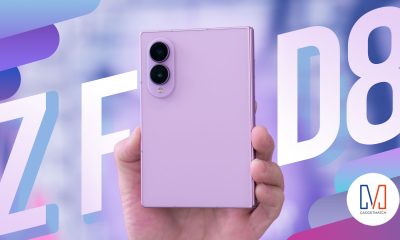

Samsung Galaxy Z Fold8 Review
8 Galaxy Folds later, Samsung finally nailed It!


30 days later with the ASUS ExpertBook Ultra: Like seeing an ex
Felt exactly as I remembered.


ROG STRIX G16 Review: Building for the moment
Setting it up however you want to make the most out of it

OBSBOT Meet Flip Hands-on
Samsung Galaxy Z Fold8 Review

Smart showcases cloud gaming platform in partnership with Blacknut

What your smartphone color choice reveals about you

New EV player XPENG to launch in the Philippines in September

Hands-on: Samsung Galaxy Z Fold8, Flip8, Ultra

VinFast debuts two-wheeler models, opens 21 e-motorcycle showrooms

Garmin launches its first screenless fitness band

Samsung releases teaser with Spider-Man: Brand New Day Easter eggs

Sony announces new FX5 full-frame camera


-
 Automotive2 weeks ago
VinFast debuts two-wheeler models, opens 21 e-motorcycle showrooms
-

 Automotive2 weeks ago
Xiaomi debuts SkyNomad Series featuring new Kunlun platform
-

 News1 week ago
OnePlus officially leaves the United States and Canada
-

 Gaming2 weeks ago
Call of Duty: Modern Warfare 4 clip shows Losing Ground 1st look
-

 Automotive2 weeks ago
GAC launches new trio of MPVs
-

 Gaming2 weeks ago
Genshin Impact opens Snezhnaya in Version 7.0 this August 12
-

 News1 week ago
Google will force Android users to use Gemini next month
-

 Gaming1 week ago
Tides of Annihilation opens first public demo at Gamescom 2026