


NVIDIA seemed to have struck gold with the announcement of their brand new graphics cards for gamers. These cards are set to bring the gaming world into unparalleled heights thanks to the technologies behind them. The company calls them the RTX series, and the biggest feature within these graphics cards is real-time, ray tracing technology.
But, what is ray tracing technology? What is it about this technology that had NVIDIA wanting to produce a new line of cards to house it? Will it really change the gaming experience as a whole?
Ray tracing in a nutshell
Ray tracing is a rendering technique that uses rays of light to project images or objects onto your screen. These rays of light determine the colors, reflections, refractions, and shadows that the objects possess. These also show more accurate, more realistic images as the rays trace back to any source of light in the surrounding. To put it simply, ray tracing is what happens when you could take a picture of anything around you with your eyes.
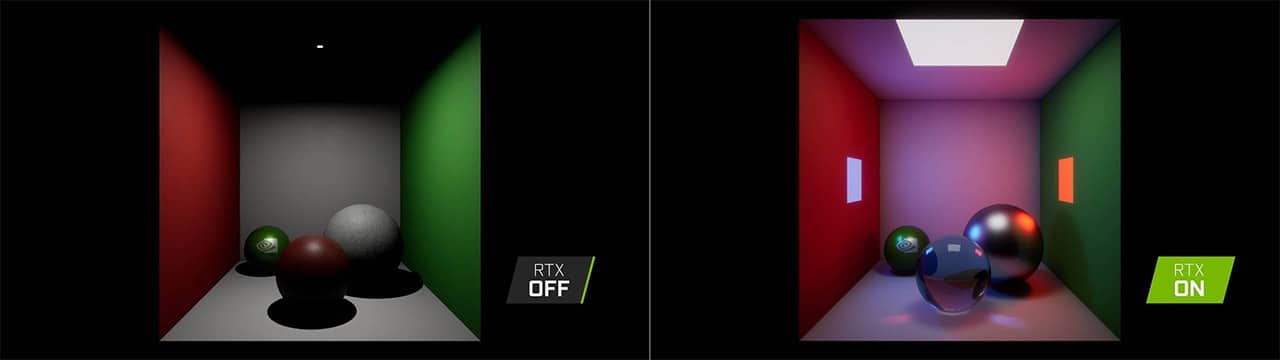
The technology isn’t that new; in fact, it has been used since the 1960s for movies and television. Ray tracing is the main proponent behind CGI, where most special effects are often rendered to recreate realistic backgrounds with accurate coloring. In 2008, Intel showed a demonstration of the game Enemy Territory: Quake Wars that used ray tracing powered by a Xeon Tigerton processor. Currently, there are applications that allow you to edit videos using ray tracing such as Adobe’s After Effects.
Shifting from rasterization to ray tracing
For the longest time, NVIDIA has worked with multiple companies to produce game-grade graphics cards for consumers. The main technology behind these graphics cards is rasterization. In a nutshell, rasterization creates shapes to outline certain elements during gameplay. These shapes are given various colors to mimic reflections and shadows produced by such objects. The technology does not use up too much processing power to produce high-quality images for games. Rasterization enables gamers to play at smoother frame rates while getting the best and most realistic image quality.
However, NVIDIA wanted to take things up a notch when producing the next generation of graphics cards for the modern-day gamer. The company wanted to improve the gaming experience by any means, thus bringing in ray tracing in their graphics cards. With ray tracing, colors are more accurate allowing for a more immersive gaming experience — at least that’s how the company explains it. This is clearly seen with their exclusive gameplay of Shadow of the Tomb Raider:
This technology became the backbone for their new RTX graphics cards, putting much emphasis on real-time interactions within games. The RTX graphics cards possess greater memory capacity and processing speeds to keep up with the demands of the technology inside it. With NVIDIA’s Turing architecture, these new cards make the ray tracing processes much faster while using less computations.
Risks of going for ray tracing
Of course, with new technologies comes risks to consider before buying into them. First, ray tracing heavily relies on multiple calculations to generate accurate images on your screen. Back then, computers and graphics cards were not powerful enough to produce quality images immediately using ray tracing. Production of such images can take days to possibly weeks or months, as seen with most movies that heavily rely on CGI.
When applying ray tracing technology to modern games, graphics cards tend to suffer more. The computational requirement for ray tracing is much more than the graphics card’s virtual memory (VRAM) could handle. Of course, it depends on how much RAM is included in your graphics card — even then, it would consume more energy than it’s optimized for. These are the risks that NVIDIA is constantly trying to address with their new RTX cards.
There is still a lot of work needed to prove that ray tracing is the future for gaming. While the technology wants to bring to you the most immersive gaming experience ever, it also comes with a heavy cost — not just on your wallet. Let’s hope that the RTX series is worth the wait.








With a huge change in naming scheme, Apple promises a big leap ahead.
The all-new Liquid Glass design isn’t just breath of fresh air — it’s a bold redesign ever since the iOS 7 came out.
It’s not limited just to the iPhone. It’s coming to the iPad, Mac, and even the Apple Watch!
And with latest Public Beta now available across all devices, now is the perfect time to try ’em out.
Here are our favorite features, design updates, and hidden gems in Apple’s latest OS 26 series of software updates.
Namely iOS 26, iPadOS 26, watchOS 26, visionOS 26, and macOS Tahoe.
Shopping for a new Windows laptop?
With so many choices out there, it can be tough to know where to start.
Should you prioritize performance, battery life, or portability? Can you find something affordable and premium-looking?
In this video, we break down everything you need to know about the new Snapdragon X Series laptops — a new category of Windows PCs that promise power, efficiency, and sleek design in one package.
Whether you’re a student, creative, or just looking to upgrade, this buyer’s guide will help you decide if a Snapdragon X Series laptop is right for you.

Apple dropped a ton of surprises in this year’s WWDC — and there’s more than just the Liquid Glass redesign.
From Workout Buddy, to game-changing Apple Intelligence features.
All the way to collaborative visionOS updates, and the next generation of iOS 26, macOS 26, and iPadOS 26.
Watch to see the top announcements NEED to know from the WWDC 2025 keynote!
Here are Michael Josh’s biggest takeaways from WWDC 2025 in one video — with the help of some TechTuber friends!





nubia to launch new Neo 5 series gaming phones on March 28

SHINOBI: Art of Vengeance’s SEGA Villains Stage out on April 3

AMD poised to lead agentic AI era with high-performance CPUs

CIPTA debuts AI GPU server, edge workstation at CloudFest 2026

Dune: Part Three teaser trailer: First look at Robert Pattinson’s Scytale


-

 Reviews4 days ago
POCO X8 Pro Max review: A new beast from the far east
-

 News4 days ago
POCO X8 Pro Series: Price, availability in the Philippines
-

 Laptops1 week ago
Apple MacBook Neo Review
-

 Computers2 weeks ago
GIGABYTE collaborates with Capcom for RE Requiem custom PC
-

 Apps1 week ago
Google Maps is finally getting a 3D mode
-

 Entertainment1 week ago
The internet is thirsting over the One Piece Season 2 cast
-

 Features1 week ago
Galaxy AI on the Samsung Galaxy S26 Ultra
-

 News2 weeks ago
Globe postpaid opens pre-orders for Samsung Galaxy S26 series