


Gaming
Digimon Story Time Stranger: Back to the digital past
A (personally) nostalgic Digimon return

I came into Digimon Story Time Stranger already excited. Trailers and previews gave me flashes of a Digimon game I once played during a summer at my relatives’ house. I spent every waking moment of those two weeks trying to beat it — though I never did.
I don’t even remember which Digimon World title it was, but I was hooked. My aunt used to call me out for playing before I’d even had breakfast. That memory stayed with me, and this new entry in the franchise instantly felt like a chance to relive it.
I’ve had less time than I’d like with the game since getting the review code, so think of this more as a review-in-progress. But I’ve played enough to know it’s worth talking about.
Time travel and the inferno
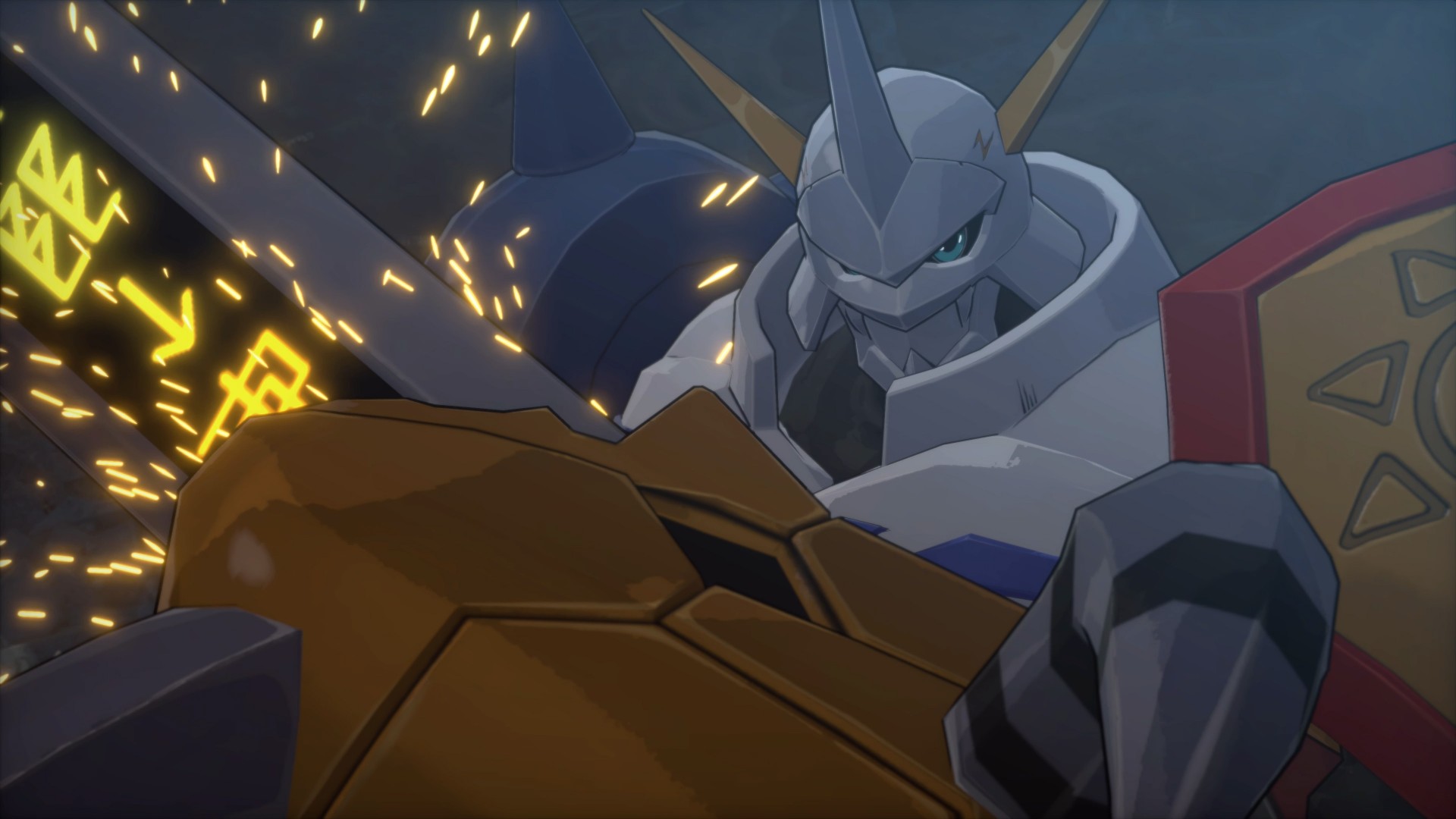
The story sends your protagonist eight years into the past. Your role is to unravel the events that led to the “Shinjuku Inferno,” a catastrophe that left the world in ruins.
Not rolling credits yet actually helps here since it keeps things spoiler-free. What I can say is that there’s enough happening in the early hours to keep you intrigued. Things ramp up gradually. The mystery of what caused the Inferno pushes you along, and the more you progress, the more you want to connect the dots.
The characters I’ve encountered so far didn’t immediately latch on to me. I couldn’t fully identify with or feel invested in them. That does dampen how eager I am to move forward with their arcs, but it doesn’t take away from the pull of the central mystery. The looming Inferno itself is strong enough to keep you curious.
The joy of collecting

The monster-collecting gameplay loop is the real hook here — it’s addicting and built for completionists.
You begin by picking your first Digimon partner. From there, the system opens up. Every time you battle a Digimon, you add to your scan percentage of that species. At 100% you can convert it into a new companion, but waiting until you’ve scanned 200% guarantees you’ll get the Digimon at its max possible stats.
Digivolution is the next big mechanic. Each Digimon has multiple evolution paths that depend on its stats and level. For example, a Koromon can evolve into Agumon, Guilmon, Dracomon, and more. This branching evolution system encourages experimentation. You can also go backward through de-Digivolution, which not only helps with strategic flexibility but also lets you work toward completing your full Digimon compendium.
If your roster starts to get crowded, you can fuse duplicates to enhance another Digimon or break them down into digital currency. It’s another loop that feeds back into progression.
With over 450 Digimon available, there’s more than enough here for players who love collecting, refining, and tweaking their party until it’s perfect. The loop is layered and rewarding — not just about “catching them all,” but about shaping the collection into something uniquely yours.
Strategy meets nostalgia

Combat in Digimon Story Time Stranger doesn’t try to be revolutionary, but it’s polished and layered enough to feel engaging. If you’ve played JRPGs from the late ‘90s and early 2000s, this will feel instantly familiar.
Dungeons are where you’ll encounter hostile Digimon. By pressing R2 (on PS5), you can attack first to gain the upper hand. If your party completely overpowers the enemy, you’ll defeat them instantly. Otherwise, you’ll be pulled into the turn-based battle arena.
The backbone of combat is the type triangle: Data beats Vaccine, Vaccine beats Virus, Virus beats Data. On top of that, elemental affinities add another wrinkle to keep you on your toes.
Your bond level with your Digimon plays a big role too. The closer you are to them, the more likely they are to perform quick follow-up attacks. These little assists can swing momentum in your favor and give combat a more dynamic flow.
There are also quality-of-life touches that stand out. You can swap party members mid-battle without losing a turn, which makes tactical adjustments painless. And with a flick of the right analog stick, you can speed up combat animations — a small feature that makes grinding far more bearable.
The system feels like a culmination of mechanics you might have seen in Persona 5 and Shin Megami Tensei. It’s not redefining the genre, but it knows what works and sharpens it in smart ways.
A Saturday morning cartoon come to life

What struck me most about Time Stranger is that it feels like playing a Saturday morning cartoon. From the colors to the tone to the music, the whole package captures that vibe.
The anime-inspired visuals are sharp and bright, with Digimon designs that pop. I also had a personal chuckle at the protagonist customization options — the red-haired male and short-haired female were exactly how I might’ve designed them myself.
The soundtrack deserves mention too. It changes with each location, sometimes even from room to room in the same house. Every track is thoughtfully matched to the scene and the mood.
There’s also optional DLC music. The pricing feels a little steep, but seeing Butter-fly from Digimon Adventure included was almost enough to convince me. It’s one of my all-time favorite anime songs, and hearing it in the game would push the nostalgia factor even higher.
Is Digimon Story Time Stranger your GameMatch?

Playing Digimon Story Time Stranger has felt like reliving that summer memory — the excitement of discovery, the satisfaction of raising Digimon, and the pull of wanting to see what comes next.
It isn’t trying to reinvent anything, and that’s part of its charm. Instead, it offers a polished, nostalgia-driven JRPG that rewards the time you sink into it. The story pulls you in even without a standout cast. The monster-collecting systems are rich and addictive. The combat strikes a balance between old-school comfort and modern convenience.
For me, it became a welcome contrast. I had just come from another game’s bloody revenge quest, yet I felt just as thrilled hopping into this time-traveling, monster-collecting adventure. One scratched my itch for grit. The other gave me wonder and comfort.
If you ever spent a summer glued to a Digimon game, this will take you back instantly. And if you’re new to the franchise, there’s more than enough depth here to keep you invested.
Verdict: It’s a Swipe Right.







GIGABYTE and Capcom have collaborated for a limited time Resident Evil Requiem-inspired custom PC giveaway.
The setup is inspired by the title, which recently released, and includes an exclusive monitor game bundle to bring players closer to the experience.
Headlining the collaboration is the Umbrella Corporation — Level 3 Access custom rig giveaway. It is one of a kind, fully-built desktop featuring a Z890M AORUS ELITE WIFI7 ICE motherboard and RTX 5080 AERO OC SFF graphics.
Of course, it draws inspiration from the visual identity and atmosphere of Resident Evil Requiem. It also features a GIGABYTE C102 GLASS ICE chassis design and custom GIGABYTE MO27Q28G gaming monitor to complete the setup.
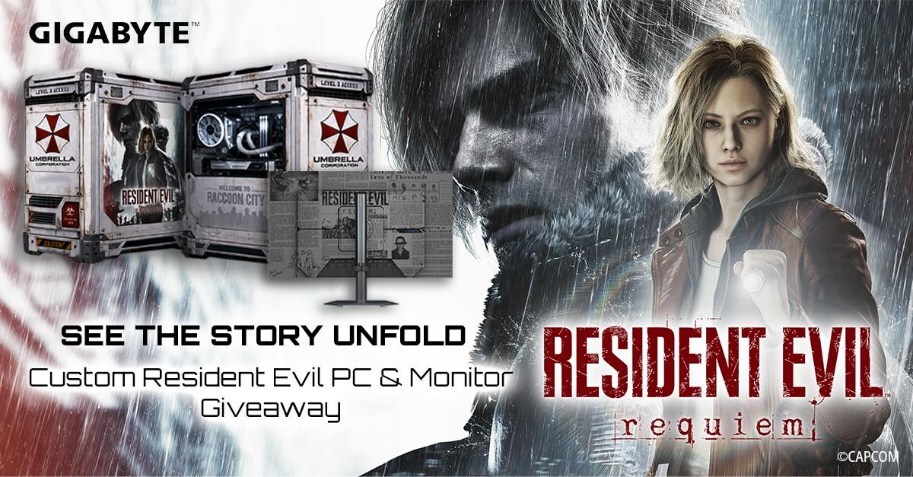
The giveaway runs from March 2 to March 31 via the official campaign website. Fans can enter for a chance to win the custom rig, with no purchase necessary. The only caveat is that they have to be a United States or Canada resident.
Such experience is designed to invite players and PC enthusiasts alike to engage with the collaboration while highlighting GIGABYTE’s premium hardware craftmanship and attention to detail.
In addition to the giveaway, GIGABYTE is also offering a Resident Evil Requiem game bundle with select gaming monitors. Included are AORUS brand monitors, ranging from 27 to 55 inches in size.
This bundle is available until March 31. Customers who purchase eligible models can redeem a digital game code through GIGABYTE’s official redemption platform.
The featured monitor is the MO27Q28G, which has fourth generation WOLED panel with 280Hz refresh rate and 0.03ms response time. It is an ideal monitor to experience the spine-chilling terror and death-defying action of the title.
Gaming
Project Helix is Xbox’s next console, and it plays PC games
It might be as powerful as a modern PC.


Among all the platforms in today’s generation of consoles, the Xbox has to be biggest loser. Compared to the PlayStation 5 and the Switch 2, the Xbox Series X|S isn’t as memorable. To rectify its position in the rankings, Xbox is heavily teasing its next console codenamed Project Helix.
As was hinted before, Xbox is trying something different with its next-generation console. Rather than just a simple iteration over the current-generation console, the upcoming one will reportedly double as a PC. Today, the company itself has confirmed that this is the case for Project Helix.
Through a post on X, Xbox CEO Asha Sharma said that the console will “lead in performance and play your Xbox and PC games.”
Great start to the morning with Team Xbox, where we talked about our commitment to the return of Xbox including Project Helix, the code name for our next generation console.
Project Helix will lead in performance and play your Xbox and PC games. Looking forward to chatting about… pic.twitter.com/Xx5rpVnAZI
— Asha (@asha_shar) March 5, 2026
There are two things to unpack here. Firstly, Project Helix will aim to bridge the perilous divide between console players and PC players. Unlike the past, there will be a way to play both platforms on both devices… except for games exclusive to the PlayStation and the Switch, that is.
Secondly, a “lead in performance” seems to indicate that this isn’t just a mini-PC. Most recently, Valve announced the Steam Machine. Though it offers a convenient way to play Steam games in one device, it doesn’t have the best specs. Project Helix, if Sharma’s words are to be believed, might be as powerful as a modern PC.
Xbox won’t wait long before revealing more details about the console. Sharma, who only recently started her post as CEO, will be at next week’s Game Developers Conference to explain Project Helix more.
SEE ALSO: AMD teases next-gen Xbox coming in 2027
Gaming
Ubisoft confirms Assassin’s Creed: Black Flag remake
It’s officially called Assassin’s Creed: Black Flag Resynced.
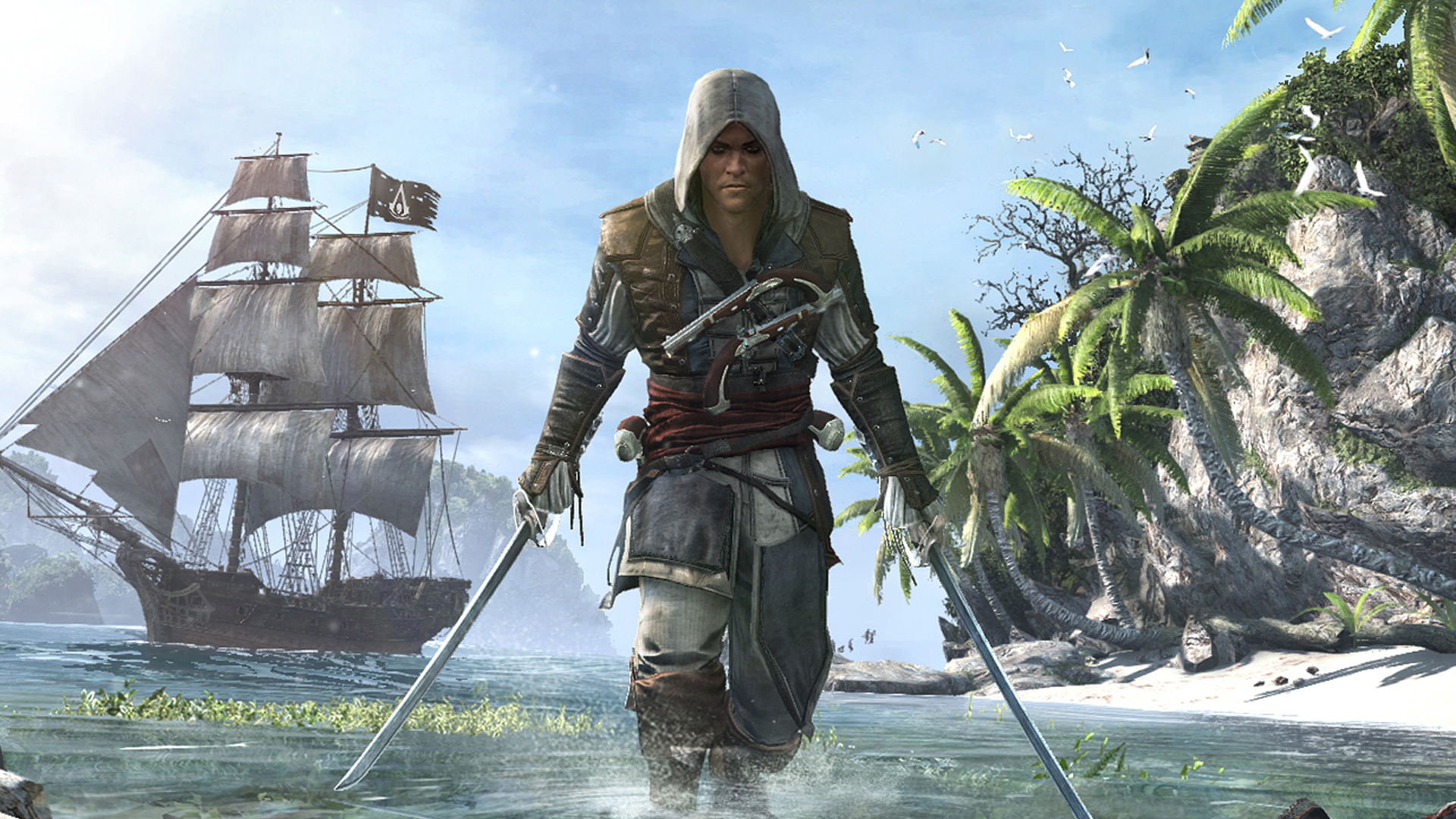
If you ask an Assassin’s Creed fan what their favorite game of the series is, Assassin’s Creed: Black Flag will likely be one of the top contenders. Because of its reputation, gamers are constantly asking for a remake of the popular pirate simulator. Now, the dream is finally here. Ubisoft has confirmed that a remake, called Assassin’s Creed: Black Flag Resynced, is coming.
Released in 2013, Assassin’s Creed: Black Flag saw the journey of Edward Kenway, a vagabond pirate haplessly thrust into life as part of the Assassin Brotherhood against his will. The critically acclaimed game was something that all gamers have been clamoring for since Sid Meier’s Pirates: a true pirate simulator. It was no surprise that the game got as popular as it did.
Today, through an official roadmap shared by the company, Ubisoft has confirmed that Assassin’s Creed: Black Flag Resynced is real, and it might launch later this year. The company also released the first concept art for the remake.

Currently, there’s no official word as to how Ubisoft is remaking the game. At the very least, we can expect significant graphical upgrades to put it up to par with the modern games. We wouldn’t be opposed to more stories and missions too.
Now, though the Black Flag remake is already a big deal, the same roadmap also emphasizes that Codename Hexe, the next mainline title, is still coming. Ubisoft hasn’t confirmed the actual timeline yet, but the game will depict “a pivotal moment in history.” With post-launch development for the ongoing Shadows winding down, efforts to launch Codename Hexe should be ramping up soon.
SEE ALSO: Assassin’s Creed Shadows gets Attack on Titan-themed content


Crime on Prime: Streaming platform unveils powerhouse crime, thriller slate

New medieval action RPG, Echoes of Aincrad, out July 2026

GIGABYTE collaborates with Capcom for RE Requiem custom PC

OPPO Find N6 global launch set for March 17

Samsung is done chasing specs, says TM Roh

Xiaomi 17 Ultra is now available outside China

TECNO will showcase the CAMON 50 and POVA 8 series at MWC 2026

The art of being in and behind the frame

HUAWEI MatePad 11.5 S 2026: The better-than-ever 4-in-1 productivity tablet

TECNO MEGABOOK K16s 13th review: No-frills beneath those grills


-
 News1 week ago
Xiaomi 17 Ultra is now available outside China
-
 MWC 20261 week ago
TECNO showcases cool concepts at MWC 2026
-

 MWC 20262 weeks ago
TECNO resurrects modular phones with this new concept
-

 MWC 20265 days ago
Infinix NOTE 60 Ultra makes a motorsport-inspired debut
-

 MWC 20266 days ago
TECNO launches the all-new CAMON 50 series
-

 Reviews6 days ago
TECNO CAMON 50 Ultra review: End of an era?
-

 Reviews1 week ago
Xiaomi Pad 8 review: Slab that slaps!
-

 Reviews1 week ago
Forget the Phone: Xiaomi 17 Ultra Is A CAMERA!