

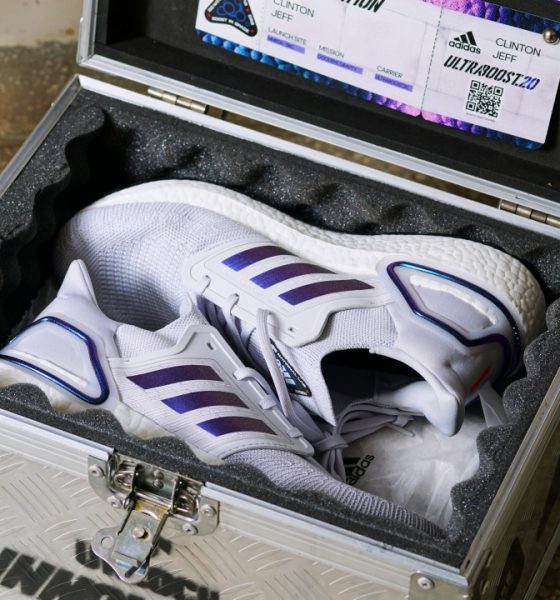
Accessories
adidas Ultraboost 20 review: Great just got better
The ISS National Lab collab is straight 🔥

It’s almost a new year, and here’s the Ultraboost 20 — the latest version of my favorite sneakers.
Ever since they were announced in 2015, the Ultraboost has always been my go-to everyday sneaker. They’re just so comfortable to wear and they look so darn good as well.
Adidas has been making small changes to the shoe every year but they were mostly just changing the pattern of the upper which wasn’t really that big of a deal.
A sudden design shift
It wasn’t until 2019 when Adidas redesigned the Ultraboost to create the Ultraboost 19 (UB19) which was a huge change in the line.
Initially, the Ultraboost was more of a casual lifestyle pair first then a performance running sneaker second. This changed with the UB19 when Adidas decided to focus on making a performance running sneaker.
It was a controversial change at the time since the aesthetics of the shoe really changed. Some fans of the line didn’t receive the news well.

UB19 (left) and UB20 (right)
Admittedly, I was one of those people. But then the reviews started coming in and everyone kept talking about how comfortable they were — much more comfortable than they have ever been which makes them a better performance sneaker overall.
Design-wise, I still prefer the Ultraboost 1.0 more than the 4.0 but the new ones are definitely way more comfortable — an all-out performance running sneaker.
With the 2020 version, Adidas decided to make a few more tweaks. Somehow they took something already great and made it even better. As an aside, I’m happy these were minor tweaks because I don’t think we would have survived another dramatic overhaul.
One of the best things about Ultraboost back in the day were the collaborations, so I’m happy to see Adidas trying that out again.
Ultraboost X ISS National Lab
I got the ISS National Lab collaboration to check out, which is the official collaboration to launch the Ultraboost 20.
First thing you’ll see is the Light grey Primeknit upper. This is usual with Ultraboost and it does get small tweaks every year. This time it feels like there’s more give in this version vs the UB19.
One major difference in the upper this year is the addition of the Tailored Fiber Placement technology or TFP. It’s the thick embroidered looking details around the edges of the toe box area which gives you more stability and durability.

These areas aren’t as flexible and stretchy as before but they do a better job at containing your toes. So the upper is still stretchy and soft, but holds your foot in place better.
There’s still a sock-like fit but it’s slightly thicker and less flexible than the older ultraboost 1.0 to 4.0 uppers. I really like the arrow shaped ventilation pattern in the toe-box area which is a very subtle throwback to the ‘ol Ultraboost 1.0.

There’s the white or light grey Ultraboost laces going through an updated midfoot cage. I definitely like the new midfoot cage, I think it’s better looking than the UB19 cage. It’s a cleaner, better look vs the mesh used on the 19. This also has some TFP detailing as well to help contain your foot better.
At the top of the tongue is the ISS National Lab collab tags which says ISS National Lab Adidas CRS Boost in Space. ISS stands for the International Space Station and this is a collab with their National Lab. Adidas is apparently going to send some Boost up to the National Lab in space — which is crazy but hey maybe those hypebeast astronauts will appreciate it.
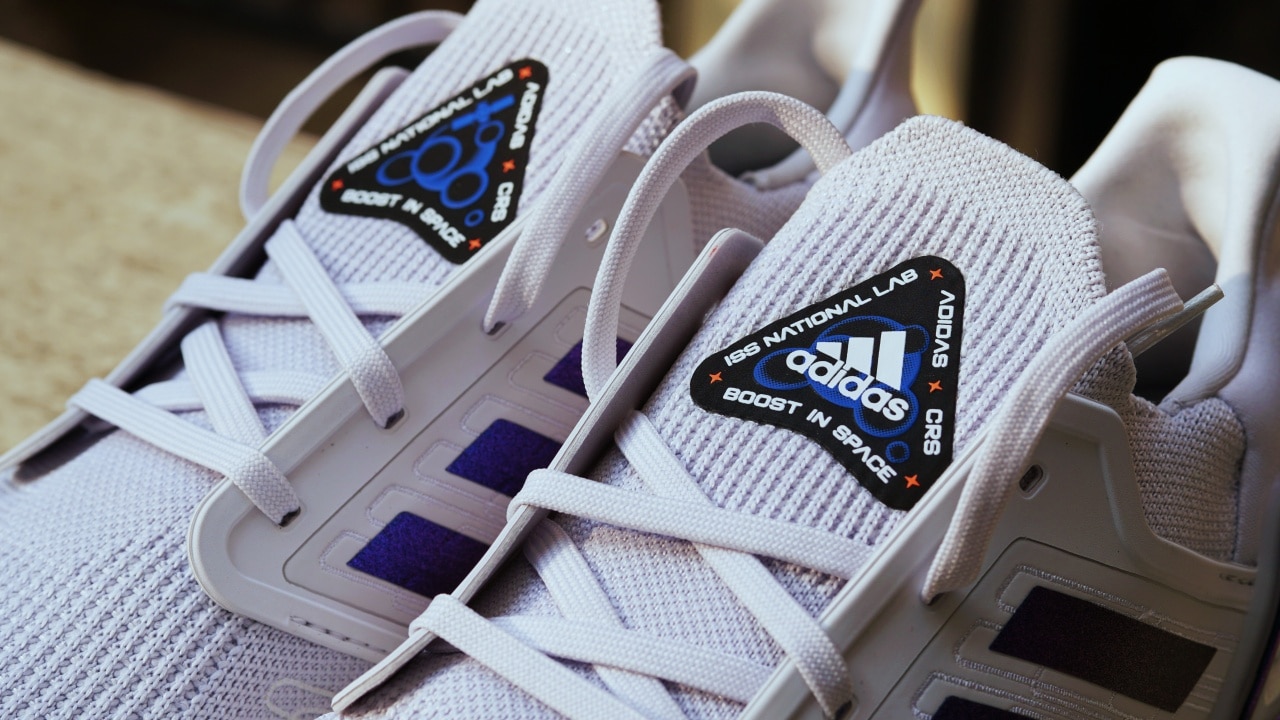
In the ankle area of the shoe you see another big difference vs the UB19. There’s still a prime kit tongue, but in the back you have a padded neoprene material which is really appreciated because it really adds to the comfort.
This extra padding around the heel feels great against your foot but also makes your foot feel more secure in the sneaker as it pushes it forward. Apart from that, your foot is up against primeknit for a very sock-like fit.
It does feel a little bit more snug than the UB19. This helps make it more performance oriented than before which is definitely helpful for runs.
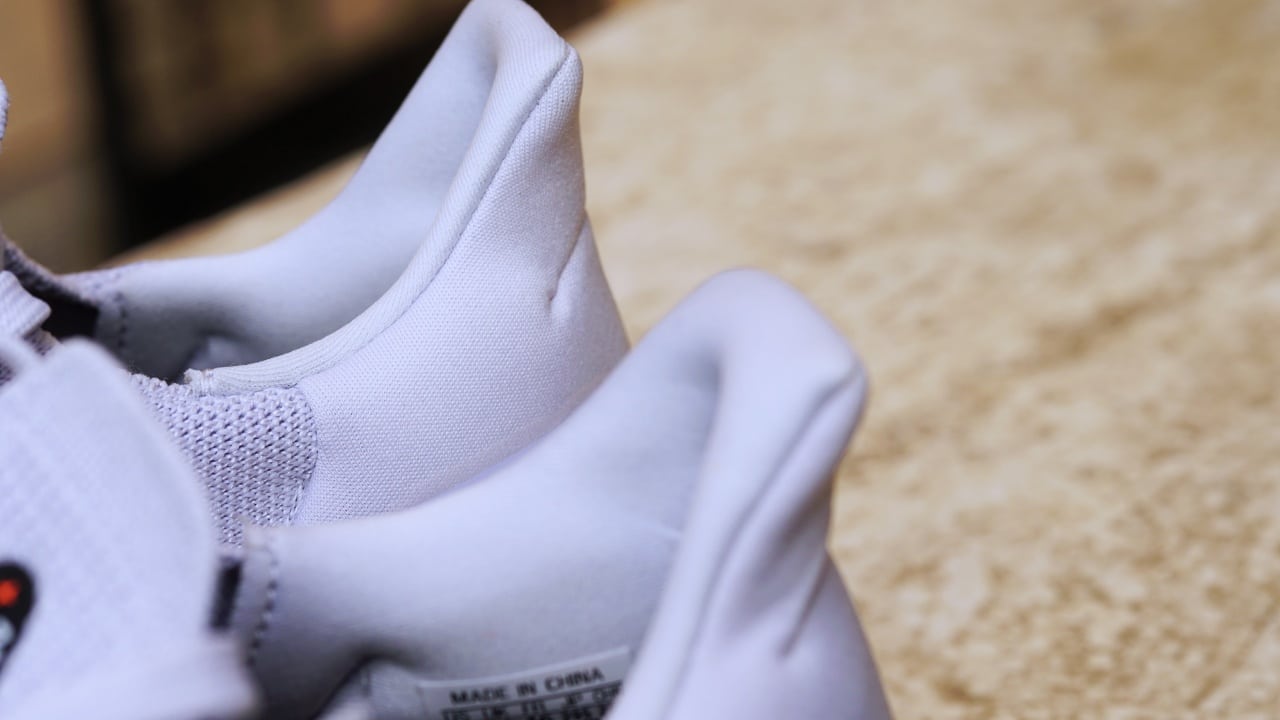
If you’re going to want this for lifestyle wear as a shoe sneaker I’d advise going up a size. Same is true if you have wide feet like I do. It’s always best to try the shoe on in a store first to make sure you get the best fit possible.
The insole comes in black with Adidas and ISS National Lab branding in white and orange. Each insole is different which is a nice touch.
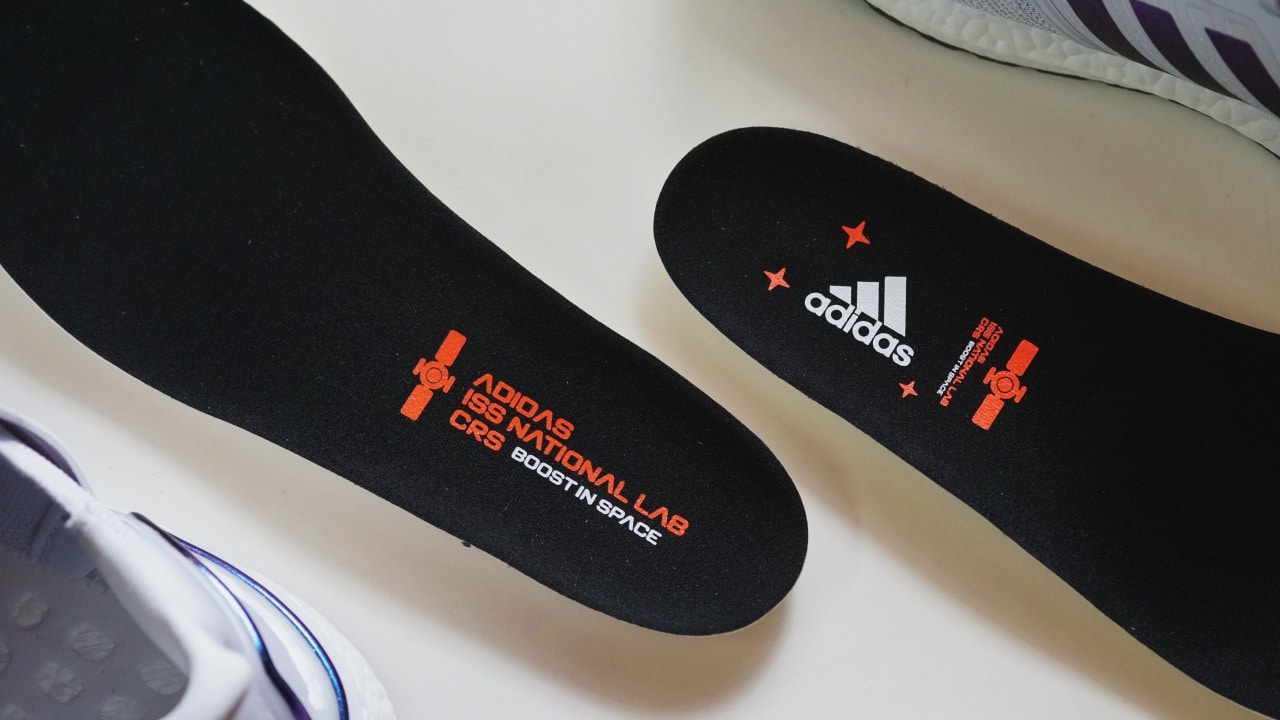
Coming to the heel counter, it seems to be just an outline just like the UB19. Adidas calls it their “3D Heel Frame” which cradles the heel and holds it in place. I like that the heel counter spills over onto the boost midsole and gives you more stability because it really keeps the boost in place.
At the back of the shoe you have a nice padded neoprene material instead of primeknit. I definitely like the way it feels against my foot vs just primeknit in this area.
Another new addition is the bright orange accent. It definitely stands out but ties in nicely with the ISS collab.
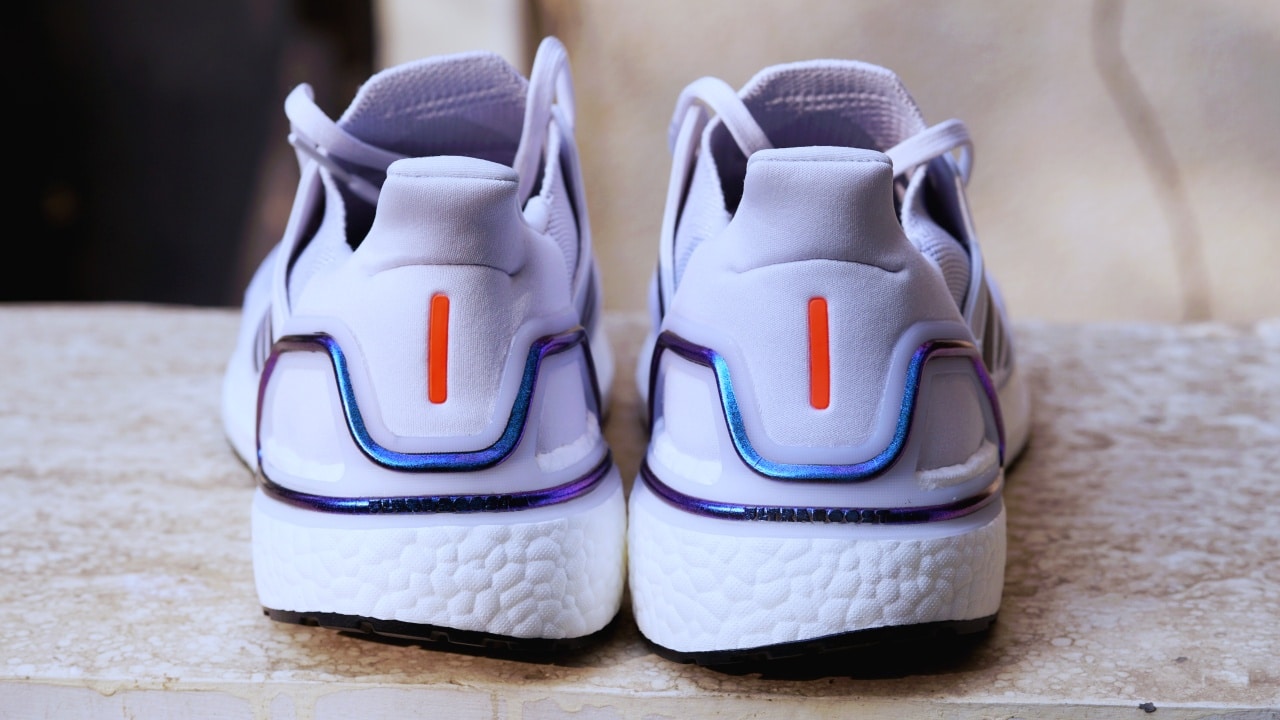
Speaking of eye-catching — moving downwards, you have the good ol’ white Boost mid-sole. The ISS collab Ultraboost 20 actually comes in seven colorways, four of which have an iridescent boost midsole which looks pretty neat.
It’s really flashy, and you’ll either love it or hate it but I actually like the implementation here on my Dash Grey colorway.
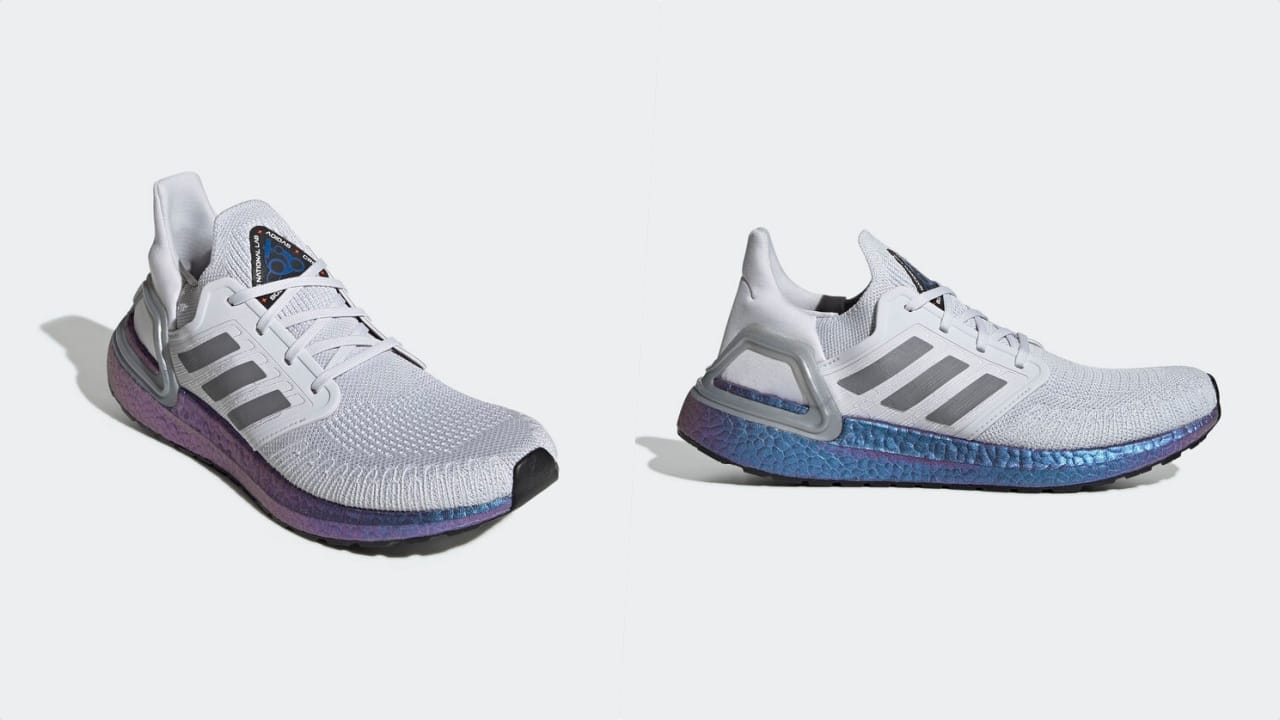
UB20 iridescent midsoles
Instead of the iridescent boost midsole, this colorway has an iridescent heel frame and midfoot cage, which I think looks much nicer. It’s minimalist and more my style.
Either way it definitely looks very space-like. I guess it’s meant to make you think of outer space and it definitely does that. If you’re wearing them out, people are definitely going to ask you about your sneakers.

Coming to the outsole, it is the usual Stretchweb outsoles with Continental rubber for multi-surface traction and the usual lightweight Torsion Spring construction for support when the foot lands to propel runners forward.
Still a top-tier midsole cushioning
Boost is still boost — it is still the best midsole cushioning tech that I love. There’s 20 percent more boost in this shoe than the older UB 1-4, just like the UB19.

The Boost feels the same, but that’s okay. If it ain’t broke, why fix it, right?
In case you haven’t tried out a sneaker with Boost yet, I encourage you to go on over to an Adidas store and try one out as soon as possible.

The big deal here is the cushioning and energy return. You can feel it absorb the impact as you run, and then spring back to return some of that energy to help you take off.
It’s this reason why Boost and the Ultraboost series in particular are so popular amongst runners and gym goers. They’re not only some of the most comfortable shoes around but it also really helps with running and aerobics. I even wear Ultraboost for my dance fitness and boxing classes. I totally recommend it.
Is the Ultraboost 20 your Sneaker Match?
The UB20 is an iterative but meaningful improvement to the Ultraboost line in comparison to the UB19.
It is even more performance oriented, and even more comfortable at the same time. Honestly just go into an Adidas store and try them on — I’m pretty sure you’ll walk away impressed.
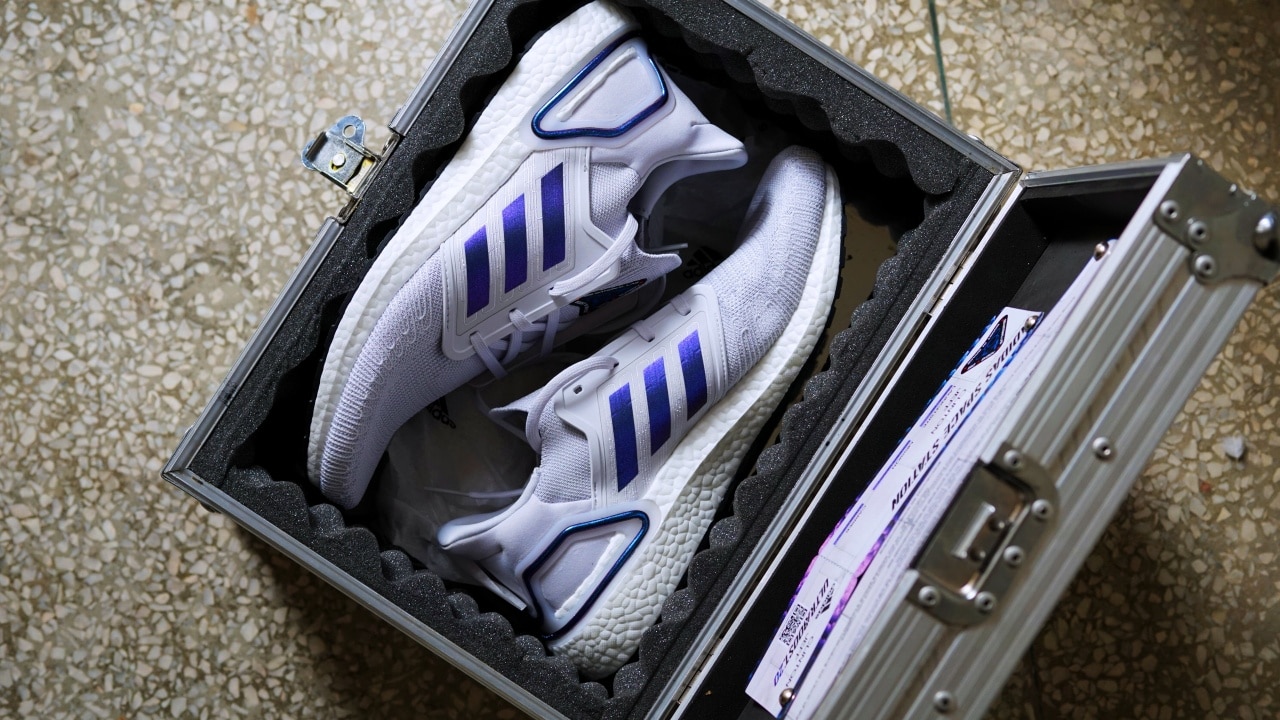
The ISS Collab is really exciting, and while it may or may not all just be marketing hype, it is definitely an exciting way for Adidas to launch the UB20.
While I’m always going to be a fan of the aesthetic of the older Ultraboost 1-4 more, you have to admit the new Ultraboost 20 definitely looks crazy futuristic. It’s the best performance sneaker out there, and I can’t recommend it enough.
SEE ALSO: Asics Gel Cumulus 21: Your everyday training sneaker






Accessories
Razer sharpens its competitive edge with Viper V4 Pro and Gigantus V2 Pro
Ultra-light. Ultra-tuned.

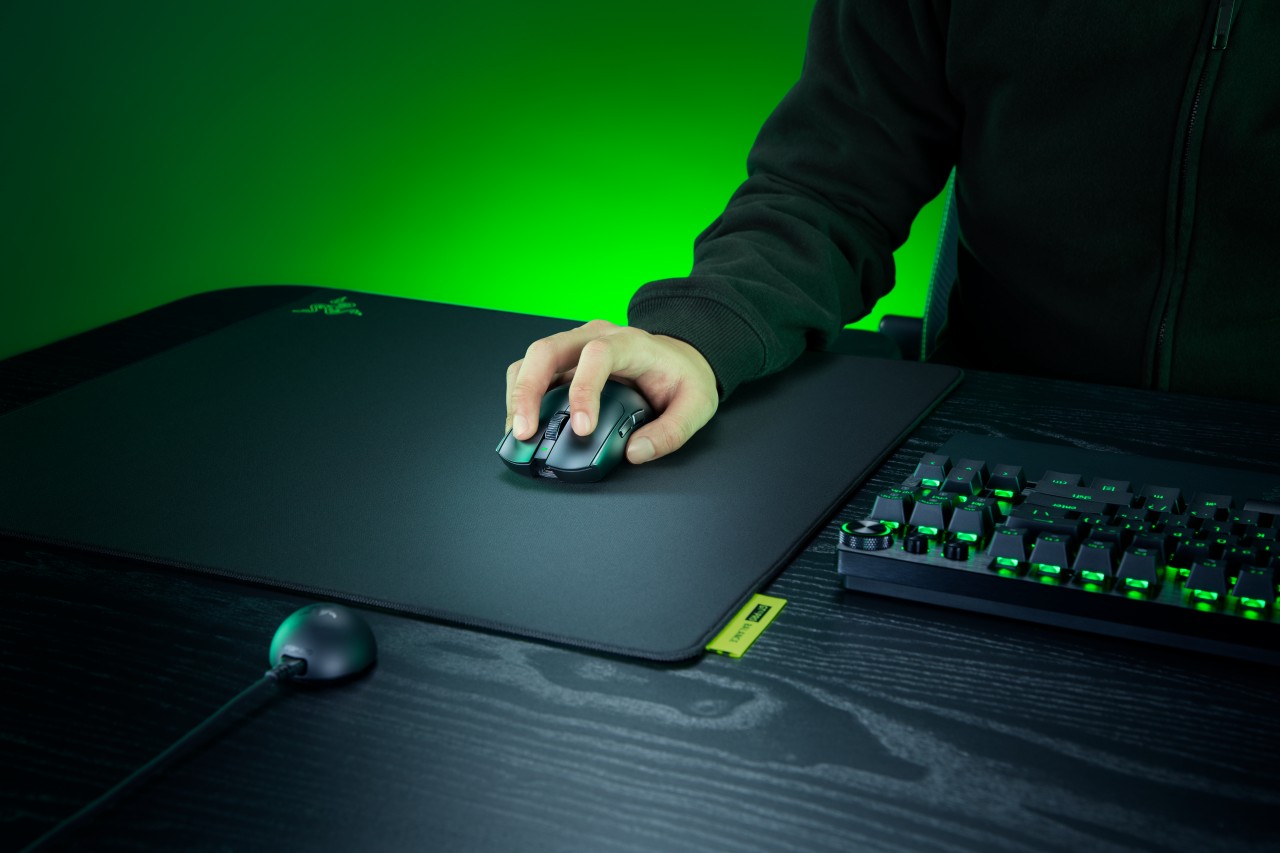
Razer expands its pro-grade lineup with a lightweight mouse and a highly customizable mouse mat built for different playstyles. The Razer Viper V4 Pro focuses on speed, precision, and responsiveness, while the Razer Gigantus V2 Pro brings tailored surface options that adapt to how players move.
Lighter, faster, and built for control
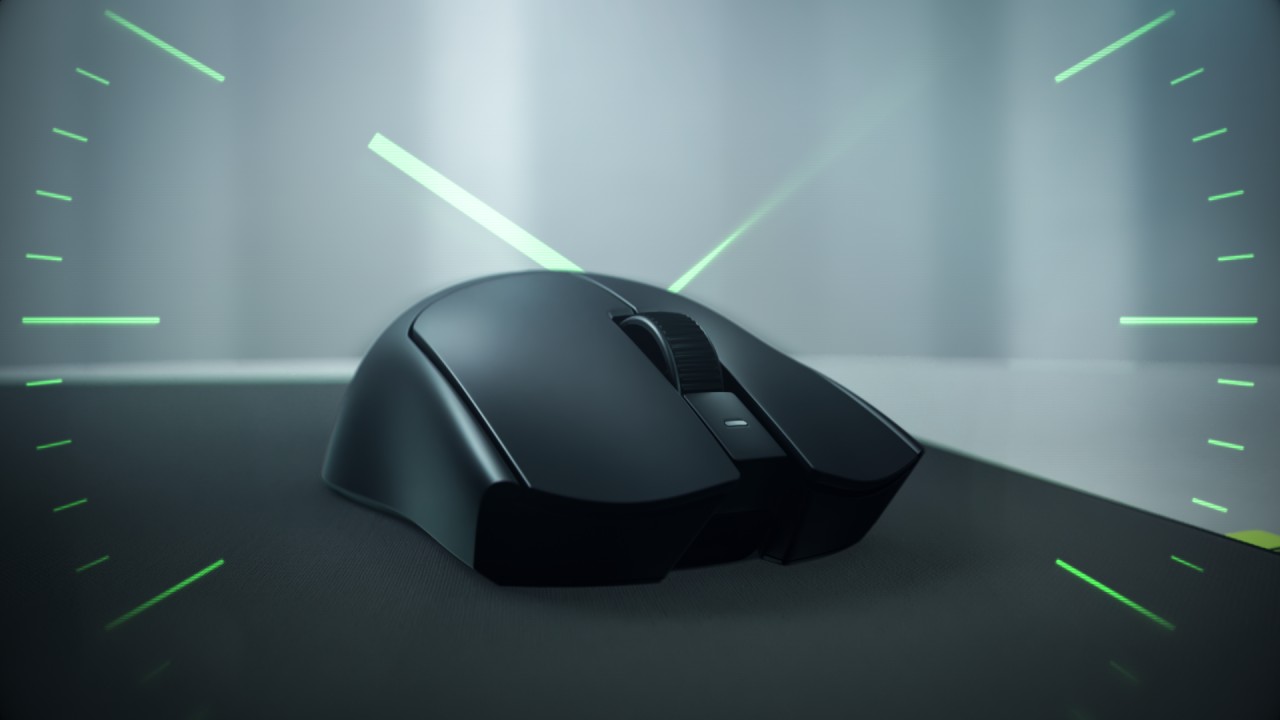
The Viper V4 Pro weighs approximately 49g in Black and 50g in White, making it around nine percent lighter than its predecessor. Razer achieves this through mechanical refinements like a thinner shell and a more compact PCB, without compromising durability. The structure still feels solid in hand, even with the aggressive weight reduction.
This balance matters in competitive play. A lighter mouse reduces fatigue and allows quicker adjustments, but stability keeps movements consistent. The Viper V4 Pro aims to deliver both.
Plug in, tweak, and play instantly
Razer also streamlines setup and tuning. The optimized hemispherical dongle maintains stable connectivity while providing quick status updates through LED indicators.
Players can adjust settings without installing software using Razer Synapse Web, enabling browser-based customization. Onboard controls allow quick DPI and polling rate changes mid-match, so adjustments happen without breaking focus.
A mouse mat that adapts to your play style
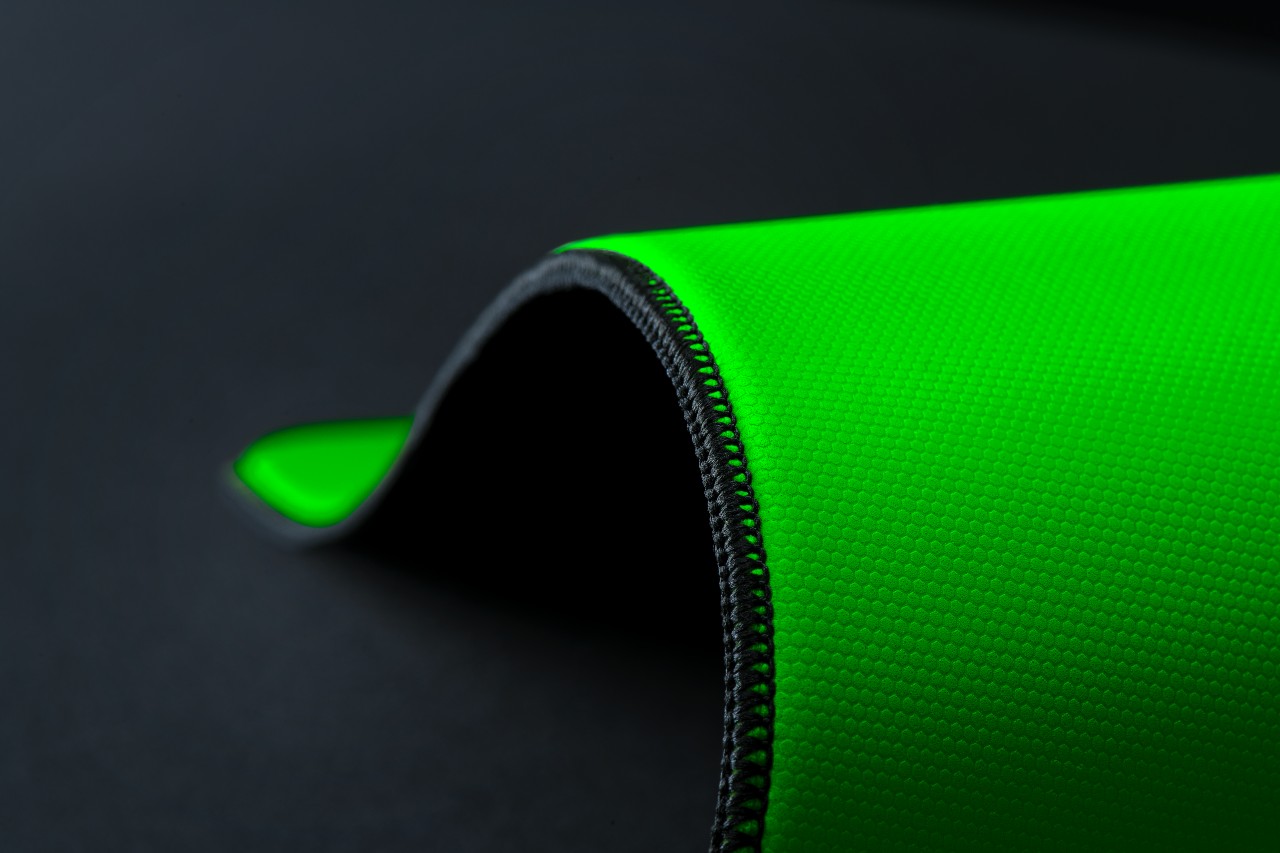
The Gigantus V2 Pro evolves Razer’s mouse mat lineup by introducing five distinct speed ratings paired with corresponding foam firmness. Instead of a one-size-fits-all surface, players can now choose based on how they aim and move.
Developed with esports pros like Nikola “NiKo” Kovač, Faker, and Zellsis, each variant reflects real competitive needs across different roles and playstyles.
The five surface options include:
- Max Control for ultra-high friction and precise flicks
- Control for consistent micro-adjustments
- Balance for a mix of speed and stopping power
- Speed for quicker swipes
- Max Speed for the fastest possible movements
Each surface is paired with Razer’s GlideCore foam, tuned to match the friction profile. Softer variants provide more stopping power, while firmer ones prioritize speed and responsiveness.
Built for consistency across every match
Razer ensures the Gigantus V2 Pro works seamlessly with modern optical sensors. Lab testing guarantees consistent tracking, whether for fine adjustments or wide flicks.
The mat is also designed for competitive environments. It features stitched edges to prevent fraying, an anti-slip base for stability, and a rollable build that makes it easy to bring to tournaments.
A complete competitive setup
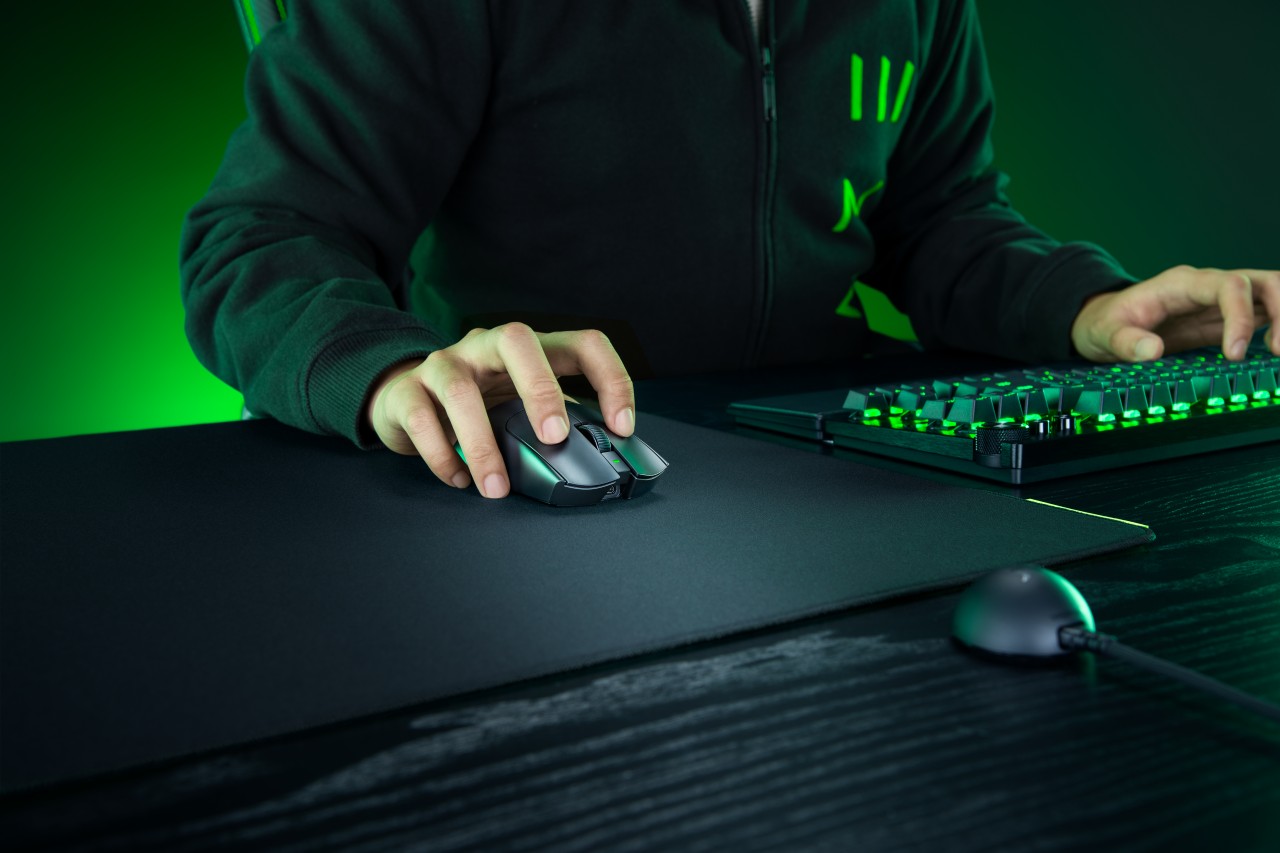
Together, the Viper V4 Pro and Gigantus V2 Pro form a cohesive setup that covers both input and surface. The mouse emphasizes low latency, precision tracking, and a shape validated by pros. The mouse mat complements it with clear, playstyle-based options.
Rather than focusing on a single standout feature, Razer builds a system. One that supports consistent performance, adapts to player preference, and helps turn practice into results when it matters most.
Accessories
Logitech G debuts PRO X2 SUPERSTRIKE with faster click tech
Faster clicks, deeper control
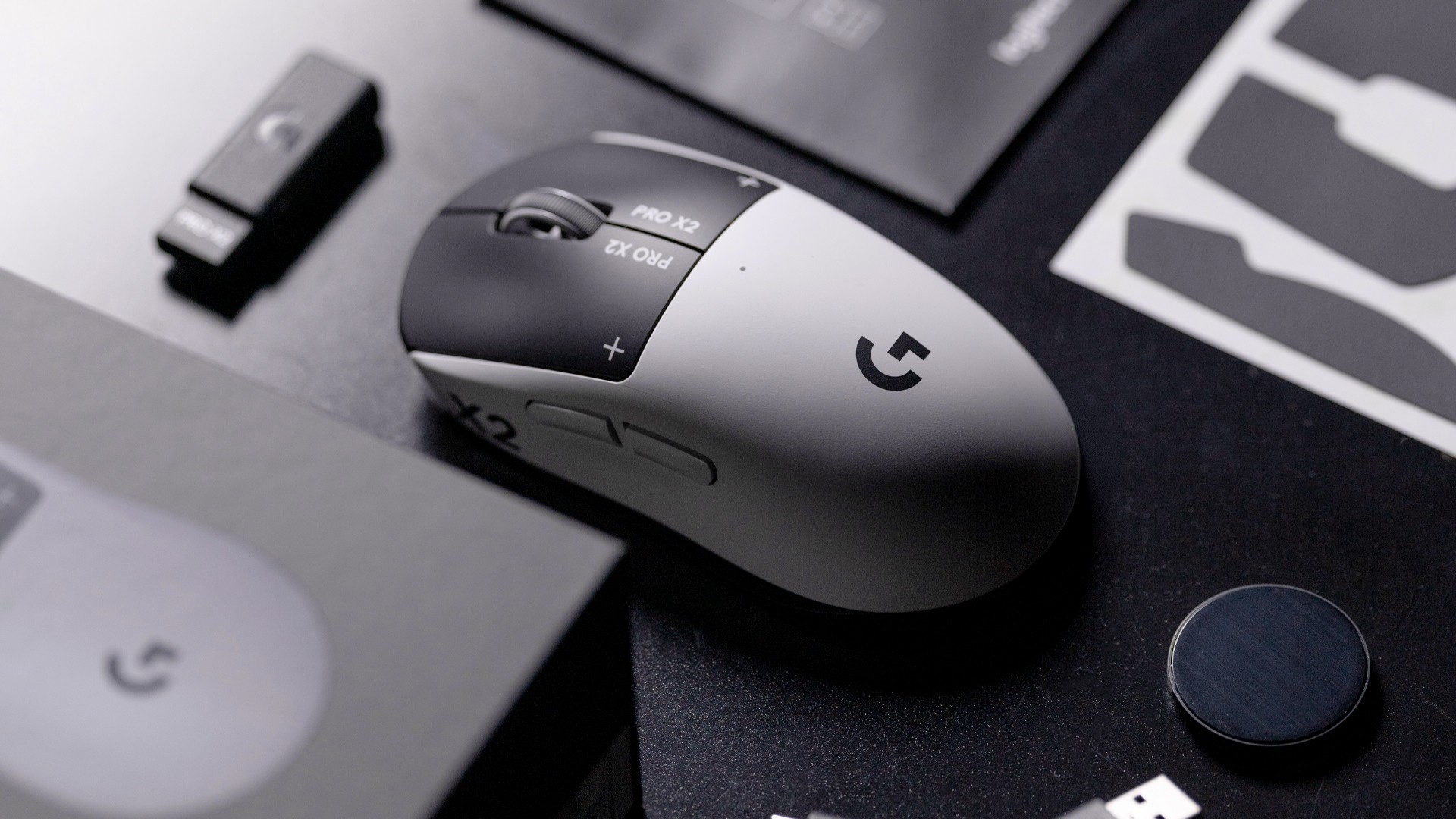
Logitech G is pushing competitive gaming performance further with the launch of the PRO X2 SUPERSTRIKE. It’s a next-generation wireless mouse built around a new click system designed for speed and control.
At the center of the PRO X2 is its patent-pending SUPERSTRIKE technology. It reduces the travel distance needed to register a click, cutting latency by up to 30 milliseconds based on internal testing. The result is faster inputs that can make a difference in high-stakes, split-second moments.
The mouse also introduces the Haptic Inductive Trigger System (HITS), replacing traditional mechanical microswitches. Instead of relying on physical contact, it delivers tactile feedback the moment a click signal is sent, helping players feel each input in real time.
Customizable clicks for competitive play
Developed with esports teams like G2 Esports, NAVI, and BLG, the PRO X2 SUPERSTRIKE focuses on precision and consistency. It supports 10 selectable actuation levels, allowing users to fine-tune how deep a click needs to be before it registers.
These adjustments can be made through Logitech G HUB, giving players the flexibility to match their setup to different games, roles, or playstyles without interrupting gameplay.
The mouse also uses Logitech’s LIGHTSPEED wireless technology with up to an 8kHz polling rate. This ensures fast and stable performance without the limitations of a wired connection.
Precision tracking and lightweight build
Powering the PRO X2 is Logitech’s HERO 2 sensor. It supports up to 44,000 DPI, 888 IPS tracking speed, and over 88G acceleration. Logitech says tracking remains free of smoothing, acceleration, or filtering, allowing for more consistent and direct input.
Despite its performance-focused internals, the mouse keeps a lightweight build at 61 grams. Logitech says this supports faster movements and reduces fatigue during long sessions.
Battery life is rated at up to 90 hours on a single charge, letting players stay in the game longer without interruptions.
Price and availability
The Logitech G PRO X2 SUPERSTRIKE is priced at PhP 11,945. It is available in the Philippines via Shopee and authorized Logitech retailers.
Accessories
Jackery SolarSaga series: Free power for small devices
Portable solar panels can charge small gadgets directly
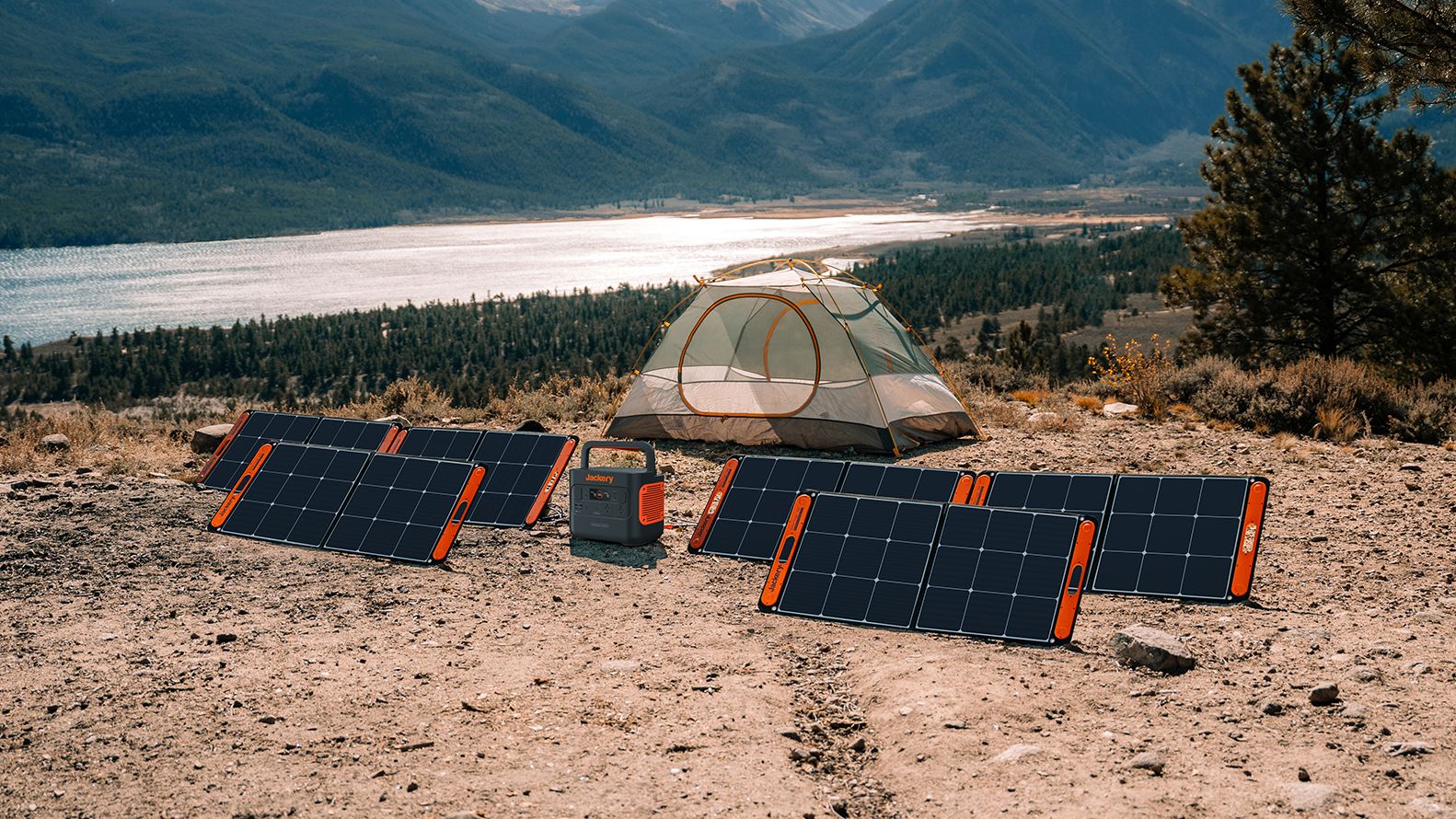
As fuel prices continue to surge as of late, one of the ways to make up for the additional expenses is to turn to alternative power sources. That’s including solar power.
And Jackery is here to help Philippine consumers, with the availability of their portable SolarSaga panels.
These solar panels are an alternative to traditional and permanently installed rooftop solar panels. They are engineered for modern and mobile life with portable, lightweight, and sleek designs. They are built primarily to be set up and put away easily, and charge small devices directly.
Simply put the Jackery SolarSaga panels where sunlight is available, and it will convert up to 25% of sunlight into usable energy.
To charge small gadgets like phones and portable fans, or even smartwatches, the SolarSaga panels come with a USB-C and USB-A port.
Another way is connecting the SolarSaga to Jackery’s Explorer power stations like the Explorer 300 Plus or 1000 Plus.
From there, users can power up devices, essentially for free. On its own, the Jackery SolarSaga panels are available in 100W and 200W variants.
The panels are also IP68 rated for water and dust resistance. This makes them usable outdoors when brought to adventures like camping, picnics, or beach trips.
The panels are already available through Jackery’s Lazada and Shopee platforms, as well as Techroom’s Lazada and Shopee accounts.


Galaxy Buds4 Pro review: I thought I was done with in-ears
This Buds4 you


WWE 2K26 lets you live out all the fantasy matches you could want
But you have to play for hours and hours to unlock everyone.

The HONOR X8d is serviceable
Steady but slow?

Life is Strange: Reunion now available on consoles and PC

Why this AI-powered eye health exam is the only reading you need this season

DJI officially launches the Avata 360 with 8K immersive imaging

The Changan Eado Plus officially lands in the Philippines

PLDT Home, Samsung team up for exclusive entertainment deals


-
 Reviews1 week ago
POCO X8 Pro Max review: A new beast from the far east
-

 News1 week ago
POCO X8 Pro Series: Price, availability in the Philippines
-

 Reviews1 week ago
POCO X8 Pro Iron Man Edition review: Midrange phone in superhero armor
-

 Reviews2 weeks ago
Samsung Galaxy S26 Ultra review: A phone you live with
-

 Automotive1 week ago
VinFast extends free unlimited charging in 3 markets amid rising fuel prices
-
 News1 week ago
POCO introduces X8 Pro Series with Dimensity 9500s
-
 Gaming1 week ago
NVIDIA’s DLSS 5 can turn your favorite AAA game into AI slop
-
Philippines1 week ago
The HONOR X8d is serviceable