


Explainers
Explainer: Differences between Snapdragon processors
Let’s understand what’s inside our phones

In the world of mobile phones, each device is ranked by performance based on what’s powering them. The processor inside your smartphone is constantly working as much as it can to keep your phone running.
Today, especially on Android phones and tablets, the most popular of all mobile processors is Snapdragon from Qualcomm. There are several Snapdragon processors out there, and each model number gets more confusing as new variants come out. Let us help you with that.

First, a brief introduction. Snapdragon is a family of system on chip (SoC) products made by Qualcomm for use in a variety of mobile devices such as phones and tablets. It contains not just a central processing unit (CPU), but also a graphics processing unit (GPU), global positioning system (GPS), modems for LTE and Wi-Fi, and whatever is needed to create a complete chip to power a mobile device. Let’s simply refer to it as a processor so we won’t get too technical.
Not all Snapdragon processors are of the same level. Currently, Qualcomm has four Snapdragon platforms, and they’re classified by three numbers. Each series helps classify what tier (i.e. entry-level, midrange, flagship) the phone belongs to during its launch. Knowing each series also gives us a quick idea of how the device’s performance will fair.
Snapdragon 200 series
The Snapdragon 200 series is the entry-level processor range. As of writing, there are five models under the 200 series: 200, 205, 208, 210, and 212. They are found on low-cost phones and other smaller devices that don’t require much processing power. The latest to be powered by these processors is the Nokia 2 which is a cheap Android smartphone for basic functions.

We don’t see many Snapdragon 200 series-powered phones lately due to competition with MediaTek, another SoC maker that’s known to be found on budget Android devices.
Snapdragon 400 series
Moving up the ladder, we have the Snapdragon 400 series. This series bridges the gap between the entry-level and mid-tier. Like with the 200 series, the 400 series is commonly used for budget devices around the US$ 200 range and also faces tough competition with MediaTek’s offerings.

There are a number of models in this series but thankfully, as the number goes up, the specifications and performance do too. Some models in the series don’t differ much with slight modifications in speed and modem features. Also, as high-tier processors get more advanced, the lower-tier processors like the 400 series get the old higher-end features.
Some of the phones in this series are inside the Huawei Y7 Prime and LG Q6 which both have a Snapdragon 435 and the OPPO A71 (2018) and Vivo V7 which have a Snapdragon 450 — the latest and greatest in the series as of writing.
Snapdragon 600 series
Many consider the Snapdragon 600 series to be the most well-rounded in Qualcomm’s family. Why? It offers a great balance between performance and cost. Smart buyers would prefer a great midrange phone rather than an expensive flagship which they would replace in a year or two. That’s where the 600 series comes in. It offers far greater performance than the 400 series and inherits the features of a high-tier processor without the added cost.
There are more model numbers that fall under the 600 series, but the most famous of them all is the Snapdragon 625. It was a game changer when it was announced back in 2016 because it brought the efficiency of more expensive processors to cheaper phones. The Snapdragon 625 is still widely used today since it’s a reliable processor and gives budget phones midrange performance.
Since the introduction of the 625, more manufacturers are relying on the 600 series. The latest releases, the Snapdragon 630/636 and 660, are now even up to par with flagship processors from 2016. The newest phones like the Nokia 7 Plus and OPPO R11s have the Snapdragon 660, while the recently announced ASUS ZenFone 5 has the Snapdragon 636 with artificial intelligence (AI) features.
Snapdragon 800 series
The Snapdragon 800 series is Qualcomm’s top-tier lineup. Flagship phones use the latest Snapdragon 800 series processor at launch. The 800 series is not as confusing as the others because Qualcomm doesn’t release multiple high-tier processors at the same time; they usually announce two per year. Actually, we only had one for 2017 which is the Snapdragon 835 and for 2018, we currently have the Snapdragon 845 so far.

All the newest features are found on the latest 800 series processor. It uses the latest manufacturing process, highest performing graphics unit, best display tech such as higher dynamic range, and has support for the fastest storage and memory. With the trend of artificial intelligence among mobile devices, the Snapdragon 845 even has a neural processing engine dedicated to AI.
The Snapdragon 800 series has the best and most exclusive features, but they come with a price. Since the 800 series processors power flagship phones, it’s always expensive to afford one except those from Xiaomi and OnePlus.
Since we’re still in the first quarter of 2018, there aren’t that many phones available with the latest Snapdragon 845 but the list already includes the Samsung Galaxy S9, Xperia XZ2, and ZenFone 5Z. Last year’s Android flagships were all powered by the Snapdragon 835 like the OnePlus 5T, Google Pixel 2 XL, LG V30, and HTC U11+.
Ranking of the processors
At this point, it’s pretty obvious that the 800 series is the best performer of the bunch since it always gets the latest features and advancements in mobile processors. But let’s not belittle the capabilities of the 600 series which vastly improves with every release. Since it’s the next in line, whatever the 800 series has will soon be available to the 600 series. There are even rumors about a 600 series processor based on the same 10nm manufacturing process of the Snapdragon 835/845 which will be a big deal for midrange phones.
The 400 series is there to draw the line between upper-midrange and lower-midrange phones. Gadgets powered by a 400 series processor, especially the latest Snapdragon 450, aren’t totally inferior to any of the 600 series-powered devices, though. The 400 series is also picking up from where the 600 series was every year. If the phone has a 200 series processor, don’t expect much. It’s really designed to cover the basics while keeping up with faster LTE speeds.
How the new low-tier processors are catching up to the old mid-tier processors
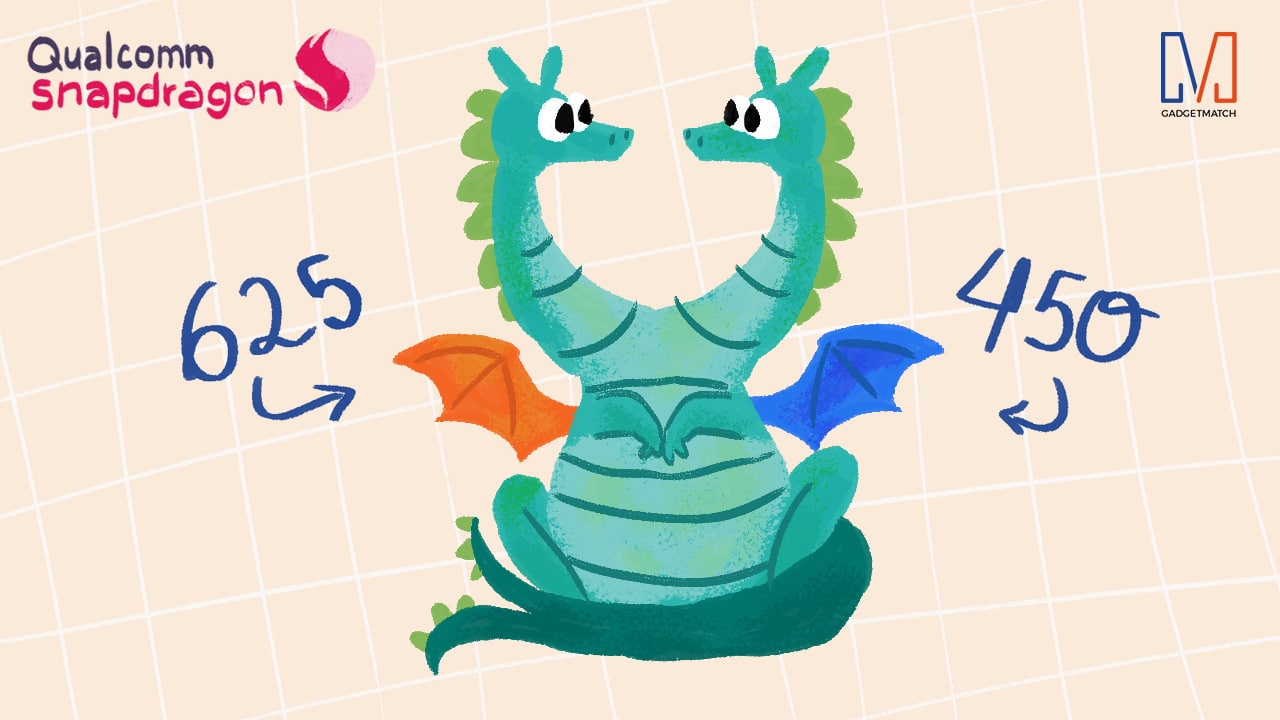
It may seem easy to rank the processors based on what series they belong to but, as mentioned earlier, lower-tier processors inherit the features of higher-tier processors. Also, a higher number doesn’t always mean better. The best example would be the Snapdragon 625 and the new Snapdragon 450. The Snapdragon 450 was announced a year after the Snapdragon 625, but they are practically the same. The only advantage of the 625 over the 450 is a slightly faster clock speed for marginally better performance.
Then there’s the Snapdragon 630 and Snapdragon 652. You’d think that the 652 is better than the 630, but it isn’t. The Snapdragon 630 is newer, more efficient, and performs better all around. We can’t blame you for the confusion because the Snapdragon 652 is formerly known as the Snapdragon 620. It is Qualcomm who brought up the confusion by renaming older processors
What about Kirin, Exynos, and MediaTek?
Before we wrap up, let’s be clear that Snapdragon is not the only mobile processor on the market. They might be widely used on phones, but even phone manufacturers themselves make their own: Samsung has Exynos which powers the Galaxy S9 in some markets while Huawei is quite loyal to the Kirin processors found on most of their phones.

Both Exynos and Kirin can match the performance of Snapdragon processors, thus making the phone market more exciting for consumers but fragmented for developers. Then there’s also MediaTek that’s quite popular among budget devices. They also have high-tier processors but they’re yet to make a dent in Snapdragon’s share.






With a huge change in naming scheme, Apple promises a big leap ahead.
The all-new Liquid Glass design isn’t just breath of fresh air — it’s a bold redesign ever since the iOS 7 came out.
It’s not limited just to the iPhone. It’s coming to the iPad, Mac, and even the Apple Watch!
And with latest Public Beta now available across all devices, now is the perfect time to try ’em out.
Here are our favorite features, design updates, and hidden gems in Apple’s latest OS 26 series of software updates.
Namely iOS 26, iPadOS 26, watchOS 26, visionOS 26, and macOS Tahoe.
Shopping for a new Windows laptop?
With so many choices out there, it can be tough to know where to start.
Should you prioritize performance, battery life, or portability? Can you find something affordable and premium-looking?
In this video, we break down everything you need to know about the new Snapdragon X Series laptops — a new category of Windows PCs that promise power, efficiency, and sleek design in one package.
Whether you’re a student, creative, or just looking to upgrade, this buyer’s guide will help you decide if a Snapdragon X Series laptop is right for you.

Apple dropped a ton of surprises in this year’s WWDC — and there’s more than just the Liquid Glass redesign.
From Workout Buddy, to game-changing Apple Intelligence features.
All the way to collaborative visionOS updates, and the next generation of iOS 26, macOS 26, and iPadOS 26.
Watch to see the top announcements NEED to know from the WWDC 2025 keynote!
Here are Michael Josh’s biggest takeaways from WWDC 2025 in one video — with the help of some TechTuber friends!


EastWest rolls out Google Pay access for debit cardholders

Globe postpaid opens pre-orders for Samsung Galaxy S26 series

The Xiaomi 17 shoots Leica dream

Nintendo sues the United States

OPPO Reno15 F 5G hands-on

Xiaomi 17 Ultra is now available outside China

TECNO will showcase the CAMON 50 and POVA 8 series at MWC 2026

The art of being in and behind the frame

HUAWEI MatePad 11.5 S 2026: The better-than-ever 4-in-1 productivity tablet

TECNO MEGABOOK K16s 13th review: No-frills beneath those grills


-
 News1 week ago
Xiaomi 17 Ultra is now available outside China
-

 MWC 20266 days ago
TECNO showcases cool concepts at MWC 2026
-

 MWC 20261 week ago
TECNO resurrects modular phones with this new concept
-
 MWC 20264 days ago
TECNO launches the all-new CAMON 50 series
-

 Reviews1 week ago
Xiaomi Pad 8 review: Slab that slaps!
-

 Reviews1 week ago
Forget the Phone: Xiaomi 17 Ultra Is A CAMERA!
-
 Reviews4 days ago
TECNO CAMON 50 Ultra review: End of an era?
-
 MWC 20263 days ago
Infinix NOTE 60 Ultra makes a motorsport-inspired debut