


What makes for a good horror title? More than a smattering of jump scares, critically acclaimed titles are often smooth assemblages of grotesque imagery, chill-inducing sound design, and foreboding background storytelling. By themselves, these elements can create an amazing film or series. However, a horror game needs so much more to be effectively scary.
Today, a lot of games rely on a bag of tricks — sparse resources, brutishly overpowered enemies, emphasis on sneaking — to keep players on their toes throughout the entire playthrough. Branching from a long tradition of similar games, The Callisto Protocol is the latest title to take on the genre. Can it leverage horrifying storytelling with tense gameplay?
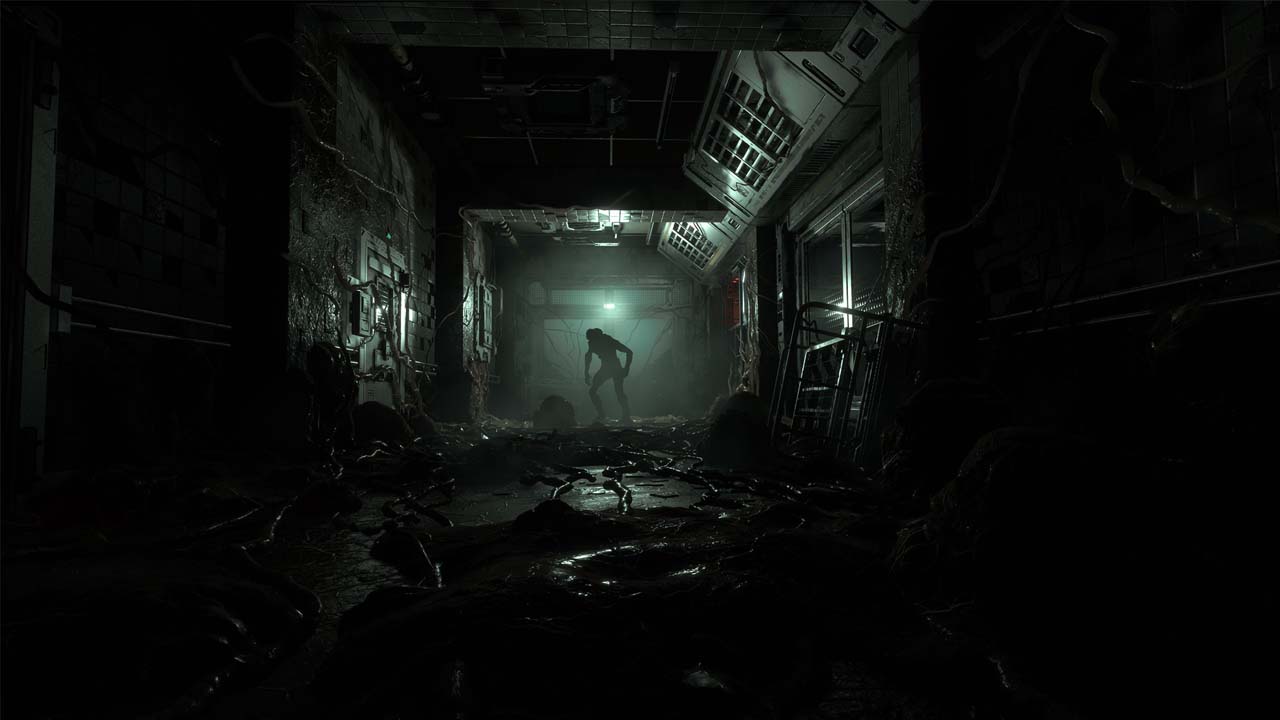
Back to sci-fi basics
The sci-fi horror genre needs no introduction. Over the years, it has spawned several notable titles like Alien: Isolation, Prey, and Dead Space. Besides waving the flag of the genre, The Callisto Protocol also comes from Glen Schofield, the co-creator of the Dead Space series. With that distinction, the title should be primed for success. Or so one thinks.
As the name implies, the title takes players to the frozen climes of Jupiter’s moon, Callisto. Jacob Lee, played by Josh Duhamel, finds himself trapped inside Callisto’s Black Iron Prison. Coincidentally, both inmates and guards alike are getting infected by an unknown virus, turning them into mutating zombies. Like other survival horror games, the title features dark hallways and a limited array of resources to fight monsters.

A feast of viscera
Given its creator, The Callisto Protocol successfully recreates the dark and ominous atmosphere of its spiritual predecessor. The game is as creepy as its gory. Claustrophobic, unlit hallways open into veritable museums of the human anatomy in various states of disfigurement. Entrails splayed out, entire torsos chopped off, naked bodies dangling on alien cobwebs. Even if you’re already used to the gore of the horror genre, there’s something in Callisto that can still inspire awe and disgust.
The same goes for the game’s limited-but-adequately-spaced out enemy design. Though most of the monsters you’ll face in Callisto are humanoid, there are a few enemies that escape comprehension including a human body contorted into a spidery crawler and another squeezed into a snake-like form. The game can always use more enemy types; however, it adequately spaces out special monster types, ensuring that the limited number we see keep their scare factor.

Clunk
The Callisto Protocol deserves praise for its excellent environmental storytelling. However, a game needs more than just an environment. It also needs a complementarily scary gameplay system. Unfortunately, the title does little to deliver.
Though the game takes scarcity of resources to heart, The Callisto Protocol’s combat system is clunky. Instead of two dedicated buttons to dodge and block, the game asks players to use the left thumbstick, the same one you use for movement. Players have to accurately predict which side an enemy is attacking from and counter with the opposite direction on the thumbstick. Otherwise, players can block attacks by holding down on the stick. It’s certainly a chore to get used to, especially when most games these days use either the X or the O button to dodge.
Once you do get dodging down to a rhythm, the game doesn’t offer much variation for attacking. There are light and strong attacks, but it’s ultimately a spam of the right trigger then an occasional burst of gunfire. There are a variety of guns available, but a lot of the latter enemies are bullet sponges so it doesn’t matter much.
It also doesn’t help that the targeting system freaks out in scenarios with more than one monster. Most of the time, a strike just fails to land or mistakenly lands on an entirely different target, often leading to the player getting hit instead.
The game’s horror finds itself tied so much into the foreignness of its gameplay and the controls. As such, the fear factor quickly dissipates after mastering the system. A couple of hours into the game, the monsters stopped being scary. Whenever the game told me to sneak past enemies, I still got into fights intentionally just to quicken the pace. Fighting just became an inconvenience, rather than a death sentence.
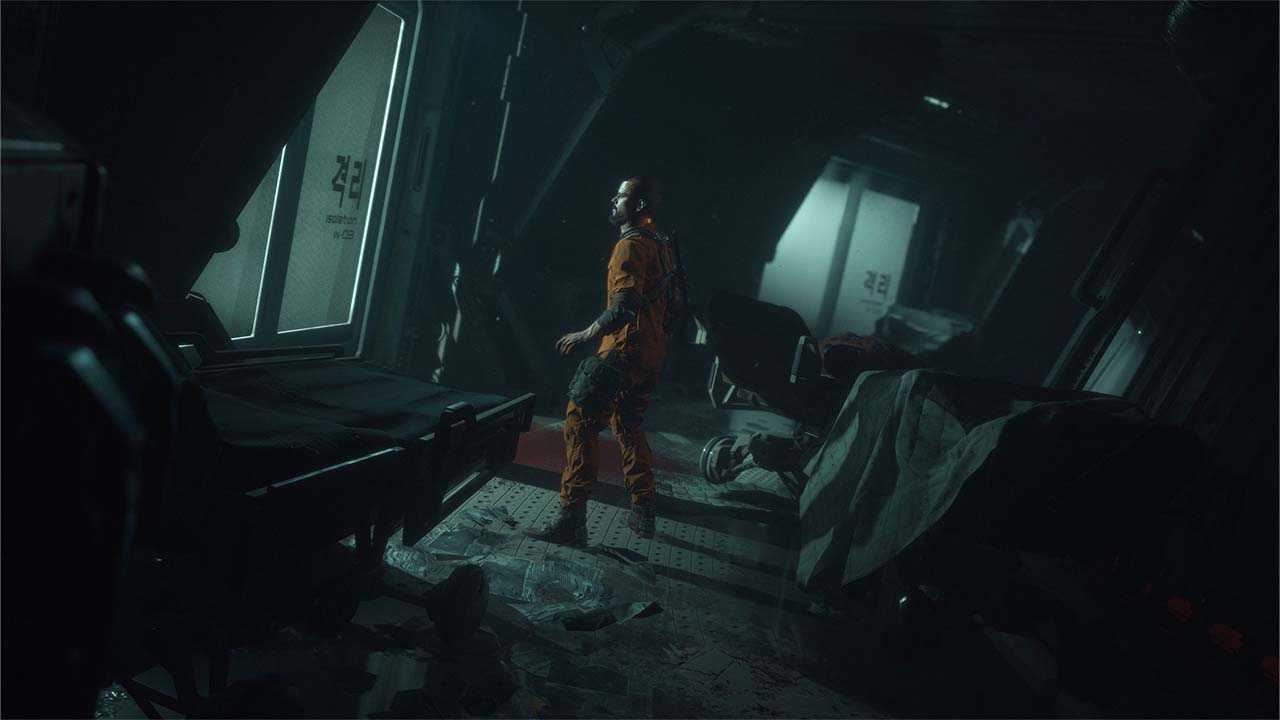
A problem of pacing
In between fighting, players traipse through dark hallways and cramped vents. The game also offers divergent paths, adding a bit of choice as to where players explore first. In moderation, these elements can help build tension and reward players for exploring beyond the main path. The Callisto Protocol’s take, however, is problematic.
Though framed as a way to increase tension, the game also uses empty hallways and vents as cleverly disguised loading screens. Jacob crawls through at a snail’s pace so the game can load the next area. While other games use this moment to build lore or continue the dialogue, a lot of Callisto’s loading screens offer nothing but silence or the same, reused set pieces of monsters running offscreen to parts unknown. One segment even had a vent, an empty room, and another vent follow each other — basically, three loading zones in quick succession. It’s just a tax on time.
The divergent paths aren’t as effective either. There are several times when exploring a hidden room ends up with nothing, a battle, a middling reward, or just an audio recording. It’s hardly rewarding enough to explore unbeaten paths.

Is The Callisto Protocol your GameMatch?
For what it’s worth, The Callisto Protocol is still a masterclass in depicting virtual gore. Schofield knows how to make space terrifying. If you’re looking for a quick fix to tide over a hunger for horror, this title might be for you.
Unfortunately, the title’s lackluster gameplay keeps The Callisto Protocol from hanging with other masterpieces in the genre. However, if it’s any consolation, the title still has a post-launch roadmap to follow including story-focused DLC. The game might be more worth its price tag once the DLC comes out.




Valve has been embroiled in an odd war as of late. A few weeks ago, the New York Attorney General filed a lawsuit against the gaming company for allegedly encouraging children to gamble through loot boxes primarily found in Counter-Strike 2. Today, Valve is fighting back by declaring how little its loot boxes have to do with gambling.
For years, governments have had a problem with loot boxes. To them, the mechanic makes it too easy for gamers to fall into a gambling addiction. In essence, loot boxes are earnable packs that contain a single or a number of random items that the player can use for their game. Most of the time, these items are purely cosmetic and don’t give a gameplay advantage.
Like Blizzard before it, Valve is also defending its loot boxes as non-essential to how players engage with their games. “There is no disadvantage to a player not spending money,” their statement reads.
Additionally, Valve says that their loot boxes are no different from Pokémon cards and Labubu blind boxes. As such, the company is also defending their users’ right to transfer obtained items to other users, as with two players trading cards or Pop Mart figurines.
Now, these items have monetary value in the market. In the same way, a rare Counter-Strike 2 skin can fetch thousands of dollars. However, Valve says that they are already proactive in shutting down accounts made only to gamble and avoiding pro-gambling businesses.
Valve is capping off its statement by saying that the NYAG is forcing the company to collect more information from its users, especially those using VPNs to prevent being located in New York. The company says that it will continue to protect user data, despite the demand.

What is an Xbox? For the past year and a half, Microsoft will tell you that anything can be an Xbox. Now, with Project Helix on the horizon, Xbox wants to bring the idea of playing anywhere to the next level. Microsoft will start rolling out its new Xbox Mode to PCs in April.
Since the very first device out in the market, handheld consoles have changed how people play games. Naturally, a lot can already be said about the portability and the convenience of its hardware. But the software needs a special shoutout, too.
Though they are essentially PCs at heart, these consoles are built explicitly for gaming. Fiddling around with Windows isn’t ideal. Instead, they have special software that can collate all of a user’s games into one hub.
The new Xbox Mode, adapted from the ROG Xbox Ally X’s Xbox Full Screen Experience, will do just that but on an actual PC. As announced via an official blog post, Xbox will release the new mode to Windows 11 devices in April, starting with select markets. Like the software used in handheld consoles, Xbox Mode should include all the available games from the Game Pass, Steam, and the Epic Games Store.
Right now, the feature will likely go up against Steam’s Big Picture Mode, which does the same thing but only for Steam titles. However, it should also transition neatly to Project Helix. Xbox is now ramping up the development of its next-generation console codenamed Project Helix. The upcoming machine will be a high-end PC and a gaming console rolled into one, making it perfect for Xbox Mode.
SEE ALSO: Project Helix is Xbox’s next console, and it plays PC games
Gaming
Resident Evil Requiem will get a story expansion
There’s no word yet on when the story expansion will drop.

Resident Evil Requiem, Pokémon Pokopia, and Slay the Spire 2. Between these three, gamers today are eating well and good. Or rather, they’re not, because of how addicting of a time sink these titles are. The latter two especially are built to be played over and over for weeks and months. Now, Resident Evil Requiem is working on something, so you also won’t forget about it in a few months’ time.
Via an official post on Resident Evil’s social media platforms, Capcom has confirmed that a story expansion is coming to the horror game. Currently, the base game doesn’t take long to beat, especially when compared to other RPGs today. The expansion should add more content to explore the story’s world.
Right now, Capcom can’t share a timeline for the update’s launch. However, in the meantime, the developers are cooking up a few minor updates to keep the game alive. For one, the game will receive performance updates to improve the smoothness of gameplay and fix bugs. It will also get a photo mode for all you Leon-holics out there.
Finally, in May, the base game will get a “minigame” added to the main game. There’s no word as to what this minigame is, so we’ll have to wait for when it drops.
Resident Evil Requiem is out now on all major platforms. The game features the survival horror style of the modern Resident Evil games, while serving up the classic action gameplay with the return of Leon S. Kennedy as a co-protagonist with Grace Ashcroft.
SEE ALSO: Resident Evil Requiem is out now



Disney+ launches a TikTok-coded vertical feed called Verts

Google Maps is finally getting a 3D mode

KPop Demon Hunters is officially getting a sequel

Bringing Care-a-Lot to my daily carry

Galaxy AI on the Samsung Galaxy S26 Ultra


-

 Reviews2 weeks ago
TECNO CAMON 50 Ultra review: End of an era?
-

 MWC 20261 week ago
Infinix NOTE 60 Ultra makes a motorsport-inspired debut
-

 MWC 20262 weeks ago
TECNO launches the all-new CAMON 50 series
-

 MWC 20262 weeks ago
TECNO showcases cool concepts at MWC 2026
-

 MWC 20262 weeks ago
TECNO unleashes Tonino Lamborghini collection
-

 Computers2 weeks ago
AMD announces Ryzen AI 400, AI 400 PRO series at MWC 2026
-

 MWC 20262 weeks ago
HONOR unveils Robot Phone concept at MWC 2026
-

 MWC 20262 weeks ago
TECNO debuts latest devices, HiOS 16, upgraded Ella at MWC 2026