
Computers
Windows 11 is official with major UI and performance changes
There’s a lot of new changes here!

This is it: Windows 11 is now official. Weeks after an early build leaked to the public, Microsoft took to the stage to announce the next Windows six years after the last major version. Windows 11 is a major departure from its predecessor, featuring big UI and performance changes.
The new Start menu, taskbar, and Teams integration
Booting up Windows 11, users will notice a new and refreshed experience. By default, the taskbar is now centrally aligned. The system tray (systray) icon also sees some major change while invoking a sense of familiarity.
The Start menu is still there, yet gone are the live tiles that defined Windows 10. Simplicity is the norm here, as the Start menu surfaces app icons and recommendations by default. By the way, the recommendations are now tightly integrated with Microsoft 365 and cloud experiences.
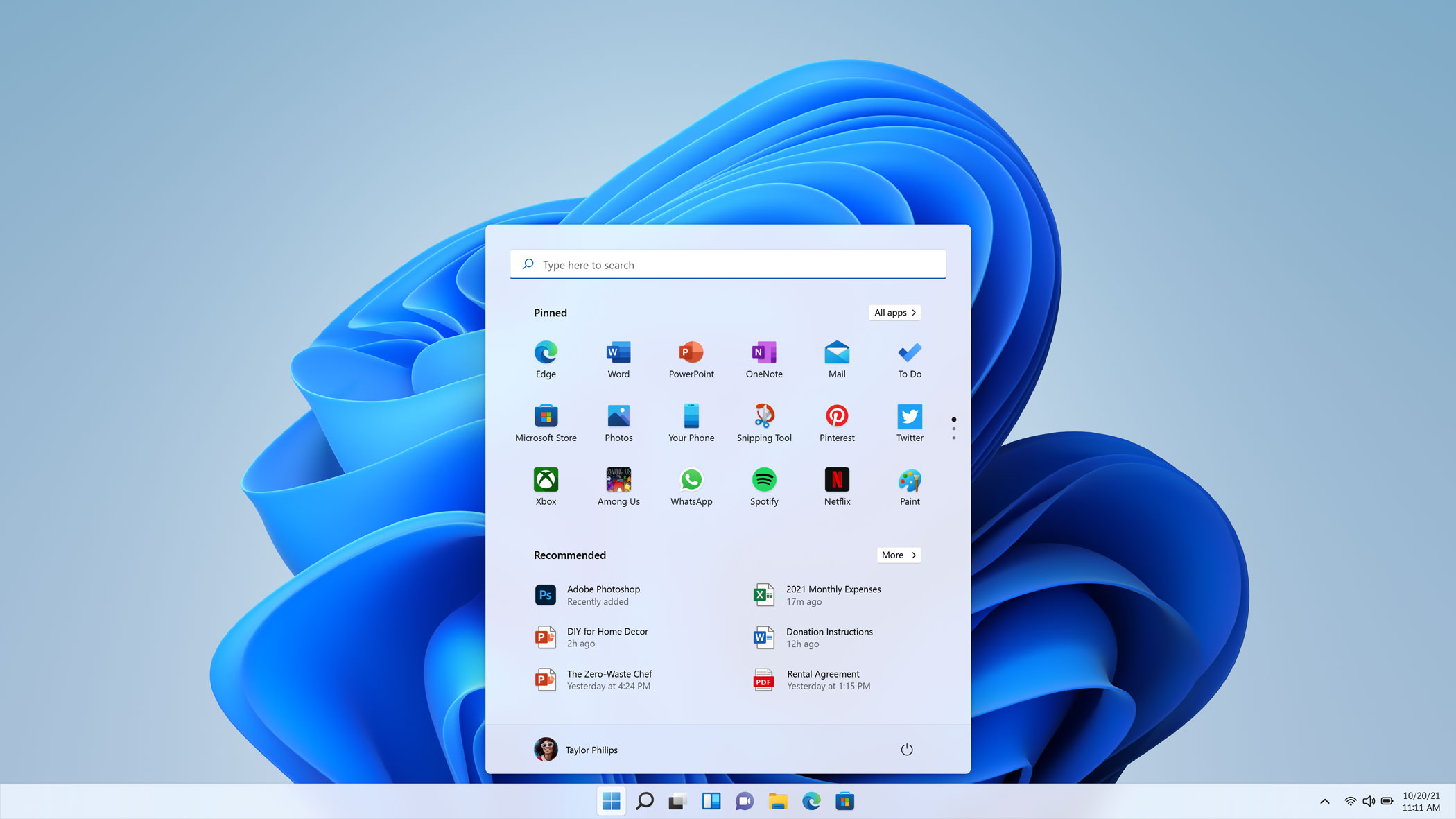 The new Start menu. Image Source: Microsoft
However, live tiles aren’t completely gone. Windows 11 introduces Windows Widgets, which is a separate place for AI-powered widgets. It looks like familiar to the one on iOS right now, and frankly, this is where Windows 10’s News & Interests widgets now reside. Still, it is a welcome addition to Windows, considering that Windows 7 also has an almost-similar functionality in the form of Sidebars.
 Windows Widgets. Image Source: Microsoft
Microsoft Teams are also getting a much tighter integration on Windows 11. Users can now access the Chat from Microsoft Teams right from the taskbar. In a way, it replaces the People section on the taskbar which is gone from Windows 11.
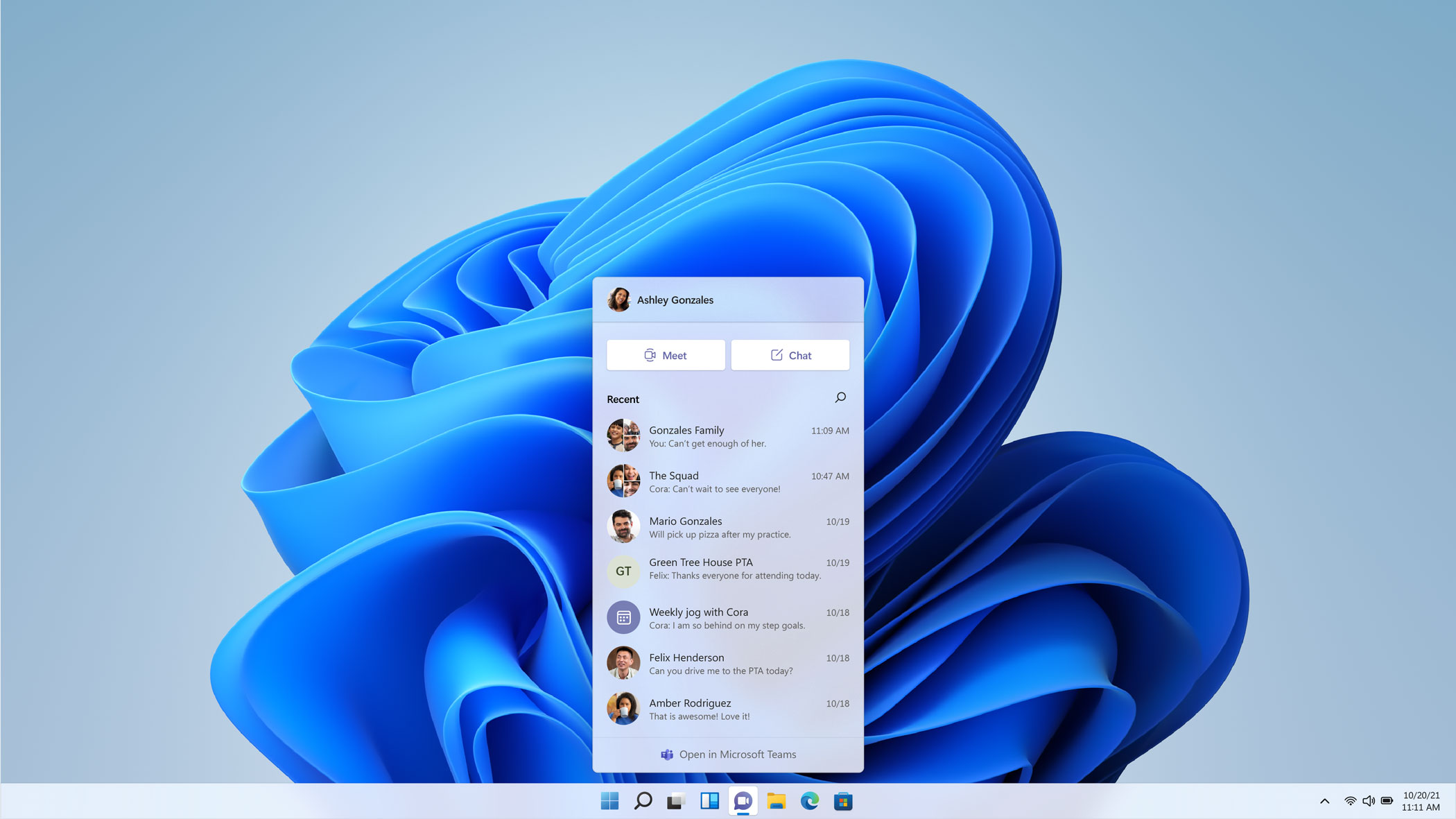 Tighter Microsoft Teams integration. Image Source: Microsoft
Improved window snapping experience and desktops
Microsoft states that Windows 11 “cuts through complexity and brings simplicity.” One way they did that with the new Windows is by bringing an improved window snapping experience.
With the improved snapping experience, users can take advantage of bigger screens and snap up to three windows. A new fly-out appears when snapping with different layouts for the windows. Snapped windows show as groups in the taskbar too, so users can easily switch on a whim.
 Improved snapping experience. Image Source: Microsoft
Desktops — a feature introduced by Windows 10 — is also getting some nifty improvements. Windows 11 will now remember the desktops for each screen. For example, users can use a desktop for work and project it to their second monitor. Upon reconnecting to that second monitor, Windows 11 will automatically surface that desktop for work.
Focus on gaming, Microsoft Store gets an overhaul
Windows 11 will also bring improvements to gaming. Microsoft name three big additions to improve the gaming experience: Direct X 12 Ultimate, DirectStorage, and Auto HDR. It is worth noting though, that Auto HDR is not totally new since Windows 10 users are also getting that feature.
Meanwhile, Microsoft Store is getting a major overhaul for Windows 11. This is welcome news for many Windows users, as Microsoft Store has been traditionally ridden with problems. Big changes include major UI overhaul, as well as changes to the commerce model. Microsoft will now allow app developers to publish their own apps and keep all the revenues to themselves.
 The new Microsoft Store. Image Source: Microsoft
Android apps are coming along with new app designs
Microsoft also teased major UI redesigns for some of its in-built apps during a separate session for developers. That includes redesigned Settings, File Explorer, refreshed Microsoft Paint and Notepad, and more. The session also teased a new Microsoft Office design. All in all, these designs feature the Fluent Design that Microsoft has been pushing across all its apps and services for the past few years.
 A redesigned Settings app. Image Source: Microsoft
Finally, one of the biggest highlights of the Windows 11 is the capability to run Android apps. Microsoft partnered with Amazon to bring a selection of Android apps to the Microsoft Store. Sure, there are limitations on what Android apps can run in Windows 11. However, this is still a big addition to Windows, since users may now run supported Android apps natively without resorting to any third-party solutions.
By the way, the capability to run Android apps is all thanks to Intel Bridge, a new technology resulting from collaboration between Microsoft and Intel.
 Android apps on the Microsoft Store. Image Source: Microsoft
Availability
Microsoft didn’t announce any concrete dates for the launch of Windows 11. Rather, the company announced a general availability during the later part of 2021. The new Windows will be offered as a free update for eligible Windows 10 PCs. Users may check if their PCs are eligible through this website.



Computers
CIPTA debuts AI GPU server, edge workstation at CloudFest 2026
Malaysia-made AI infrastructure

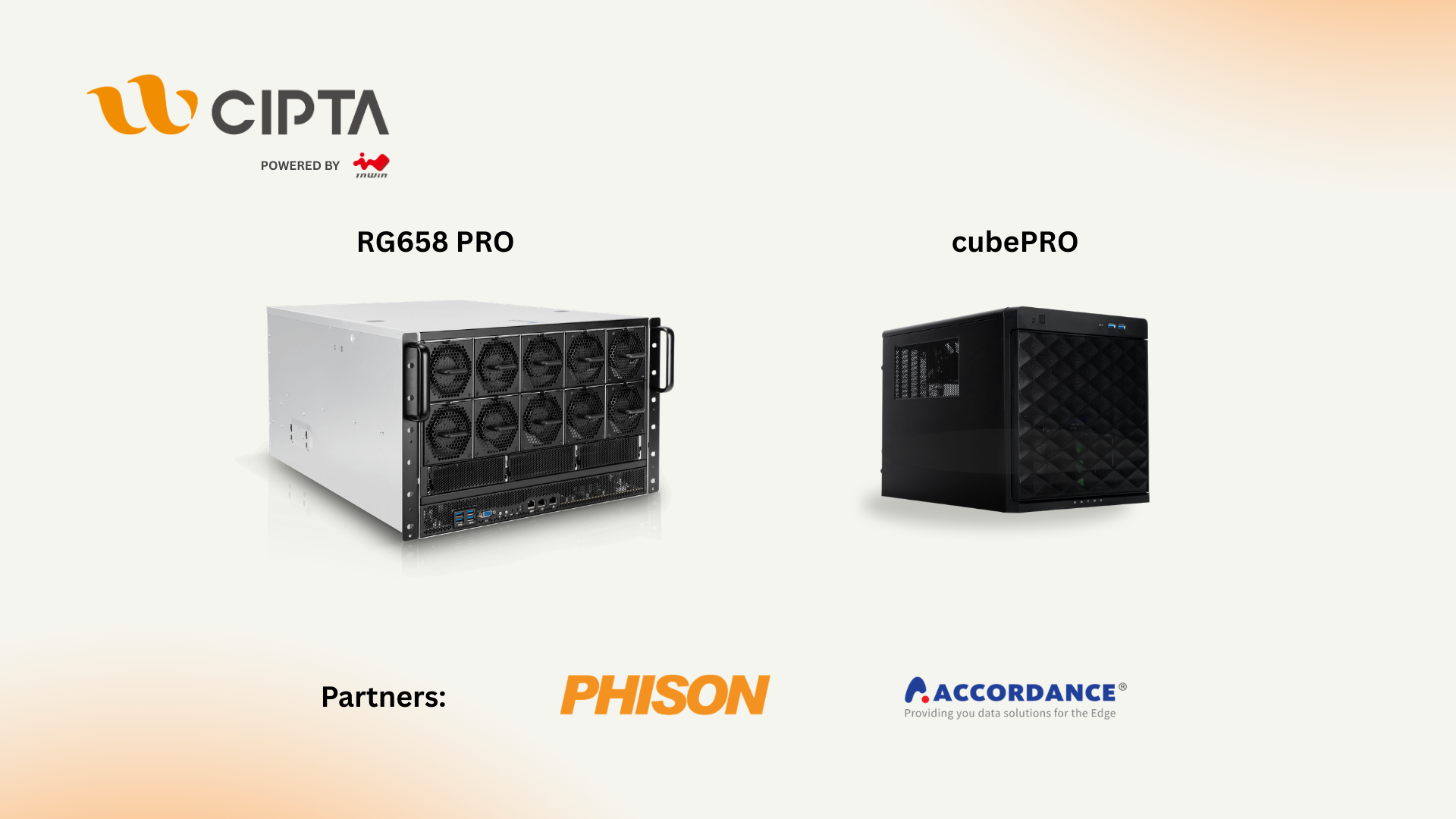
CIPTA Industrial Sdn Bhd steps onto the global stage with its European debut at CloudFest 2026. They introduced high-density AI infrastructure and edge-ready systems built for modern enterprise workloads.
Held at Europa-Park in Rust, Germany from March 23 to 26, the event marks the company’s first major international showcase under its own brand. Backed by InWin Development Inc., CIPTA positions itself as a new-generation EMS provider focused on AI, cloud, and enterprise systems.
At Booth R41, the company is highlighting two key platforms: the RG658 PRO GPU server developed with Phison, and the cubePRO edge workstation created in collaboration with Accordance.
Built for scalable AI workloads
Leading the showcase is the RG658 PRO, a high-density GPU server designed to handle large-scale AI training and inference without pushing costs out of reach for enterprises.
The system supports up to eight high-performance GPUs and integrates Phison’s Pascari aiDAPTIV alongside its PASCARI enterprise SSD lineup. This combination aims to improve data throughput, reduce latency, and streamline AI pipelines.
Thermal performance is a key focus. The RG658 PRO uses a dual-chamber design to separate heat zones, paired with up to 14 high-speed PWM fans for sustained cooling under heavy workloads. Power delivery is handled by a 3+1 redundant configuration of 80PLUS Titanium PSUs, scaling up to 9600W.
The result is a platform built to scale AI deployments on-site while maintaining efficiency and reliability.
Edge computing without downtime
Alongside its GPU server, CIPTA is introducing the cubePRO, a compact edge workstation designed for environments where uptime and data integrity are critical.
The system supports up to four PCIe slots for GPU configurations, making it suitable for AI workloads at the edge. It also features high-capacity multi-SSD setups and optimized airflow for continuous 24/7 operation.
Through its partnership with Accordance, the cubePRO integrates the Disk Array ARAID M500 solution, enabling high-availability storage and data protection. This ensures uninterrupted performance for use cases such as industrial systems, remote nodes, and enterprise branch deployments.
The focus here is clear: bring AI processing closer to where data is generated, without sacrificing reliability.
Strengthening Malaysia’s role in AI infrastructure
CIPTA’s debut also reflects a broader shift in global supply chains. Operating from Malaysia, the company offers end-to-end services—from concept to production—along with flexible manufacturing cycles and cost-efficient operations tailored for Southeast Asia and international markets.
With access to InWin’s server chassis ecosystem and infrastructure solutions, CIPTA combines global platform capabilities with localized integration. The goal is to help enterprises deploy AI and cloud infrastructure faster while diversifying their supply chain footprint.
As demand for AI systems continues to grow, CIPTA is positioning Malaysia as a key hub for scalable, production-ready infrastructure.
Visitors can find CIPTA at Booth R41 during CloudFest 2026 in Europa-Park, Rust, Germany.
Computers
AMD expands Ryzen AI Embedded P100 series lineup
Scalable, efficient AI compute for industrial, edge solutions
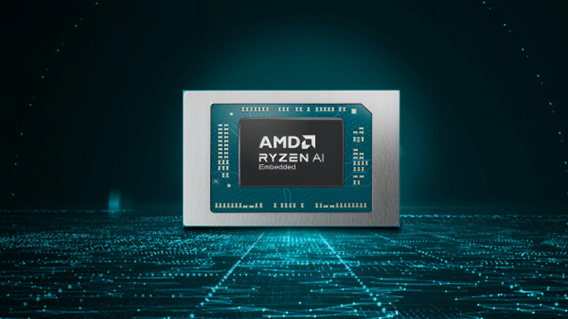
AMD has recently announced the expansion of its AMD Ryzen AI Embedded P100 Series processor lineup.
This enables scalable and power-efficient AI compute tailor-built for industrial and AI edge systems. Scenarios include factory automation, physical AI in mobile robotics, and other AI-driven edge applications.
With eight to 12 high-performance Zen 5 cores, AMD ROCm support, and up to 80 total system TOPS, the new x86 embedded APUs deliver up to:
- 2x more CPU core counts
- 8x higher GPU compute
- 36% higher system TOPS
This way, developers and system designers get an expanded and scalable portfolio of power-efficient edge computing solutions. These processors support real-time AI from vision to control and reasoning, as well as offer advanced graphics capabilities.
On a single chip, clients get up to 80 TOPS physical AI acceleration, AMD RDNA 3.5 graphics for real-time visualization, and an NPU based on the AMD XDNA 2 architecture.
Moreover, the processors can withstand industrial temperature ranges (-40° C to 105° C) and can support continuous 24/7 operations for up to 10-year life cycles. That’s along with low-latency and power-efficient AI inference.
Real-life applications include intelligent factories, autonomous robots, and medical imaging devices. For instance, the processors can deliver CPU performance required for real-time inspection and process optimization.
For mobile robots, meanwhile, processors can manage navigation, motion, control, and route planning while the GPU processes multi-camera feeds for spatial awareness.
Furthermore, for 3D health imaging, the processors can enable the powering of 3D imaging for ultrasounds, endoscopes, tissue classification, and tumor detection at the edge. This is done with models like U-Net, nnU-Net, and MONAI.
The processors then accelerate image-to-report workflows with MedSigLIP and support clinical reasoning and Q&A with Med-PaLM 2.

GIGABYTE and Capcom have collaborated for a limited time Resident Evil Requiem-inspired custom PC giveaway.
The setup is inspired by the title, which recently released, and includes an exclusive monitor game bundle to bring players closer to the experience.
Headlining the collaboration is the Umbrella Corporation — Level 3 Access custom rig giveaway. It is one of a kind, fully-built desktop featuring a Z890M AORUS ELITE WIFI7 ICE motherboard and RTX 5080 AERO OC SFF graphics.
Of course, it draws inspiration from the visual identity and atmosphere of Resident Evil Requiem. It also features a GIGABYTE C102 GLASS ICE chassis design and custom GIGABYTE MO27Q28G gaming monitor to complete the setup.

The giveaway runs from March 2 to March 31 via the official campaign website. Fans can enter for a chance to win the custom rig, with no purchase necessary. The only caveat is that they have to be a United States or Canada resident.
Such experience is designed to invite players and PC enthusiasts alike to engage with the collaboration while highlighting GIGABYTE’s premium hardware craftmanship and attention to detail.
In addition to the giveaway, GIGABYTE is also offering a Resident Evil Requiem game bundle with select gaming monitors. Included are AORUS brand monitors, ranging from 27 to 55 inches in size.
This bundle is available until March 31. Customers who purchase eligible models can redeem a digital game code through GIGABYTE’s official redemption platform.
The featured monitor is the MO27Q28G, which has fourth generation WOLED panel with 280Hz refresh rate and 0.03ms response time. It is an ideal monitor to experience the spine-chilling terror and death-defying action of the title.


Galaxy Buds4 Pro review: I thought I was done with in-ears
This Buds4 you


WWE 2K26 lets you live out all the fantasy matches you could want
But you have to play for hours and hours to unlock everyone.


The HONOR X8d is serviceable
Steady but slow?

Samsung Galaxy A57, A37 bring Galaxy AI closer to more users

ASUS launches Zenbook DUO and S14 in the Philippines

Logitech G debuts PRO X2 SUPERSTRIKE with faster click tech

More iPhone switchers this year than Android switchers, report says

Marvel’s Wonder Man greenlit for a rare second season


-

 Reviews1 week ago
POCO X8 Pro Max review: A new beast from the far east
-

 News1 week ago
POCO X8 Pro Series: Price, availability in the Philippines
-

 Laptops2 weeks ago
Apple MacBook Neo Review
-

 Features2 weeks ago
Galaxy AI on the Samsung Galaxy S26 Ultra
-

 Apps2 weeks ago
Google Maps is finally getting a 3D mode
-

 Entertainment2 weeks ago
The internet is thirsting over the One Piece Season 2 cast
-

 Reviews1 week ago
POCO X8 Pro Iron Man Edition review: Midrange phone in superhero armor
-

 Reviews1 week ago
Samsung Galaxy S26 Ultra review: A phone you live with