

Enterprise
This Indian telco has raised more than $20 billion during the pandemic
Includes investors like Google, Facebook, and Qualcomm

The Coronavirus pandemic has forced countries to implement strict lockdowns and curb international travel. Economies have fallen drastically due to lower spendings and rising unemployment. Healthcare has become a priority. Meanwhile, defense, as well as infrastructure costs, have been sidelined.
Work-from-home has become the norm and companies are actively trying to reduce operational costs. Investors have burned a lot of money since startups dependent on the gig economy are the worst hit. Raising funds right now is a herculean task and most start-ups are expected to go out of business in the coming months.
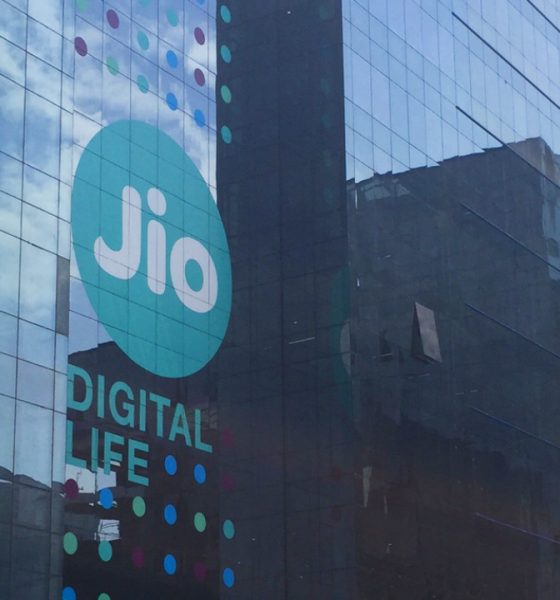
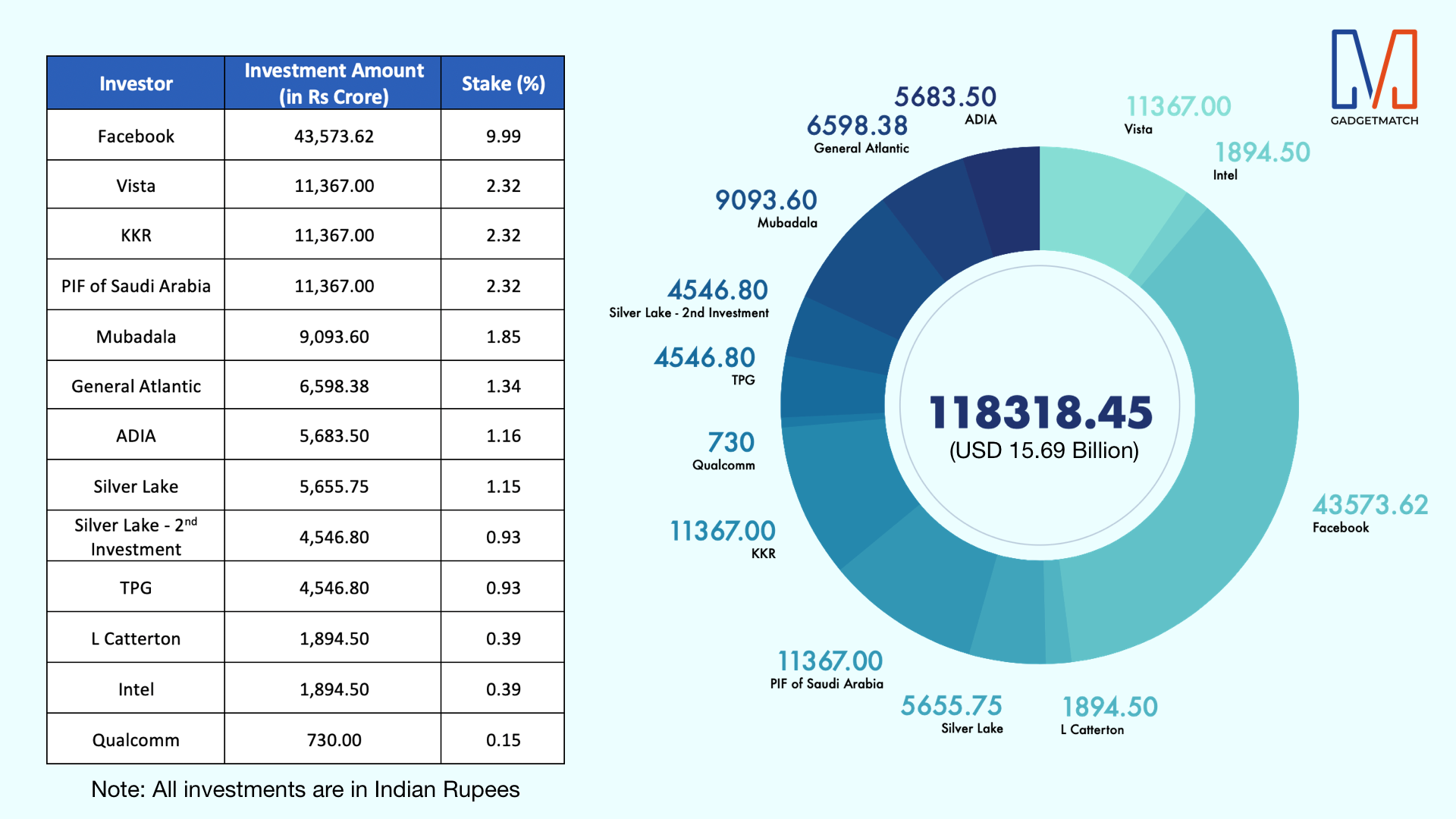
However, one company has taken full advantage of the pandemic-led lockdown. Officially called Jio Platforms, it’s an Indian telecom operator with more than 300 million active users. Dubbed Jio casually, it’s more than just a telecom operator and has managed to raise more than US$ 20 billion within a span of three months. Investors include marquee names like Google, Facebook, Qualcomm, Mubadala (sovereign fund of Abu Dhabi), Vista Equity, and more.
Google has also acquired a stake in Jio for US$ 4.5 billion. It has picked up 7.75 percent in the company, taking the total sale to 32.95 percent. The Google stake sale came to light immediately when the copy was ready for publishing and hence couldn’t be updated.
By Sanuj Bhatia
To be precise, Jio has raised US$ 20 billion from 13 companies by just selling a 25.2 percent stake. Considering the current investments, Jio is roughly valued at more than US$ 60 billion. What’s so special about this company that Facebook decided to splurge US$ 5.7 billion for just 9.99 percent?
India — the most promising market for any internet company
The US has always led the tech race in terms of research and innovation. With a developed economy, the market is self-fulfilling and companies are actively looking for new regions to expand to. The American influence is easily visible in western allies like the European Union, Japan, South Korea, as well as the Philippines.
India, on the other hand, is a developing economy that completely skipped the computer or laptop age and jumped onto the smartphone era. Today, it’s the world’s second-largest smartphone market, and 70 percent of the hardware is dominated by the Chinese. However, most phones run on Google’s Android, and American tech companies have been successful in expanding. This includes Facebook, Amazon, Netflix, Google, and more.
However, the telecom market remains hugely untapped. What will a smartphone do without wireless connectivity?
The rise of Jio and its ripple effects
At the beginning of 2016, 1GB of 3G data cost approximately INR 250 (US$ 3.3). Back then, Jio was completely owned and operated by Reliance Industries. Reliance is an Indian conglomerate that has its foothold in a plethora of segments including oil, retail, entertainment, and more. It’s one of India’s largest companies in terms of market cap and run by billionaire Mukesh Ambani. Just a few days ago, he became the seventh richest person on Earth, overtaking long-time contender Warren Buffet.
In a nutshell, Reliance pumped enough money into Jio and launched it in the middle of 2016. It was India’s first telco to offer pan-India 4G and the tariff was impossible to believe. For the first 6-9 months, unlimited 4G data was offered for free to lure customers from other networks like Airtel, Vodafone, and Idea. Considering Reliance’s backing, the company could afford to.

It also had an inherent advantage over telco’s because it directly rolled out 4G and did not support any previous standards. While other’s were figuring out inter-connection issues between 3G and 4G, Jio had already rolled out VoLTE. Jio only considered data as bandwidth and relied on internet protocol for calls, reducing its operational cost.
Within a year, 1GB of 4G data cost just US$ 0.2. India has the most affordable 4G in the world. Naturally, the competition couldn’t offer these rates without taking a hit on their profit as well as revenues. But, they had no option but to reduce tariffs. Slowly, companies like Aircel went out of business due to unsustainable rates. Vodafone merged with Indian player Idea to form Vodafone-Idea. By the end of 2019, the Indian market had only 3 players left — Jio, Airtel, and Vodafone-Idea.
Keep in mind, Jio has no debt due to its rich parent, Airtel has debt but can offload that with assets and equity, while Vodafone-Idea is on a ventilator. With more than 300 million subscribers, Jio is leading in terms of both, userbase as well as financial health.
Jio’s unique selling point — data
Reliance was planning to enter the telecom industry for a very long time and it saw it’s an opportunity with 4G. While other telcos were busy billing users for calls and SMS, Jio wanted to sell just one thing — more data. And, it came up with its own suite of services that ensured the user consumes more and more data.
India’s data consumption is expected to exceed 11GB by 2022. Although, the tariff has barely increased by 20-25 percent in the last few years. Some estimates are even more optimistic and indicate a 40 percent annual rise.
There’s no doubt that streaming services have changed the whole scenario. But, this is where Jio has an unbeatable offering. Since day one, the company has a suite of apps like Jio News, JioTV, JioCinema, JioSaavn, and even JioMeet. Today, there are 29 apps on the Google Play Store. This ecosystem ensures the user doesn’t have to look elsewhere. And, they are yet to be fully monetized. As a Jio subscriber, they’re pretty much free-to-use at the moment.
Data is the new oil
The suite of apps is mostly made for the end consumer. But, the company has grand plans for the future as well. It has already announced a partnership with WhatsApp to launch JioMart. It’ll onboard physical stores and function as a hyperlocal online shopping experience. A segment that hasn’t really taken-off yet despite investments from Amazon, BigBasket, and Grofers.
Coming to the enterprise side, Jio has acquired a plethora of startups and established companies for their know-how. This includes American telecom-technology company Radisys, Asteria Aerospace, Embibe, Haptik, and Netradyne. The company is poised to lead the 5G race due to its healthy financials and technology innovation. The company has announced it’ll carry out 5G trials based on its own technology and won’t be relying on third-party partners like Huawei.
The company is all set for the 5G future and has equivalent investments in IoT, blockchain, and digital payments. Jio may have started out as a telco, but it’s truly turning out to be a technology company.
The most lucrative technology company
All these factors make Jio a very attractive investment. Facebook tried to enter India with Freebasics and Internet.org but failed miserably. A piece of Jio gives it a chance to explore deeper than ever. For investment companies, the pandemic is a reality check. And, Jio just turned out to be a silver lining. With more and more people working from home, wireless data consumption is bound to rise.
Even companies are realizing work-from-home is a better model in many parts of the business since you can skip expensive property investments. Even if the work-from-home model fizzles out in the coming years, personal consumption will remain largely unaffected. And with India’s developing economy, smartphone penetration is expected to steadily increase. This shall also bring in more data consumption, online shopping, and other related tasks. With Jio covering all the bases, it is perfectly positioned to lead the Indian market.
Lastly, it’s essential to understand why Reliance decided to sell slightly more than 30 percent in Jio. The parent company has a debt to pay-off and its Chairman, Mukesh Ambani, had announced it’ll go debt-free by the end of FY2020. Its most valued business of refining oil has taken a hit due to the pandemic-led crude crash.
It won’t be wise to sell an undervalued asset. At the same time, Jio reached its peak. By giving away a minority stake to a range of partners, Reliance not only raised money but also established global trust and recognition of Jio Platforms.
For the global markets, the indication is clear. India is open for business and there’s huge potential.







Enterprise
ACMobility Launches ChargeFleet: Seamless solution for businesses
B2B solution for corporate fleets and transport groups


Ayala Group’s ACMobility has launched ChargeFleet, a new B2B digital solution for corporate fleets and transport groups.
The new service introduces a shareable digital wallet that streamlines charging expenses, reduces manual tracking, and improves cost control.
As more organizations explore electrifying their mobility operations, many continue to face operational challenges — including fragmented payment systems, reimbursement delays, and limited visibility over charging usage.
ChargeFleet addresses these gaps by introducing a centralized, shareable digital wallet. Here, fleet managers can allocate and monitor charging credits across multiple drivers across a single platform.
The system is a seamless process designed for long-term usage and easy deployment across any organization.
Once integrated, ACMobility assigns charging credits to the client’s fleet manager. The manager then can distribute these to multiple drivers. Meanwhile, the latter will be able to see and use their assigned credits via the Evro app.
ChargeFleet is available as a prepaid product through the ChargeFleet Store. Users can buy offers via GCash or credit card. No application process is required.
Looking ahead, ACMobility will continue to enhance the ChargeFleet experience with exclusive value-added perks integrated through Evro and Power on Wheels.
The upcoming features highlight ACMobility’s ongoing push to provide a future-proof support system for the evolving needs of their customers’ businesses.
Enterprise
Sony teams up with 13 companies for sustainable global supply chain
Sustainability through introduction of renewable plastics

Sony, along with several companies, have established the world’s first global supply chain for the production of renewable plastics that can be used in Sony’s high-performance audiovisual products.
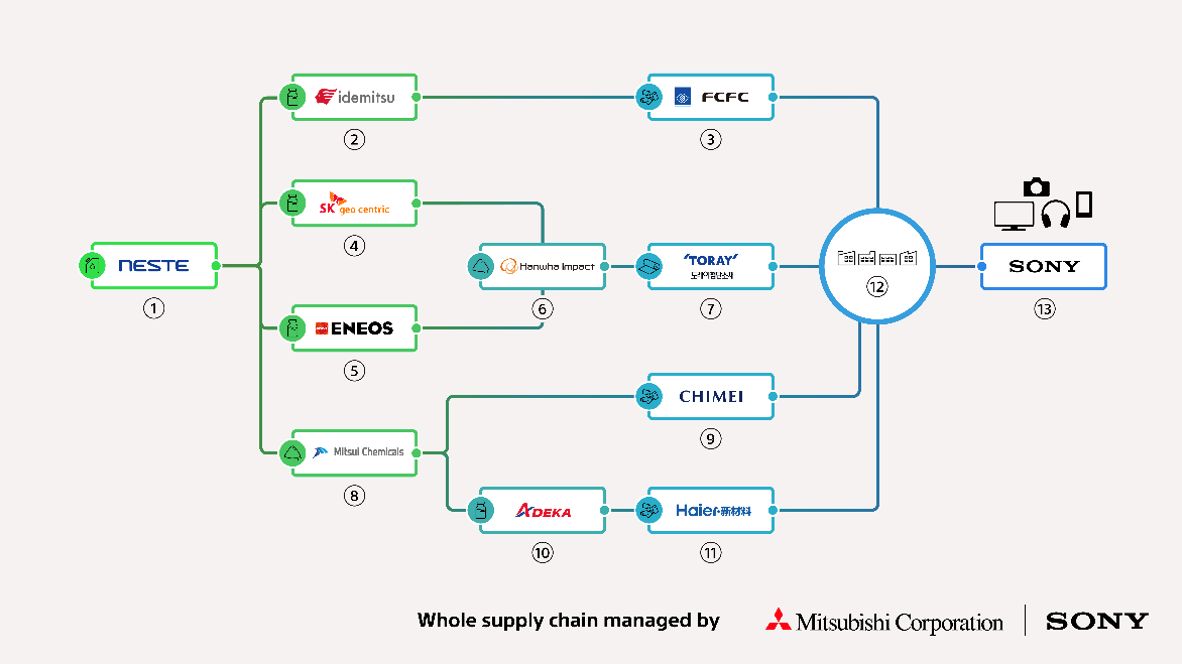
The supply chain consists of 14 companies across five countries and regions. The various plastic materials manufacture through this supply are slated for use in Sony’s products that will launch worldwide.
High-performance products such as audiovisual equipment involve a wide variety of plastics. The result is a complex supply chain that makes it difficult to visualize and manage the entire flow.
Additionally, plastic components that require high performance in terms of flame resistance and optical properties cannot be fully replaced with plastics from material recycling.
To address these challenges, these 14 companies have collaborated to visualize the existing supply chain for Sony’s products:
- Sony Corporation
- Mitsubishi Corporation
- ADEKA CORPORATION
- CHIMEI Corporation
- ENEOS Corporation
- Formosa Chemicals & Fibre Corporation
- Hanwha Impact Corporation
- Idemitsu Kosan Co., Ltd.
- Mitsui Chemicals, Inc.
- Neste Corporation
- Qingdao Haier New Material Development Co.
- Ltd., SK Geo Centric Co., Ltd.
- Toray Industries, Inc.
- Toray Advanced Materials Korea Inc.
Sustainability through renewable plastics
The new supply chain created will enable the production of multiple types of renewable plastics from biomass resources with a mass balance approach.
This allows Sony to proactively source raw materials for its products with quality, as well as properties equivalent to virgin fossil-based plastics.
Defining the supply chain also helps the companies track and document GHG (Greenhouse Gas) emissions data in a verifiable way.
This allows participating companies to leverage the data to advance efforts to reduce their carbon footprint going forward.
Sony’s initiative with a wide range of global partners is part of the “Creating NEW from reNEWable materials” jointly launched by the electronics giant and Mitsubishi.
It aims to achieve zero usage of virgin fossil-based plastics through the introduction of renewable plastics.
Enterprise
realme is reportedly going back to being an OPPO sub-brand
All scheduled phones will still launch on time, though.

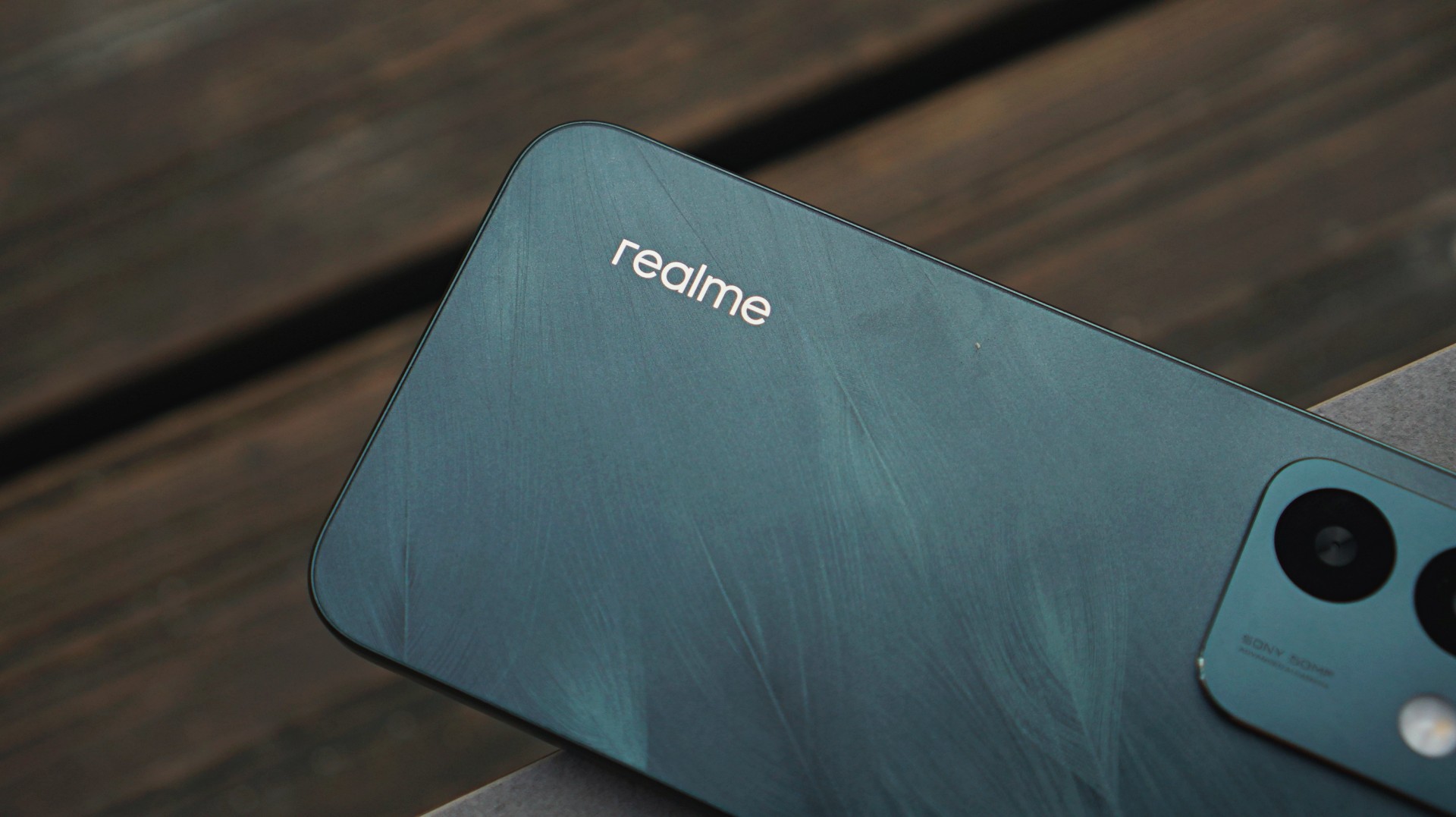
A popular story among Chinese smartphone brands is whenever a sub-brand spinning off into its own independent entity. A less common one is when an independent entity suddenly merges back into the main entity. And yet, that’s the story we have today. realme is reportedly going back to being a sub-brand of OPPO.
If you don’t remember realme’s time as a sub-brand, then it’s hardly your fault. It’s been a long while since realme was considered a sub-brand. In 2018, the brand spun off on its own to form one of the most popular names in the Chinese smartphone space.
Today, via Leiphone, realme will return to OPPO as a sub-brand. Current realme CEO Sky Li will still retain his responsibilities heading the brand. Plus, all products on the current release schedule will still come out as planned.
However, starting this year, realme will start reintegrating back into OPPO, particularly through the latter’s after-sales programs. OnePlus will also follow the same structure going forward.
Currently, realme has not officially announced the move. That said, we also don’t know how the brand will address the reported change. It’s possible that the shift is just internal and has no effect on how the brand faces the public. For now, only time will tell.
SEE ALSO: realme C85 with 7000mAh battery, 5G connectivity officially launches


iPhone 17 Pro Max is somehow the most traded-in phone today

vivo V70 launched globally, introduces 4K 60fps, OriginOS 6, more

Osmo Pocket 4 makes a surprising appearance in public

Google launches the Pixel 10a

ACMobility Launches ChargeFleet: Seamless solution for businesses

HONOR X9d 5G review: Tougher, more long-lasting and optimized

Now playing: Final Fantasy VII Remake INTERGRADE on Switch 2

Breaking up with Adobe Photoshop after 20 years

Razer fully unwraps these limited BLACKPINK Edition gaming gear

Forza Horizon 6 launches on May 19


-
 News1 week ago
TECNO will showcase the CAMON 50 and POVA 8 series at MWC 2026
-

 Laptops2 weeks ago
TECNO MEGABOOK K16s 13th review: No-frills beneath those grills
-

 Features1 week ago
HUAWEI MatePad 11.5 S 2026: The better-than-ever 4-in-1 productivity tablet
-

 Gaming1 week ago
Now Playing: Yakuza Kiwami 3 & Dark Ties
-

 Gaming2 weeks ago
Valve is delaying the launch of the Steam Machine
-

 Reviews6 days ago
The art of being in and behind the frame
-

 Gaming2 weeks ago
Horizon Hunters Gathering is an upcoming co-op roguelite spinoff
-
 Gaming2 weeks ago
No new NVIDIA GPUs this year, report says