
Apps
Grab launches Advance Booking feature for airport trips
Available for Manila airport trips for now

Grab Philippines has launched Advanced Booking, a new feature under its ride-hailing services that will allow clients to book trips to and from airports as early as one week ahead.
Currently in its beta phase, Grab Advance Booking guarantees on-time rides to the airport via the GrabAirport fleet. The flexible reservation window also allows customers to make changes to be made as late as two hours prior.
For now, the new service is currently exclusive to trips going to Metro Manila airports via its GrabAirport fleet. This was launched last year in conjunction with the MIAA. Its availability in cities and regions outside of the National Capital Region is expected to transpire in the second half of 2024.
Worry-free bookings
In case drivers ditching their bookings worry you, Grab Advance Booking has its safeguards in place. Drivers are guaranteed to be on time. Should there be a disruption, Grab will swiftly reassign passengers to an alternative ride to ensure successful trip completion. An addition, a PhP 100 courtesy credit will be offered if the driver arrives late for a pre-scheduled ride.
Furthermore, a 15-minute wait time is implemented for the specific service. This will give customers enough room should there be minor inconveniences or if they need more time to reach the pick-up location.
On the other hand, riders also get protection should there be sudden cancellations. Passengers cancelling with less than an hour left before the pick-up time will be charged in full. The same policy takes effect when a passenger becomes unreachable beyond the 15-minute window. However, there will be no charge for any passenger cancellation done at least one hour before the scheduled pick-up time.
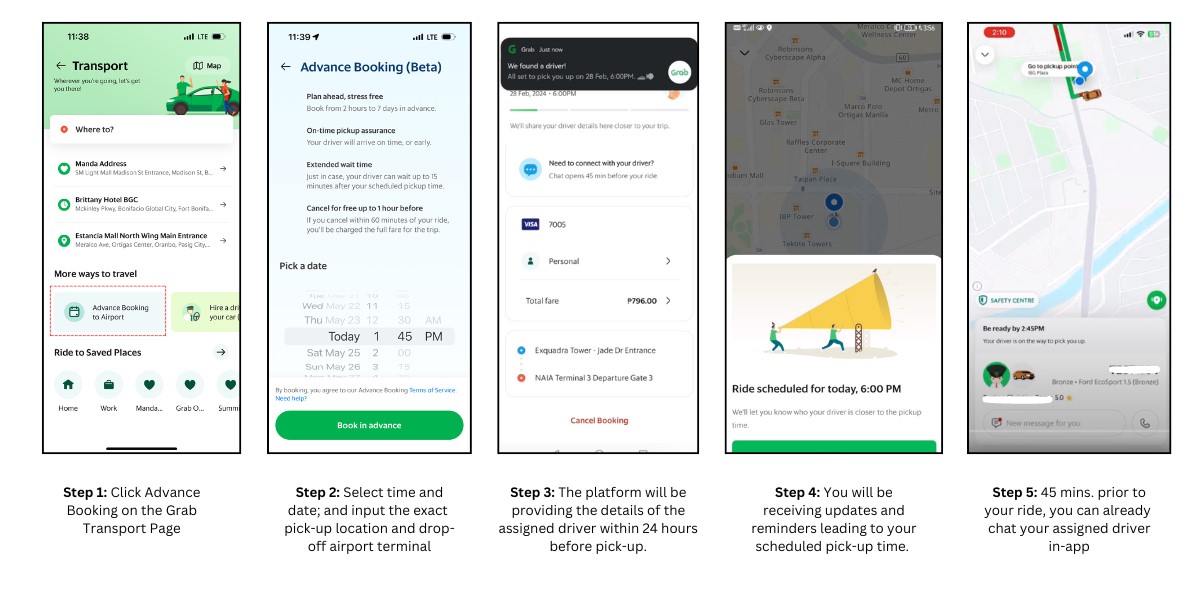
To place a booking, select “Advance Booking” under the Grab transport page. Then, enter the date and time of their ride, along with the pick-up location and the specific airport terminal.
Advance Booking passengers will also receive regular updates and reminders about their ride’s status. Finally, 45 minutes prior to the scheduled trip, passengers can already communicate with their assigned driver on the app.
As a safety and convenience precaution, rides under Advance Booking will allow only a maximum of three passengers and three pieces of luggage.






Apps
Honor, Xiaomi are working on their own Privacy Displays
Samsung’s Privacy Display is apparently very popular.


Normally, a smartphone brand’s blatant copying of another brand’s feature is not a good practice. Today, however, there is a new feature that we wish other brands would copy: Samsung’s Privacy Display. Thankfully, some brands, like Honor, have finally gotten the message and are working on version of the feature.
As reported by Digital Chat Station on Weibo, Honor is reportedly working on a privacy screen for its smartphones. Likewise, Xiaomi is working on the same thing, potentially launching the feature for the Xiaomi 18 Pro.
For the uninitiated, the Samsung Privacy Display is a built-in feature that blocks visibility of the screen at certain angles. If you’re not looking at the screen from the front, all you’ll see is a black void. It’s a built-in version of those protective screens that you can buy separately. Besides adding a nice layer of protection against scratches, it’s also meant to prevent snooping from your shoulder.
Samsung’s take was widely acclaimed for being insanely useful. When it arrives, this feature will be a godsend to more brands. Even better, users will no longer need to rely on third-party screen just to enjoy the privacy.
That said, there’s still no indication as to when these features will arrive on either Honor or Xiaomi.
SEE ALSO: LE SSERAFIM Chaewon flexes Galaxy S26 Ultra Privacy Display
Meta does not have the most stellar of reputations. Despite offering the world’s most popular social media platforms, the company, through its various experiments throughout the years, continuously proves that it has other priorities than just providing the best for its users. Today, another reported experiment wants to take Meta to a new market that its users might fall into: the prediction market.
If you haven’t heard of the prediction market, consider yourself lucky. These apps, such as Kalshi, are basically just gambling platforms without the glitz of playing cards or the rigor of the stock market. Users gamble on mundane circumstances like the weather and more serious ones like war.
Today, as reported by The New York Times, Mark Zuckerberg is reportedly asking Meta to develop a prediction app of its own. Interestingly, the experimental app, supposedly called Arena, will use virtual points, rather than real money. However, Meta has not ruled out real money — and hence, real gambling — in the future.
Meta is entering the industry at an extremely volatile time. The world is starting to crack down on prediction markets. Some users, for example, have been accused of using insider information to get easy wins on these platforms. Some markets have also accused these platforms of subverting anti-gambling laws.
SEE ALSO: Meta adds subscriptions for Facebook, Instagram, and WhatsApp
Apps
foodpanda relaunches cult-favorite roast chicken brand after 8 years of persistent search queries
Heritage chain Andok’s returns to the platform, driven entirely by long-term user analytics.


In the world of e-commerce and food delivery, platform algorithms usually dictate what consumers see. But occasionally, consumer behavior is so relentless that it shapes the platform’s strategy.
In a move driven entirely by long-term user analytics, foodpanda has officially relaunched Andok’s, one of the Philippines’ most iconic heritage rotisserie chains, back onto its platform after an eight-year absence.
The search bar as a digital wishlist
The decision to ink the partnership wasn’t just a marketing play. It was a response to an ongoing data anomaly. Despite being offline from the foodpanda platform for eight years, Andok’s consistently ranked as one of the most-searched merchants on the app.
Year after year, users treated the empty search results page as an unofficial wishlist. This persistent search intent gave foodpanda a clear, data-backed signal of pent-up demand.
Prior to the official digital rollout, teaser campaigns on social media validated this demand, generating thousands of organic interactions from users anticipating the return.
Bridging heritage flavor with digital infrastructure
For foodpanda, onboarding a merchant with this level of built-in demand fits its broader strategy of marketplace optimization and hyper-local network expansion, turning a heritage brand into another data point for how legacy retail plugs into delivery infrastructure.
For Andok’s, the integration works as a fast track to digital scale. A legacy quick-service chain skips years of independent app development and reaches customers already using foodpanda’s existing logistics network, on a platform they already check daily.
Andok’s built its following on charcoal spit-roasted chicken, a slow-cooked technique that’s stayed largely unchanged since the brand’s early days, alongside seasoned grilled pork belly.
More recently, the Dokito line extended that following into crispy fried chicken and chicken burgers, broadening the brand’s appeal beyond its original rotisserie format and giving foodpanda a menu with both heritage pull and everyday fast-food convenience.

LE SSERAFIM to perform at BlizzCon 2026

Xiaomi opens largest Singapore store yet at VivoCity

Honor is reportedly working on a 14000mAh battery

Nothing Phone (4b) shows up online, spoils some specs

Polaroid says, enjoy the beach before AI ruins it

TECNO’s POVA 8 5G is both futuristic and future-ready

Close without crossing: A Xiaomi 17T Pro photo essay

realme launches P4 Series 5G, including Power with 10,001mAh battery

The Xiaomi Watch S5 proves you don’t have to take it off

Buyer’s Guide: Xiaomi Pad 8 Series


-

 Buyer's Guide1 week ago
Buyer’s Guide: TECNO SPARK 50 Pro vs SPARK 50 5G
-

 News1 week ago
TECNO’s SPARK 50 Pro is the latest budget smartphone battery beast
-

 News1 week ago
Budget smartphone realme C100 Series launches
-

 Reviews1 week ago
HONOR Watch 6 Review: Less guessing, more knowing
-

 Reviews4 days ago
vivo X300 Ultra review: A Whole Different Animal
-

 Laptops1 week ago
ROG launches 2026 Strix gaming laptop series
-

 Entertainment1 week ago
Samsung brings the Galaxy Z series into Spider-Man: Brand New Day
-

 Reviews7 days ago
The realme P4 Power: realme’s midrange power play?