
Apps
20 Things every Pokémon Trainer should know


It has only been a week since the official release of Pokémon Go – an augmented-reality smartphone game that lets you catch pokémon, or fantasy creatures of all shapes and sizes, in the real world – but its impact has been overwhelming.
While the global rollout has been slow, the game has already spawned countless memes, news reports, and crazed fans that congregate in the hundreds all in search of shiny new pokémon.
The overnight success of the game has added billions of dollars to parent company Nintendo’s market value, perfect timing, really, as the Pokémon franchise celebrates its 20th anniversary this year.
With many playing the game for the first time, we thought we’d put together a cheat sheet for everyone wanting a quick and easy guide to the wonderful world of Pokémon. 20 tidbits, one for every year of Pokésitence.
Let’s go!

1. Pokémon is short for pocket monsters or Pokétto Monsutā in Japanese. In Katakana, it is written ポケットモンスタ, which literally means, “monsters in our pocket” – because, as we all know, you catch and store pokémon in pocket-sized containers called Poké Balls.
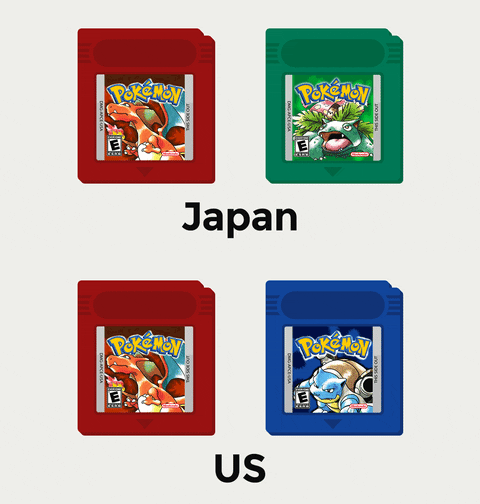
2. The first Pokémon games were Pokémon Red and Pokémon Green (Pokémon Red and Blue in the US). They came out in 1996 on the Nintendo Game Boy. Despite their colorful names, the games were initially played in black and white. Pokémon Go brings gameplay to the real world, sorta. Using your smartphone’s camera, you can track down and catch pokémon as if they were right in front of you. How crazy exciting is that?
3. Pokémon Go was released by the Pokémon Company in celebration of its 20th anniversary this year (2016). The game runs on both iPhones and Android phones. In just a week, the app has been downloaded more times than Tinder and has more daily active users than Twitter.
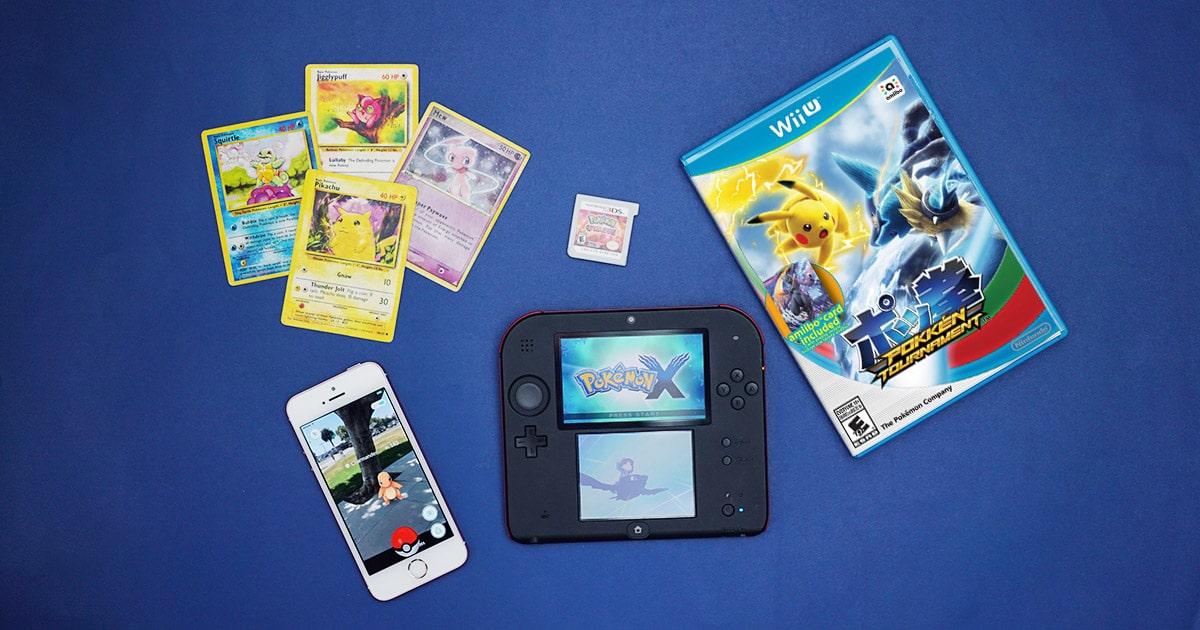
4. The Pokémon franchise includes over 70 games (including spinoffs), 19 movies, a long-running TV series, and a trading card game.
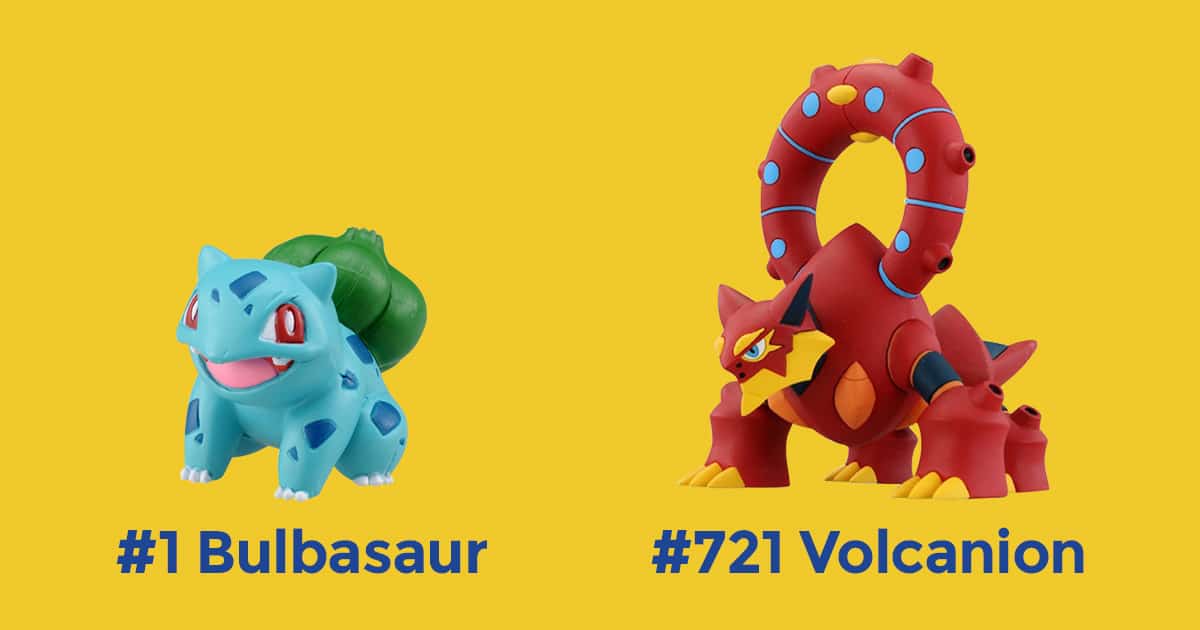
5. There were only 151 original pokémon. But hundreds more were introduced (discovered) with every new generation. There are 721 pokémon today. Bulbasaur is pokémon number 1, Volcanion is number 721. Expect a few hundred more to be added to the list when Pokémon Sun and Pokémon Moon are released this November.
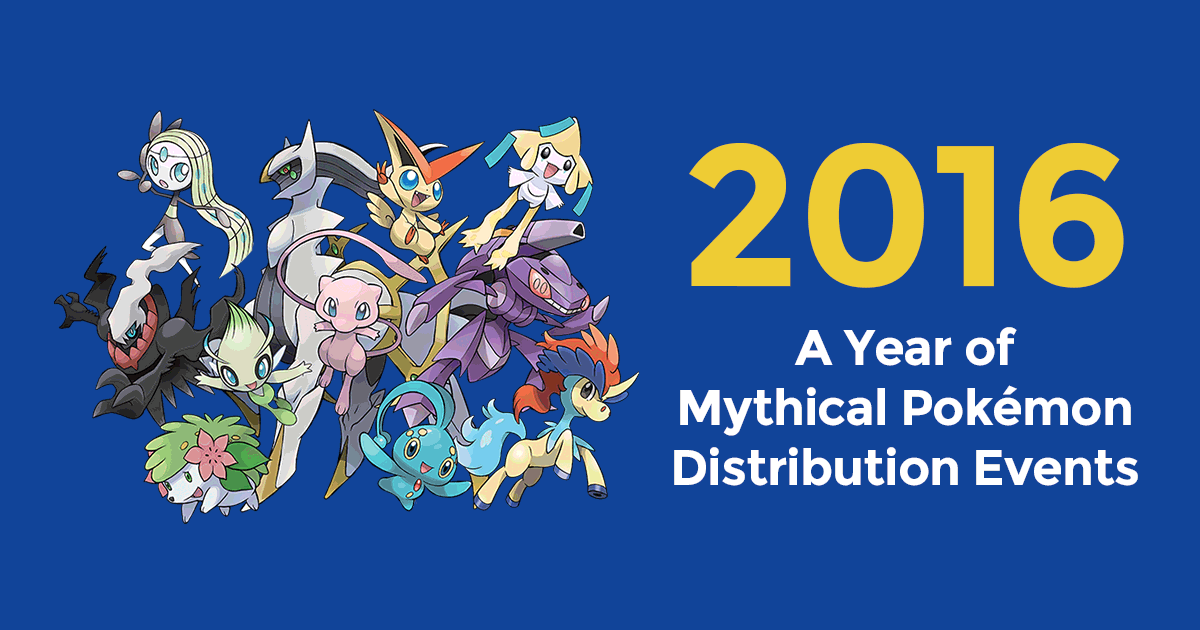
6. While the original theme song for the Pokémon TV show is “Gotta Catch ‘Em All,” you can’t catch all pokémon. There are a handful of mythical pokémon that are only available via special events; some require being at a certain place during a specific time period. In celebration of Pokémon’s 20th anniversary, mythical pokémon are distributed every month (of 2016) via the internet and in-store cards.

7. Speaking of catching them all, while the popular phrase (and song lyric) appears to describe the objective of all Pokémon games, there’s more to the games than just collecting. As the song goes, “To catch them is my real test; to train them is my cause.” The best pokémon trainers know that to defeat other trainers, it is important to know your pokémon and how best to train them.
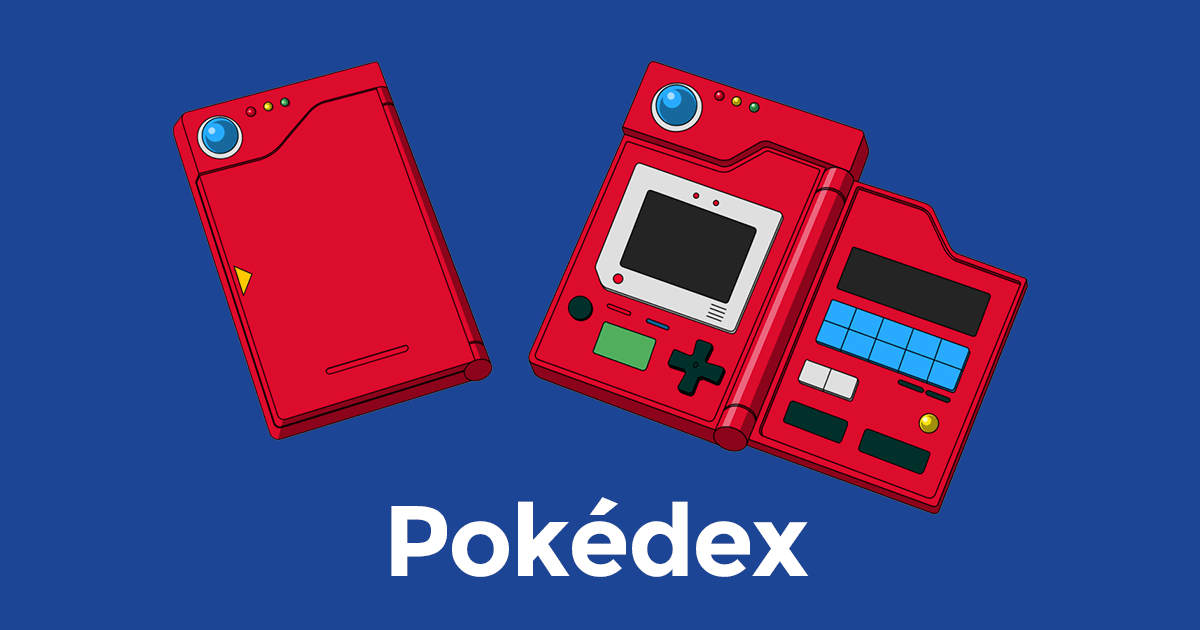
8. Now, let’s say you’ve started collecting pokémon. How do you identify and keep track of them? With the Pokédex of course. Given to players at the start of every game, the Pokédex is a digital almanac of sorts, which serves as a database of all pokémon you’ve caught. Similar to smartphones, we’ve seen an evolution of Pokédex design. The current model has a touch-screen panel and a Mission Impossible-like transparent screen for scanning pokémon.

9. Pokémon names differ in countries like Japan, Germany, and France. Jigglypuff, for example, is called Purin in Japan, which is literally a fluffy, wobbly custard pudding dessert, just like the character.

10. The most iconic of all the pokémon has to be Pikachu, the cuddly yellow creature with pointy ears. While there has been plenty of speculation as to what kind of creature Pikachu is, overwhelming evidence suggests Pikachu is actually a mouse, not a cat, as some assume.

11. Some pokémon take several forms. In the games, Pikachu evolves into the more powerful Raichu if you give it a Thunder Stone. Pikachu also has a pre-evolution form called Pichu, which evolves into Pikachu only when it has reached a certain level of friendship with its trainer.
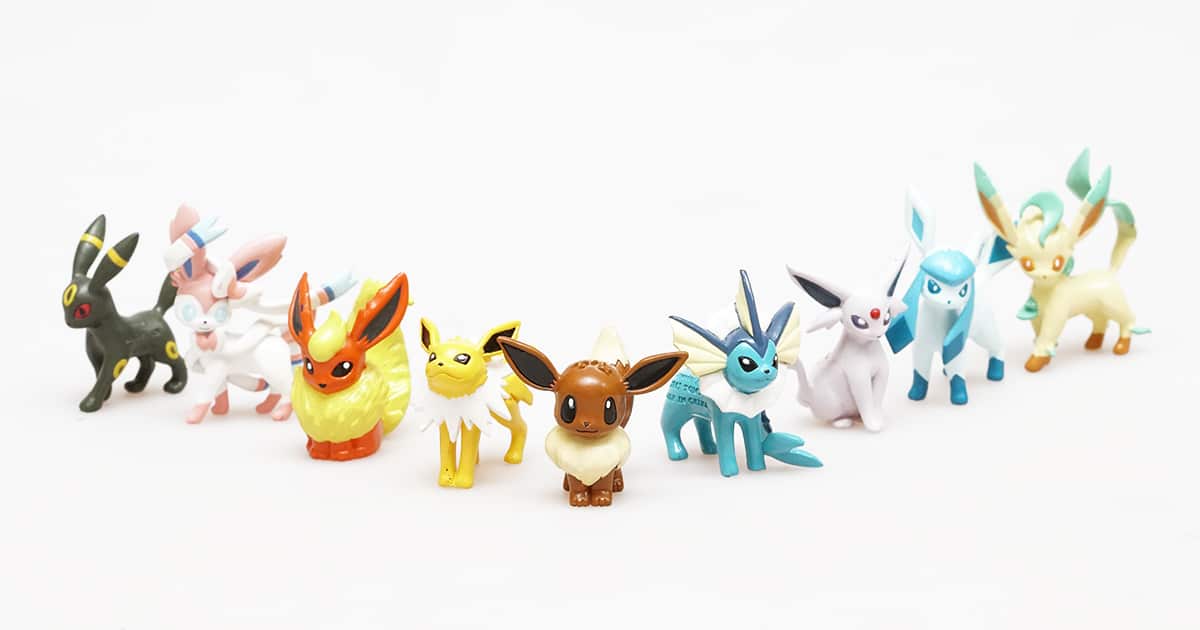
12. One pokémon in particular, Eevee, can evolve into 8 different pokémon, depending on a variety of factors: the type of evolution stone used; the time of day; its surroundings and more. Eevee can become Flareon (fire), Vaporeon (water), Jolteon (electric), Espeon (psychic), Umbreon (dark), Leafeon (grass), Glaceon (ice), or Sylveon (fairy). Will the upcoming games introduce a new Eevee type? We hope so!
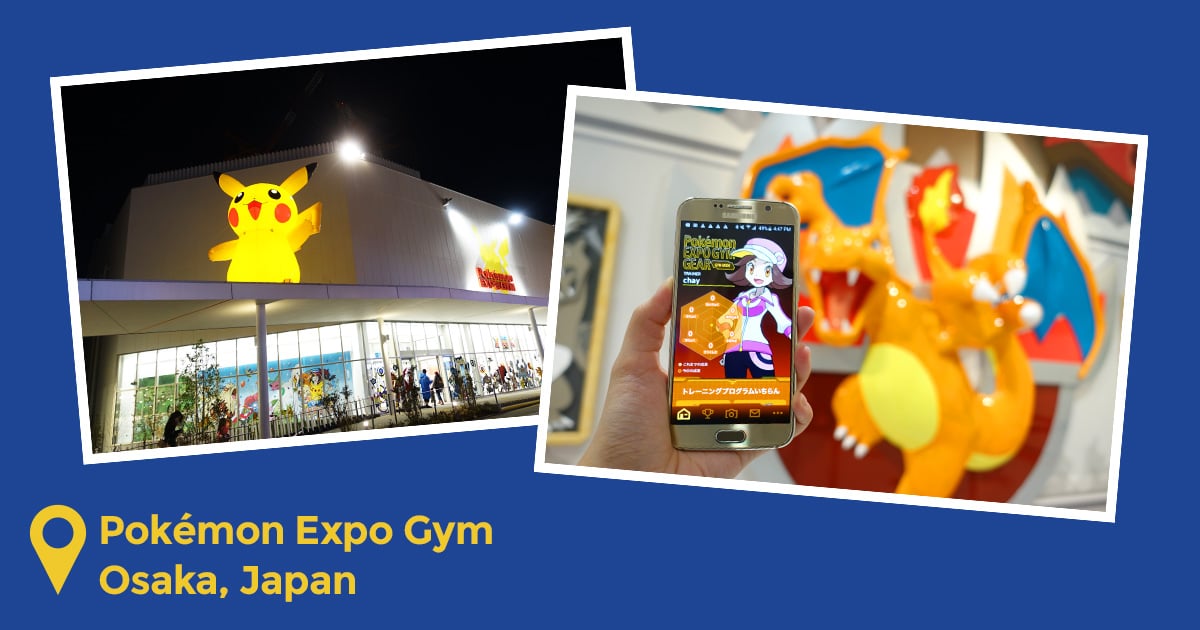
13. You heal worn out pokémon at Poké Centers, buy items at Poké Marts, and battle opponents at Poké Gyms. There’s a real-life Poké Gym in Osaka, Japan. And in Pokémon Go, Poké Stops are where you can pick up items like Poké Balls.

14. Most pokémon have a gender, either male or female, and can be bred. Female pokémon lay eggs, which eventually hatch when you carry them around long enough. If you don’t have two pokémon of opposite genders, the genderless Ditto can step in and breed with most (not all, as some pokémon don’t breed).

15. Ash is the protagonist in the Pokémon anime. In Japan, fans know him as Satoshi, a clear reference to Pokémon creator Satoshi Tajiri. There’s a theory that everything currently happening in the Pokémon TV show (now over 800 episodes strong, and still airing) is only taking place in Ash’s dream. In the very first episode, which aired in 1997, Ash was electrocuted by Pikachu. Some believe this placed him into a coma, hence the super-long dream, and thus explaining why Ash hasn’t aged one bit even after 19 years.
16. In the third episode of the Pokémon TV anime, there was an earthworm. Non-pokémon creatures appear very rarely in the show. You can see it at the 9:38 mark.

In the episode, Pidgeotto is seen eating an earthworm.

17. The pokémon regions in the game are actually based on real locations. Kanto, Johto, Hoenn, and Sinnoh are all places in Japan. There’s also Unova in the US, Kalos in France, and the new region, Alola in Hawaii.

18. Here’s how some of your favorite pokémon got their names: Ekans and Arbok are Snake and Kobra spelled backwards; Koffing and Weezing’s were originally going to be called NY and LA because of the heavy pollution in those US cities; Hitmonchan and Hitmonlee are named after Jackie Chan and Bruce Lee; Abra, Kadabra, and Alakazam’s US names are based on the magic chant “abracadabra”; Alakazam’s Japanese translation is Foodin, likely a homage to the great magician, Harry Houdini.

19. Filipino singer and actor Billy Crawford sang the theme song for the first Pokémon movie released in 1998. The movie’s soundtrack includes songs from Britney Spears, Christina Aguilera, N*SYNC, M2M, and 98º Degrees, but Billy really was the very best back then, like no one ever was.

20. Meowth is the only pokémon that can talk (we’re not including legendary pokémon that communicate with humans using telepathy). He taught himself how to talk to impress a female Meowth. Smooth.
This feature was a collaboration between Michael Josh Villanueva, Jv Ruanto, Chay Lazaro. Michael Josh still plays Pokémon on his Nintendo DS, Chay grew up on the TV show and playing cards, and Jv… well let’s just say we would have believed it if he said he wrote the entire Bulbapedia.
Image sources: 5a, 5b, 6, 8, 9, 10, 11a, 11b, 11c, 12, 13, 14, 15, 18a, 18b, 19, 20
[irp posts=”7858″ name=”Pokémon Sun and Moon out now”]





Apps
Turn conversations into completed work: Zoom launches ZoomMate
Agentic AI work surface to help people move from conversation to execution
Zoom has officially announced ZoomMate, an agentic AI work surface to help people move from workplace conversations to execution without losing context along the way.
It will be offered in ZoomMate Basic (free) and ZoomMate which is priced starting at US$ 16.67 per month.
Unlike AI tools that solely rely on prompts or manual context, ZoomMate understands what was discussed to generate grounded, relevant outputs directly from meeting context.
The feature connects live conversational context to agentic search, workflow execution, custom agents, and AI content creation. It helps users overcome the friction introduced by fragmented tools and incomplete workflow by surfacing information across Zoom and connected business systems.
This creates deliverables from meeting and enterprise context, like presentations, documents, and spreadsheets. It also coordinates follow-though across workflows without switching tools.
ZoomMate capabilities
ZoomMate introduces advanced agentic AI capabilities that help teams move from insight to completion.
Agentic Search
With agentic search, it brings enterprise knowledge to every conversation. ZoomMate can search across Zoom, the web, and third-party systems to find the most relevant information for a project, account, ticket, policy, or business question.
Connecting to data sources such as ServiceNow, Salesforce, and Workday, and indexing across users’ integrated enterprise systems allows for surfacing information from enterprise files.
This includes customer records, open issues, service tickets, knowledge articles, project updates, files, and other business content.
Moreover, relevant context from Zoom Meetings, Phone, Chat, and other connected platforms, including Google and Microsoft, can be directly integrated into the flow of work.
Orchestrate
The next step is ZoomMate’s agentic layer enables proactive coordination and execution across systems, combining AI workflows with intelligent agents that can act, learn, and adapt within enterprise environments.
Agents can monitor ongoing projects, identify steps from meeting context, and automatically initiate follow-up actions for continuity.
Aside from that, ZoomMate can coordinate real-time task execution and can schedule events across Google Calendar or Microsoft Outlook.
Moreover, it updates records, creates follow-up tasks, drafts customer communications, and triggers onboarding or support workflows.
Complete
Lastly, ZoomMate turns meetings into finished work. It automatically creates presentations, documents, spreadsheets, reports, and project plans from meeting conversations and enterprise context so teams can move from discussion to execution faster.
It leverages Zoom’s AI Productivity Suite to update deliverables as decisions evolve, keeping plans, documents, and other outputs current in real time without manual syncing.
Apps
GCash rolls out in-app OTPs via push notifications to fight scams
SMS-based codes will be phased out by June 22
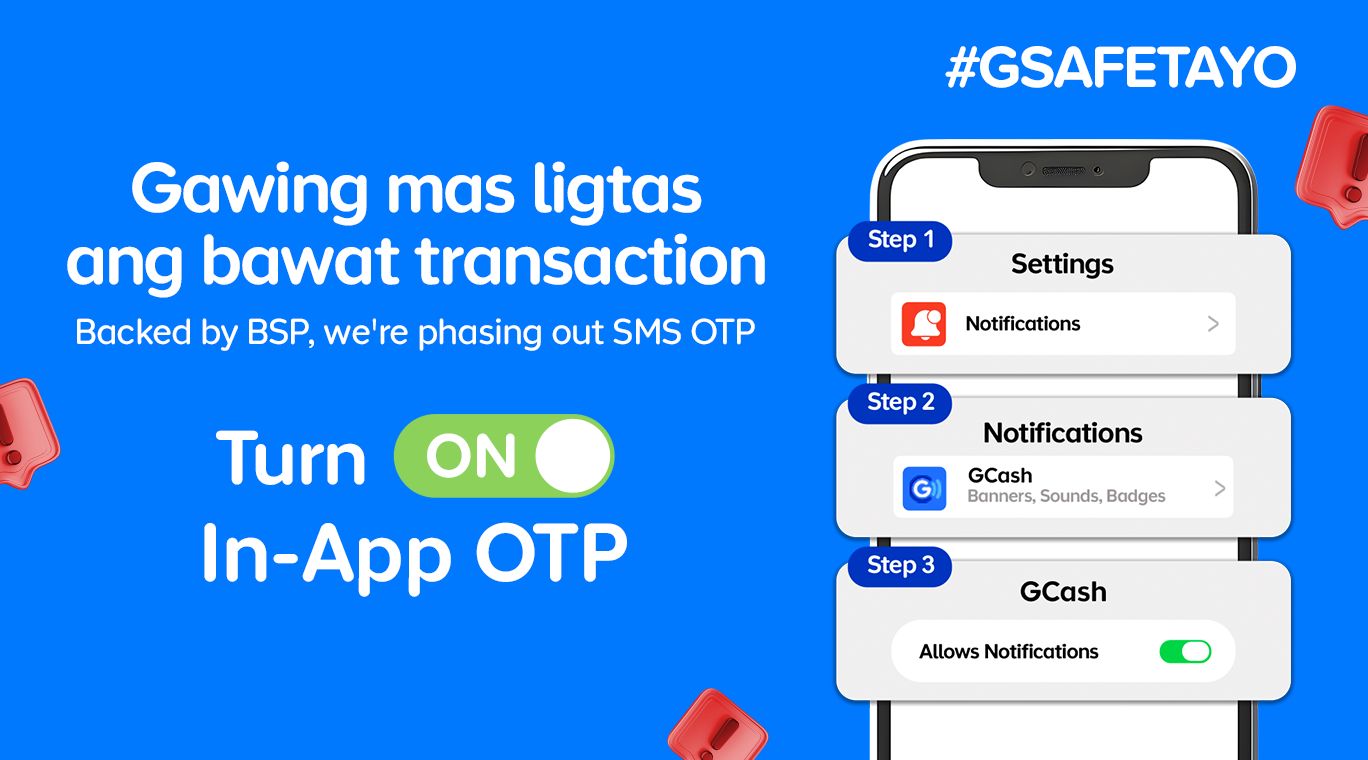
GCash is completely changing how users secure their accounts by rolling out in-app OTPs by June 22.
This fully replaces traditional SMS-based authentication as part of heightened cybersecurity measures against phishing scams and financial fraud.
With this security upgrade, users will no longer receive their OTPs via text messages. Instead, the codes will be sent through secure push notifications directly inside the GCash app.
This provides a much safer verification experiences. The migration to internal authentication is a direct response to a directive from the Bangko Sentral ng Pilipinas (BSP) to phase out SMS-based OTPs by June 2026.
Furthermore, the shift aligns with the country’s Anti-Financial Account Scamming Act (AFASA), which mandates stricter safeguards to curb digital fraud.
For years, cybercriminals have targeted SMS-based verification codes through various spoofing and phishing tactics to gain unauthorized access to accounts.
By routing OTP requests directly through the user’s authenticated GCash app, the platform ensures that only the rightful account owner can receive and use the unique codes.
Beyond security, the switch brings some much-needed convenience. The instant, one-tap authentication removes the annoying hurdle of switching between apps, copying codes, or waiting for delayed text messages to arrive in areas with poor cellular signal.
To get in-app OTPs on the GCash app, simply turn on Push Notifications on your iOS or Android device.
Apps
The No-Nonsense guide to mid-year shopping
Let AI do the heavy lifting for you this Lazada 6.6 Super WOW Sale


The mid-year sale season is here, but the days of mindless impulse buying are over.
Shoppers are shifting toward intentional, value-driven decisions, focusing on quality, authenticity, and actual utility over flashy, low-quality gimmicks.
From 8:00 PM on June 5 until 11:59 PM on June 8, 2026, the Lazada 6.6 Super WOW Sale is dropping major discounts. But the real win is using the platform’s tools to maximize your budget.
Lock in the baseline discounts

Before diving into specific items, map out how to stack the core offers.
You can stretch your money by hunting down LazFlash Deals for up to 90% off, collecting up to PhP 3,000 in stackable vouchers, and ensuring every order qualifies for the free shipping offers available throughout the event.
True value comes from combining these three layers of savings on things you already need.

Jisulife: One of the participating, trusted brands you can get from LazMall
Filter for authentic value
Shopping smart means avoiding the trap of “too good to be true” counterfeits that end up in the trash.
Data shows a massive consumer shift toward trusted quality, with LazMall growth vastly outperforming standard listings during major sales.
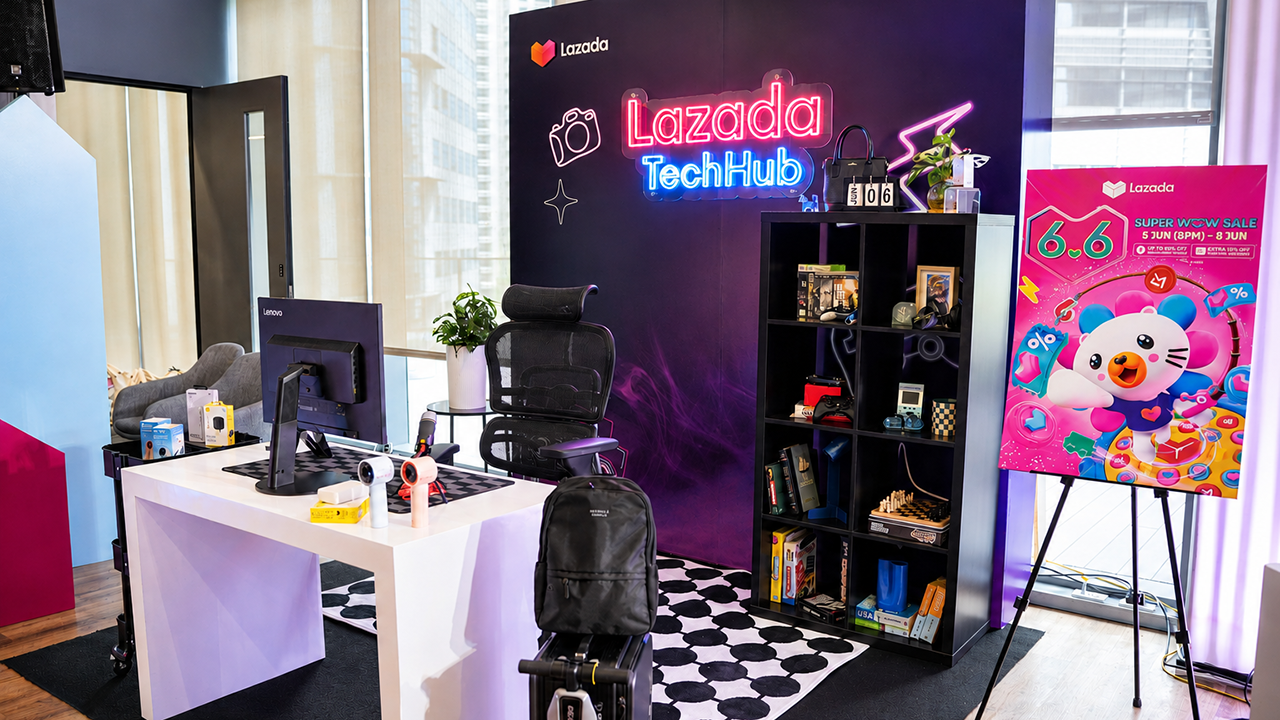
To ensure your money goes toward genuine products with real warranties, restrict your browsing to official, brand-certified stores.
If you are upgrading your tech, parenting gear, or wardrobe, look to trusted names anchoring the sale like UGREEN, JisuLife, ANTA, Maserati Watches, Momcozy, and O.TWO.O.
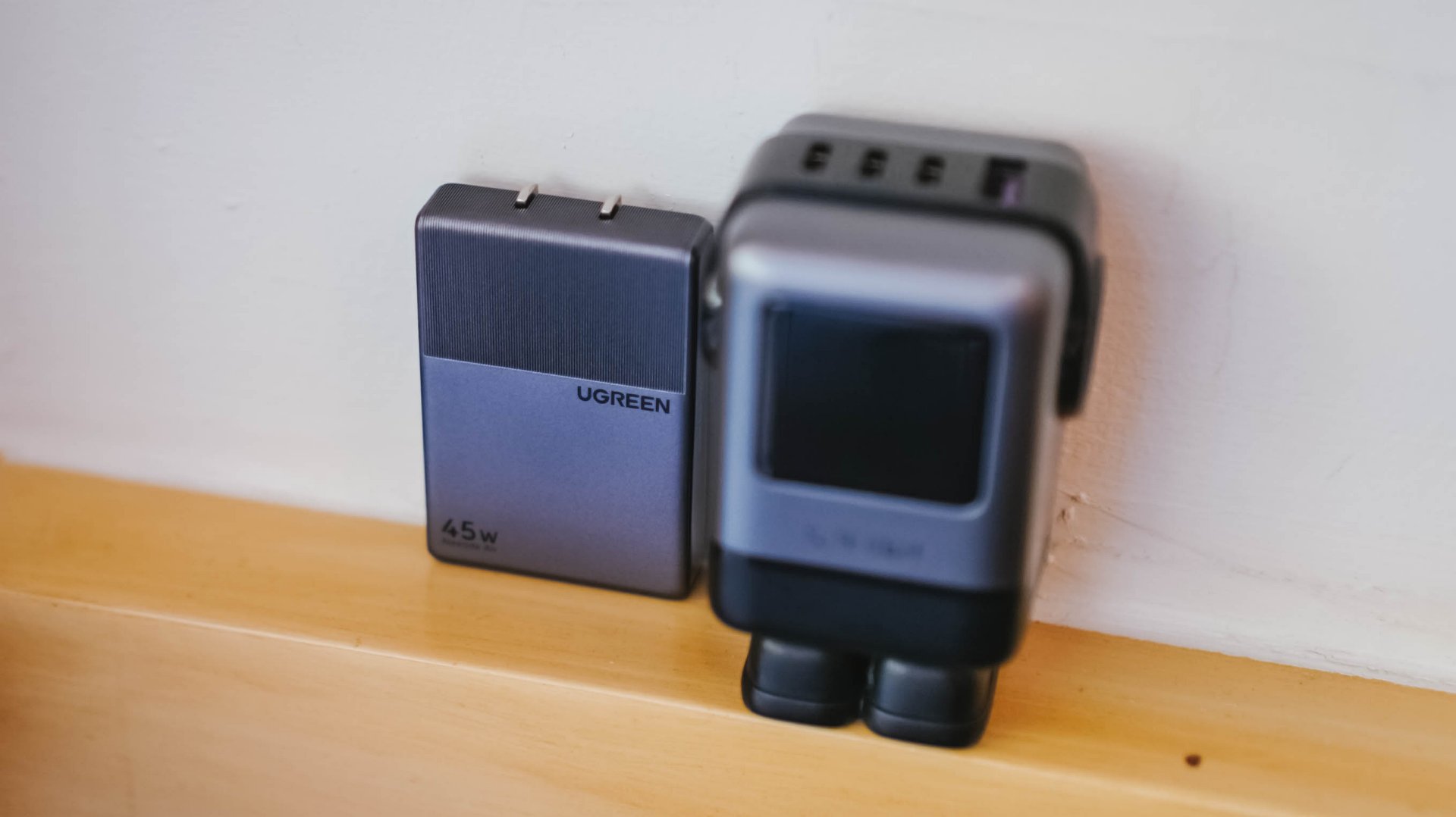
UGREEN: One of the participating, trusted brands you can get from LazMall
Outsmart the noise with built-in tech
Don’t waste hours scrolling through endless listings or guessing which product is better.
The smartest way to navigate a massive mid-year event is to let the platform’s built-in features cut through choice paralysis.

Tools like AI Lazzie and AI Picks allow you to instantly compare similar items, analyze prices, and get personalized recommendations based on actual data rather than generic marketing hype.
Smart Shopper Tip: True value is a mix of the right price, verified authenticity, and a seamless return policy. Use this sale period to stock up on everyday essentials and high-quality upgrades rather than panic-buying items you’ll regret later.


HONOR Magic V6 review: The best version of a book-style foldable?
Little left to sacrifice


Close without crossing: A Xiaomi 17T Pro photo essay
Distance and closeness are not always opposites.


Spring reset: Growing more at home with Auk Mini
From kitchen counter experiment to everyday habit

Lenovo introduces the immersive Referee View for the World Cup

Kodak Charmera gets seven Y2K-inspired designs

Gundam Rogue Orbit coming to consoles, PC in 2027

Turn conversations into completed work: Zoom launches ZoomMate

K-pop Idol Stories: Road to Debut lets you become a K-pop group’s manager

The Infinix GT 50 Pro has the most inspired design for a gaming phone

TECNO’s POVA 8 5G is both futuristic and future-ready
Spring reset: Growing more at home with Auk Mini

UGREEN MagFlow Air review: Airy Yet Mighty
Close without crossing: A Xiaomi 17T Pro photo essay


-
 India7 days ago
TECNO’s POVA 8 5G is both futuristic and future-ready
-

 News2 weeks ago
realme launches P4 Series 5G, including Power with 10,001mAh battery
-

 Buyer's Guide1 week ago
Buyer’s Guide: Xiaomi Pad 8 Series
-
Reviews1 week ago
HONOR Magic V6 review: The best version of a book-style foldable?
-

 Gaming7 days ago
Kingdom Hearts IV gets new trailer, confirms Switch 2 release
-

 Gaming2 weeks ago
Final Fantasy VII Revelation arrives in Spring 2027
-

 Gaming7 days ago
Final Fantasy fans have two big reasons to look forward to 2026
-

 Smartphones7 days ago
Upcoming realme C100 series to feature 8,000mAh battery