
News
Samsung’s next phones could have an under-screen camera
No bezels, too!


As 2018 rolls to a close, the hunt for a truly bezel-less phone continues. Across the industry, companies have invented waterdrop notches, pop-up sensors, and holed screens. However, for all their glitter and glamour, all these inventions have barely grazed the concept of a truly bezel-less screen.
Now, Samsung is inching closer and closer to the next step of screen technology. Based on a presentation from China, the company has detailed its plans for next year’s smartphones. Particularly, they are launching an all-out war against notches and buttons.
From renowned Samsung source Ice Universe, Samsung will integrate everything into the screen. Previously, the company hinted this integration through rumors of an under-screen fingerprint sensor. However, this goes beyond that.
Great news! Samsung established the direction of mobile phone design in 2019!
On October 18th, Samsung Display invited about 20 customers to hold the “2018 Samsung OLED Forum” at the Shenzhen Marriott Hotel in China. At the meeting, Samsung showed a PPT pic.twitter.com/sYu0ORTd6V— Ice universe (@UniverseIce) October 19, 2018
Aside from a fingerprint sensor, Samsung’s new screen will (shockingly) integrate sensors inside the panel. In other words, Samsung’s next front-facing camera will settle in under the screen! Beaming with confidence, Samsung has made the boldest claim: Next year’s phones won’t have a visible selfie camera at all.
Additionally, Samsung makes another bold move: Sound on Display. As is standard for every phone today, the front-facing sensors usually pair with the phone’s speakers. According to Samsung, that pairing will become a thing of the past. Strangely, Samsung’s new phones will emit sound straight from the screen.
Unfortunately, Samsung has not detailed how exactly this works. However, the company’s presentation confirms the claims, at least. We can expect these developments in the near future.
Currently, Samsung’s lineup consists of the Galaxy S10 series early next year. So far, swirling rumors haven’t pointed towards this interesting new form factor. If anything, Samsung will also out the Galaxy Note 9’s successor and a foldable smartphone. The planned developments can come with any of these. Regardless of the uncertainty, Samsung’s blueprints are the closest we’ve gotten to a truly bezel-less phones.
SEE ALSO: Samsung Galaxy A9 (2018) has insane quadruple rear cameras






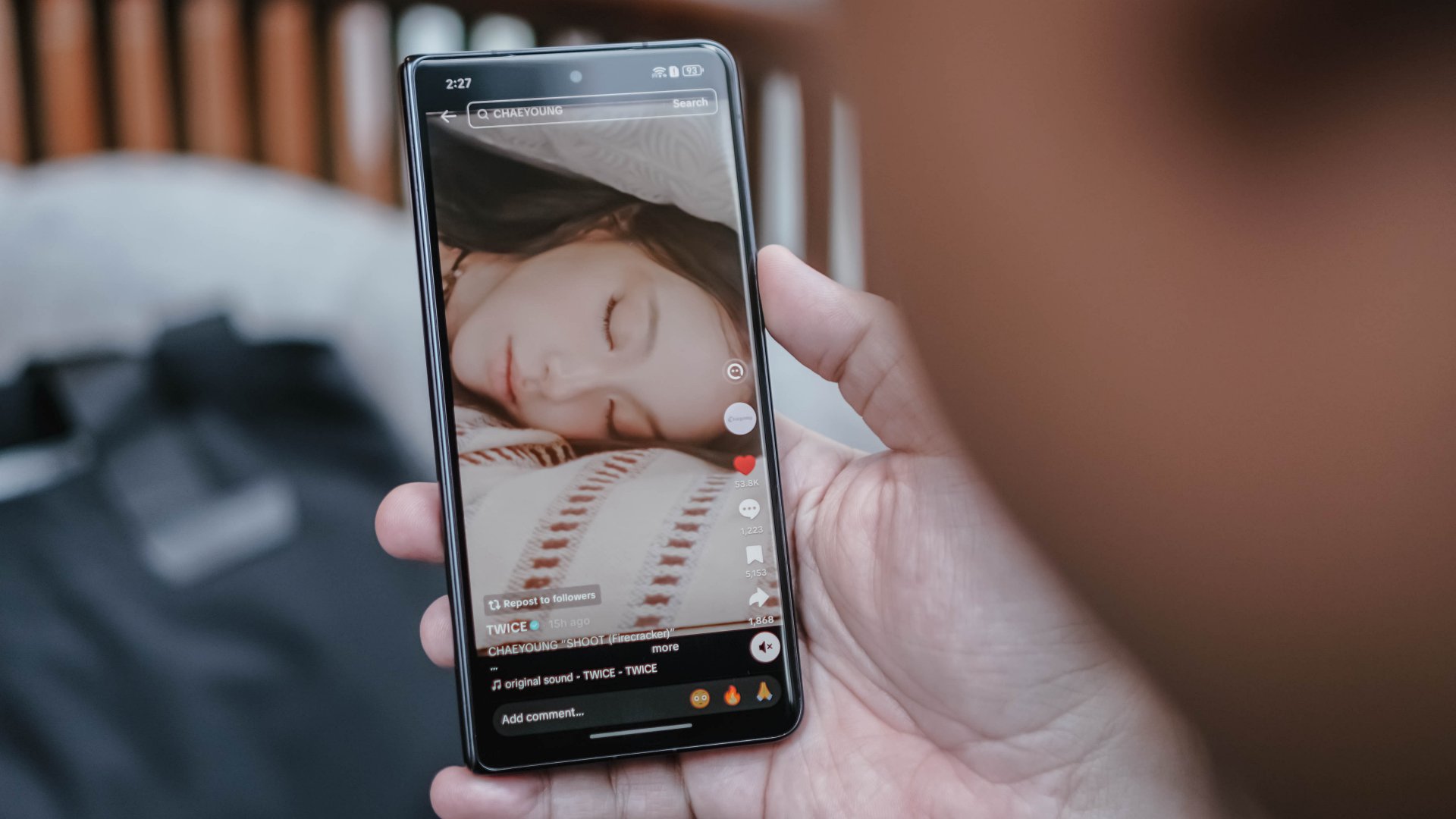
Doomscrolling is the greatest enemy to everyone’s productivity today. The temptation to keep on scrolling for hours is an ever-present temptation. Taking a very strong stance against the phenomenon, the European Commission is now investigating TikTok for having an addictive interface.
Via Politico, Brussels is now prodding TikTok to change its interface. Very technically, the European Commission is not out to get doomscrolling, specifically. However, the major changes that they want to introduce “disabling infinite scrolling, setting strict screen time breaks, and changing its recommender systems.”
App addiction is a persistent problem today. Besides concerned parents, governments around the world have been trying to regulate addiction, especially when it comes to children. The European Commission, as is apparent from this new initiative, is at the forefront of preventing addiction.
Though the target is explicitly TikTok right now, changing addictive interfaces will also affect other social media platforms including Facebook, Instagram, and X. Most platforms nowadays thrive on encouraging users to keep scrolling through more content.
Right now, TikTok isn’t set to change just yet. However, the report states that the European Commission is willing to work with platforms for a better, non-addictive interface. It’s less abrasive than the region’s recent privacy initiatives, which requires users to verify their age before accessing mature content.
Laptops
Are you ready for a more colorful MacBook?
Apple is experimenting with quirkier colorway options for the MacBook.

In recent years, Apple has relented on limiting the colors of its devices to only the more premium-looking options. Users can now pick quirkier colors for their iPhones, highlighted currently by the Cosmic Orange iPhone 17 Pro Max. Soon, the same splashes of color might make its way to the MacBook lineup.
According to Bloomberg’s Mark Gurman, Apple has been testing different colorway options for its upcoming entry-level MacBook. The unannounced lineup might come in pink, light yellow, light green, and blue.
It’s a big change for MacBooks. Currently, the only “quirky” option that users can get is the MacBook Air’s Sky Blue, which honestly looks more silvery than blue. Other than that, the MacBook simply seesaws from different shades of gold, silver, and black.
To be fair, the upcoming MacBook will still have the traditional colorways of the current lineup. Additionally, it’s unclear whether Apple will ultimately include all its experimental colors into the final lineup.
Reportedly, the new lineup will cost somewhere between US$ 699 to US$ 799. Of course, the lower price tag will come at the expense of some specs. Although, it should still be good if we’re talking about an entry-level laptop.
It’s even more interesting if it’s hinting at the return of truly colorful options but for the notebook. The iMac already got a similar renaissance back in 2024, which mimics the classic computer’s colorful history.
SEE ALSO: M5 MacBook Pro review

Brands getting banned are commonplace in today’s tech landscape. These usually happen because of geopolitical reasons, especially if it’s in the United States. In Europe, brands sometimes get banned for anticompetition reasons. Today, however, a commonly used codec, HEVC, is at the center of a controversy that has led to the banning of ASUS and Acer in Germany. Even crazier, Nokia is involved.
For context, Nokia owns several patents for video codecs. One of those codecs, HEVC (or High-Efficiency Video Coding) is ubiquitous in every PC, which means that every PC maker must purchase a license to include the codec in their machines. It’s an essential these days, so it’s unusual for ASUS and Acer to miss it.
In Germany, where licensing is stricter, both companies were found guilty of infringing the patent, as reported by German outlet Hardwareluxx. As a result, ASUS and Acer must stop selling PC and laptop sales until they obtain a license from Nokia.
To be clear, this doesn’t mean that the two brands have disappeared from the country. Third-party retailers can still sell their remaining stock. However, the companies cannot import or sell any new stock, pending a conclusion to the issue.
Naturally, the easiest fix is to just buy the license. Hisense, another company that found itself in the same mire, bought a license last month. Either ASUS and Acer are running into more technical issues, or they just didn’t feel the license was worth it for a single market.
SEE ALSO: ASUS is leaving the smartphone industry






Now Playing: ‘Wuthering Heights’

EU wages war against doomscrolling

Are you ready for a more colorful MacBook?

ASUS, Acer PCs are banned in Germany

Apple AirTag 2 Review

Infinix NOTE Edge debuts: High-end features for accessible pricing

HONOR X9d 5G review: Tougher, more long-lasting and optimized

BYD expands PH presence with entry of DENZA luxury EVs

Now playing: Final Fantasy VII Remake INTERGRADE on Switch 2

Breaking up with Adobe Photoshop after 20 years


-

 Gaming2 weeks ago
PlayStation, LE SSERAFIM Chaewon team for the ‘Love of Play’ campaign
-

 News6 days ago
TECNO will showcase the CAMON 50 and POVA 8 series at MWC 2026
-

 Accessories2 weeks ago
Sony WF-1000XM6 was accidentally leaked online
-

 Reviews2 weeks ago
nubia V80 Max: Long battery, marginal upgrades, casual budget phone
-

 Gaming2 weeks ago
Zenless Zone Zero Version 2.6 launches February 6 with idol group debut
-

 Laptops1 week ago
TECNO MEGABOOK K16s 13th review: No-frills beneath those grills
-

 Gaming2 weeks ago
My Hero Academia: All’s Justice: A familiar Final War, made playable
-

 Gaming2 weeks ago
New Civilization VII update will address everyone’s biggest issue